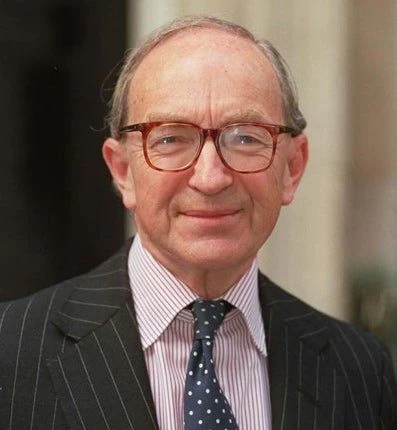
Sir Percy Cradock’s central achievement in British diplomacy was also the source of his most enduring controversy. As Britain’s chief negotiator with China over Hong Kong, he helped lay the foundations for the 1984 Sino-British Joint Declaration. He believed compromise was necessary to keep Britain involved in decisions about the territory’s future; critics saw the agreement as a failure to protect Hong Kong’s people and democratic aspirations. His career is best understood through that tension between influence and concession.
From County Durham to the Foreign Office
Cradock was born in Byers Green, County Durham, on 26 October 1923, into a farming family. He attended Alderman Wraith Grammar School in Spennymoor. During the Second World War he served in the Royal Air Force, then went to St John’s College, Cambridge, where he studied law and English. At Cambridge, reading translations of Chinese and Japanese literature by Arthur Waley helped kindle an interest in East Asia. He also served as president of the Cambridge Union Society in 1950 and wrote a history of the society, covering 1815 to 1939, published in 1953.
After postgraduate study and admission to the bar at the Middle Temple, Cradock left his academic career and joined the Foreign Office in 1954. His early assignments included London and Kuala Lumpur, where he served as a first secretary. In 1961 he went to Hong Kong to learn Mandarin; the following year he became Chinese secretary at the British chargé d’affaires office in Peking, now known as Beijing. He returned to London in 1963 and was posted back to Peking in 1966 as political counsellor and officer in charge.
That posting placed him in the city as the Cultural Revolution began. On 22 August 1967, amid the turmoil, a crowd attacked and set fire to the British office. Cradock and colleagues evacuated; accounts of the incident describe staff being manhandled before they were rescued by the People’s Liberation Army and placed under house arrest. The episode brought personal danger as well as diplomatic strain. In 1968, after serving as chargé d’affaires, Cradock received appointment as a Companion of the Order of St Michael and St George.
Back in London, he led the Foreign Office Planning Staff and later headed the Cabinet Office Assessments Staff. He became Britain’s ambassador to East Germany in 1976, before returning to Peking in 1978 as ambassador to the People’s Republic of China. This combination of Chinese-language experience, diplomatic service and work in government assessments shaped the role he would take in the dispute over Hong Kong.
Negotiating Hong Kong’s future
The immediate issue was the 1997 expiry of the 99-year lease covering the New Territories, which Britain had obtained under the 1898 Convention. Hong Kong Island and Kowloon had different treaty histories, but the territory’s connected economy and dependence on the mainland made the future of the whole colony difficult to separate. In 1979, Governor Murray MacLehose travelled to Peking to explore China’s position. Deng Xiaoping insisted that China would take over all of Hong Kong by 1997. The visit helped open the way to formal negotiations.
In September 1982, Cradock accompanied Prime Minister Margaret Thatcher and Governor Sir Edward Youde to Peking. Thatcher argued that the existing treaties remained valid; Deng rejected that position and insisted on China’s claim to the territory. The first round of negotiations began the following month, with Cradock as Britain’s chief negotiator. The two sides were far apart. He warned that prolonged talks risked leaving China free to determine Hong Kong’s future unilaterally, and advised Thatcher that Britain should compromise rather than lose its remaining influence.
The negotiations resumed in July 1983. Britain proposed transferring sovereignty in 1997 while retaining the right to govern after that date, but China rejected the proposal. Cradock came to accept that Britain would have to relinquish both sovereignty and government of Hong Kong after 1997. The negotiations established the principles that would underpin the settlement, including “one country, two systems” and arrangements for a Sino-British Joint Liaison Group. Cradock was succeeded as chief negotiator by Sir Richard Evans in January 1984, but had helped shape the basis of the agreement.
The Joint Declaration was initialled on 26 September 1984 and signed by Thatcher and Chinese premier Zhao Ziyang on 19 December. It provided for the transfer of sovereignty in 1997 and set out the framework under which Hong Kong would retain its existing system for 50 years after the handover. Cradock’s part was significant, but it did not make the outcome universally welcome. A poll reported in the Wikipedia account found that only 16 per cent of respondents felt reassured by the agreement, while 76 per cent were reserved about it. The figures convey the insecurity many Hong Kong residents felt despite the diplomatic settlement.
After the declaration: influence and dispute
After the agreement was signed, Cradock remained close to Thatcher as a senior foreign-affairs adviser and became chairman of the Joint Intelligence Committee in 1985. He continued to be involved in questions concerning Hong Kong. After the Chinese government’s crackdown on protests in Beijing in 1989, he travelled to China in an effort to preserve the Joint Declaration and secure commitments concerning Hong Kong’s future. His approach was to sustain engagement with Beijing, arguing that Britain needed to work within the realities of its limited leverage.
The question of political reform brought that approach into sharper conflict with Governor Chris Patten. Patten proposed a faster expansion of democratic elections in the final years of British administration. Cradock opposed the reforms, arguing that they risked damaging the agreed transition and Britain’s ability to influence China. Patten and Cradock criticised one another publicly. Cradock called Patten the “incredible shrinking Governor”; Patten answered with the jibe “dyspeptic retired ambassador” and used “Craddockitis” to mock what he considered Cradock’s certainty about Hong Kong’s future.
The disagreement was not merely personal. Supporters of Patten’s reforms argued that Britain had a responsibility to respond to Hong Kong public opinion and to advance democratic representation. Cradock maintained that confrontation could leave Britain with less influence and jeopardise the transition arrangements. The Joint Declaration was praised by the Chinese government and by pro-Beijing voices, while critics in Hong Kong and Britain viewed the concessions as a betrayal. Cradock defended his position as realism: Britain, he argued, had little practical power to prevent the transfer and needed to secure what it could through negotiation.
His relationship with Thatcher’s successor, John Major, also deteriorated. A dispute over the proposed Airport Core Programme led to Major’s 1991 visit to China and an agreement on the project’s financing. Major subsequently concluded that Cradock and Governor Sir David Wilson had been too accommodating. Wilson left office in 1992, and Cradock later stepped down as chairman of the Joint Intelligence Committee and as the Prime Minister’s foreign-affairs adviser. When Patten’s reforms led China to abandon the planned “through-train” arrangement for the post-1997 legislature, the dispute over the transition acquired a concrete institutional consequence as well as a symbolic one.
Books, honours and later life
Cradock’s work extended beyond government. He wrote about diplomacy and China, including Experiences of China (1994), In Pursuit of British Interests (1997) and Know Your Enemy (2002). He was a non-executive director of the South China Morning Post from 1996 to 2000. His honours included appointment as a Knight Commander and then a Knight Grand Cross of the Order of St Michael and St George; he was also appointed to the Privy Council in 1993. St John’s College, Cambridge, made him an honorary fellow in 1982.
He died in London on 22 January 2010, aged 86. Reactions to his death reflected the division that had marked his work: former colleagues remembered his service, while Martin Lee, a founder of Hong Kong’s Democratic Party, said, “I don’t think he was Hong Kong’s friend”. That judgement sits alongside Cradock’s own defence of his strategy and the continuing debate over what Britain could, or should, have secured.
Why Sir Percy Cradock deserves a place in British Legacy
Cradock deserves a place in British Legacy not as an uncomplicated diplomatic hero, but as a consequential public servant whose choices illuminate the limits and obligations of British power. As Britain’s chief negotiator, he helped shape the framework for the 1997 transfer of Hong Kong and the commitments set out in the Joint Declaration. His knowledge of Mandarin and Chinese affairs, built over years of service in Peking and elsewhere in Asia, informed negotiations in which Britain’s position was challenged and the future of millions of people was at stake.
The importance of his legacy also lies in the argument that followed. Cradock believed that compromise could preserve a measure of British influence and prevent China from acting without agreement. Critics believed that this pragmatism gave too little weight to Hong Kong’s residents, particularly when questions of democratic representation came to the fore. Keeping both views in focus makes his story more useful than a simple celebration of diplomatic skill. It shows how decisions made by British officials in international negotiations can shape political institutions and public confidence far beyond Britain, and why the judgement of those decisions may remain contested long after the officials themselves have left office.
Sources
Percy Cradock — revision 1374613742 · Percy Cradock
Adapted in part from Percy Cradock by Wikipedia contributors, under CC BY-SA 4.0. Text has been edited and combined with the existing article; this adapted text is shared under the same licence. Contributor history.