Sir Christopher Meyer spent his career moving between diplomatic service, government communications and public debate. As Britain’s ambassador to the United States from 1997 to 2003, he served through the presidencies of Bill Clinton and George W. Bush and the premiership of Tony Blair. His work in Washington was the most visible part of a career that had taken him from Moscow and Madrid to Brussels, Downing Street and the Foreign Office. After retiring, he wrote about British diplomacy, made programmes for television and radio, and chaired the Press Complaints Commission.
Education and an early diplomatic career
Meyer was born Christopher John Rome Meyer in Beaconsfield on 22 February 1944. His father, Reginald Henry Rome Meyer, was a Royal Air Force flight lieutenant serving with Coastal Command. He was killed in action over the Greek island of Icaria 13 days before his son was born. In 2011, Meyer visited the island and met people who had witnessed the shooting-down and burial. He later wrote about his childhood and his father in Only Child, a personal memoir published as a Kindle single in 2013.
Meyer attended Lancing College, the Lycée Henri-IV in Paris and Peterhouse, Cambridge, where he read history. He later studied at the Johns Hopkins School of Advanced International Studies in Bologna. After graduating, he joined the Foreign and Commonwealth Office in 1966, initially working on French-speaking African countries. Following a year of Russian-language training, he went to Moscow in 1968 as a third secretary, serving for his first year as the ambassador’s private secretary.
His early postings took him to Madrid, where he was second secretary from 1970 to 1973, and then back to London. There he headed the Soviet section in the East European and Soviet Department and wrote speeches for three foreign secretaries: James Callaghan, Anthony Crosland and David Owen. From 1978 to 1982 he served at the UK’s permanent representation to the European Communities in Brussels, followed by two years as political counsellor at the British embassy in Moscow.
After returning to London, Meyer became press secretary to Foreign Secretary Sir Geoffrey Howe in 1984. He held the post until 1988, then spent a year as a visiting fellow at Harvard University’s Centre for International Affairs. Five years at the British embassy in Washington followed, where he was minister-commercial and deputy head of mission. In 1994 he returned to London as John Major’s press secretary and government spokesman.
Ambassador in Washington
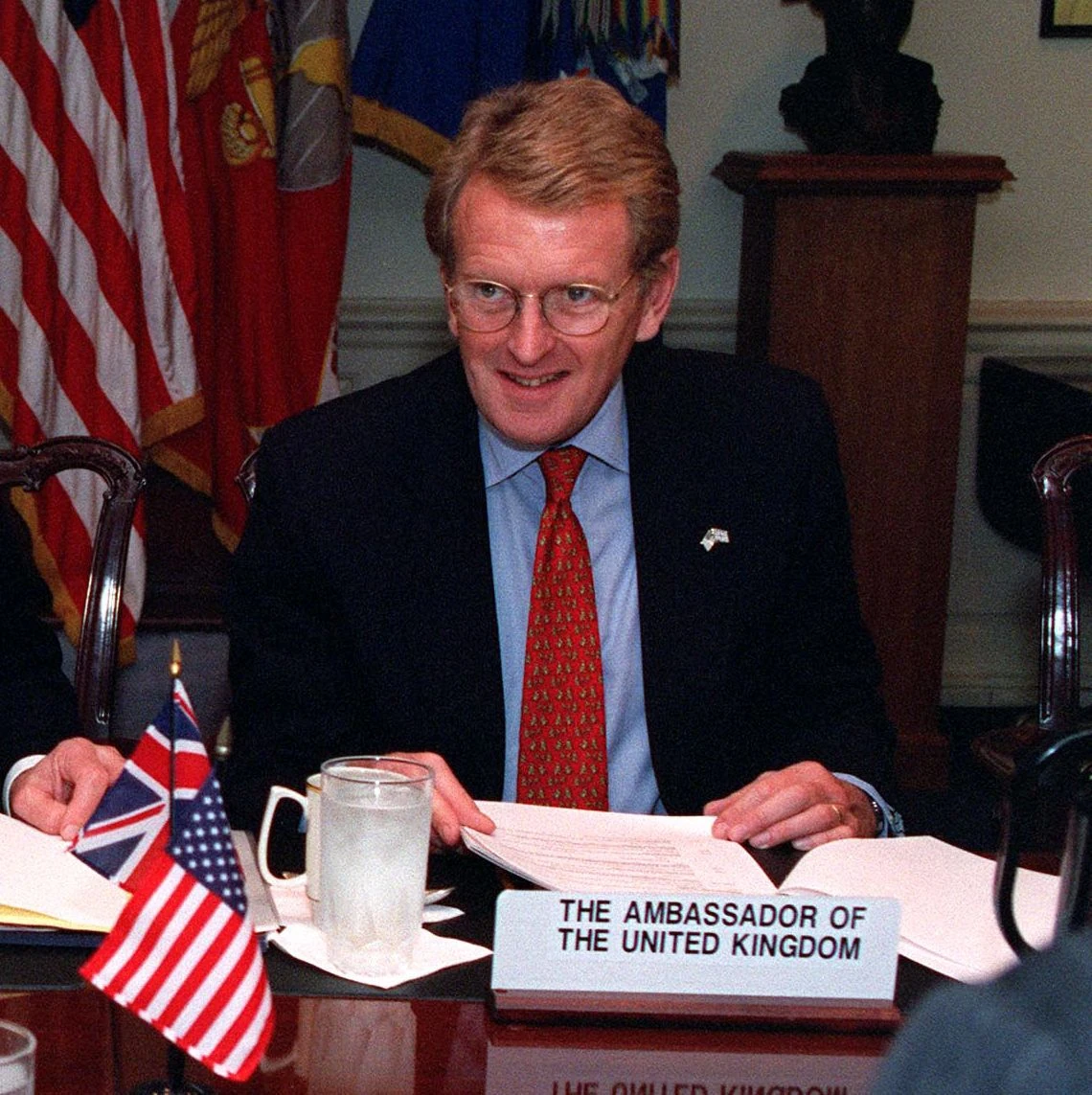
Meyer was briefly appointed ambassador to Germany in 1997 before being transferred in the same year to Washington as Britain’s ambassador to the United States. He remained in the post until retiring from diplomatic service in 2003. His tenure spanned a change of US president, from Bill Clinton to George W. Bush, and the election of Tony Blair’s government in Britain.
The account of Meyer’s ambassadorship also associates him with the UK response to the Kosovo War in 1999 and the aftermath of the 11 September 2001 attacks. The available biographical record establishes the dates and setting of his posting but does not detail the specific actions attributed to him in those accounts. His role can be situated in the work of an ambassador: representing Britain in Washington during major international events and maintaining a channel between the two governments.
Meyer’s final posting ended shortly before the invasion of Iraq in March 2003, when he underwent emergency heart surgery. In November 2009 he gave evidence to the Iraq Inquiry about his time as ambassador. His career therefore placed him close to British-American relations at a moment that remained the subject of public and official scrutiny after his retirement.
Press regulation and public argument
In March 2003, Meyer became chairman of the Press Complaints Commission, the UK press’s self-regulatory body. He held the position until 2009. During those years he introduced reforms intended to strengthen the commission’s profile, independence and credibility. These included increasing the proportion of independent commissioners, arranging independent scrutiny of its processes and decisions, and holding twice-yearly meetings outside London. The commission’s remit was also extended to online newspaper editions, including audiovisual material.
The commission’s work included a pre-publication service and an anti-harassment service intended to protect people from unwanted attention by groups of reporters. Complaints about the press rose from 2,630 in 2002 to 4,698 by the end of Meyer’s chairmanship. Those figures indicate increased use of the organisation, although they do not by themselves establish the effect of any single reform.
His chairmanship also coincided with the phone-hacking scandal. In 2007, News of the World reporter Clive Goodman and private investigator Glenn Mulcaire were jailed for phone-hacking offences. As the scandal widened, the PCC and Meyer faced criticism for not doing more to punish those responsible. Meyer told the Leveson Inquiry that phone hacking was a crime and that criminal investigation and enforcement were not within the PCC’s remit. In a 2011 lecture, the then Lord Chief Justice, Lord Judge, also argued that the commission should not be criticised for failing to exercise powers it did not possess. The episode illustrates the limits of a self-regulatory body as well as the controversy surrounding its response.
Books, broadcasting and later work
Meyer’s first memoir, DC Confidential, appeared in 2005. Its publication caused controversy, and members of the Labour government criticised it; Deputy Prime Minister John Prescott called Meyer a “red-socked fop”, while some MPs urged him to “publish and be damned”. Meyer rebutted his critics in evidence to the House of Commons Public Administration Select Committee. The book was also recognised by Washington Post foreign-affairs commentator Jim Hoagland, who included it among his books of the year and described it as thorough and credible.
In 2009 Meyer published Getting Our Way: 500 Years of Adventure and Intrigue: the Inside Story of British Diplomacy, accompanying a BBC television series of the same name. He made further programmes about diplomacy and international affairs, including the BBC documentaries Mortgaged to the Yanks, Corridors of Power, How to Succeed at Summits and Lying Abroad. His 2009 BBC Radio 4 series The Watchdog and the Feral Beast turned to the press. In 2012, he presented Networks of Power, a six-part Sky Atlantic series examining power-brokers in Mumbai, Rome, Moscow, New York, Los Angeles and London. He also appeared regularly on news and current-affairs programmes.
Alongside writing and broadcasting, Meyer held a number of other public and professional roles. He was an active board member of the charity Parents & Abducted Children Together, founded by his wife, Catherine Laylle. His appointments also included non-executive director of Arbuthnot Banking Group, chairman of the advisory board of Pagefield, honorary fellow of Peterhouse and Senior Associate Fellow of the Royal United Services Institute from 2013. He was appointed Knight Commander of the Order of St Michael and St George in 1998.
Why Sir Christopher Meyer deserves a place in British Legacy
Meyer’s place in British history rests on more than his years as ambassador in Washington. His diplomatic career shows the range of work behind international representation: country postings, policy departments, speech-writing, government communications and service at Britain’s representation to the European Communities. As ambassador, he served during the Clinton and Bush presidencies and the Blair premiership, and later gave evidence to the Iraq Inquiry. Taken together, those roles connect the daily practice of diplomacy with decisions and debates that shaped Britain’s international affairs.
His public work after leaving the Foreign Office adds another dimension. At the Press Complaints Commission, he pursued reforms to its independence, scrutiny and reach, while the phone-hacking controversy exposed the limits of the body’s authority and the difficulty of making self-regulation accountable. His books and broadcasts brought British diplomatic history and contemporary international relations to wider audiences, from the five-century perspective of Getting Our Way to programmes examining diplomacy, the press and global power. Meyer’s legacy is not simply a claim of diplomatic triumph. It includes a long record of public service, an effort to explain diplomacy to readers and viewers, and a revealing chapter in the debate over who should hold the press to account.
Sources
Christopher Meyer — revision 1372200757 · Christopher Meyer
Adapted in part from Christopher Meyer by Wikipedia contributors, under CC BY-SA 4.0. Text has been edited and combined with the existing article; this adapted text is shared under the same licence. Contributor history.