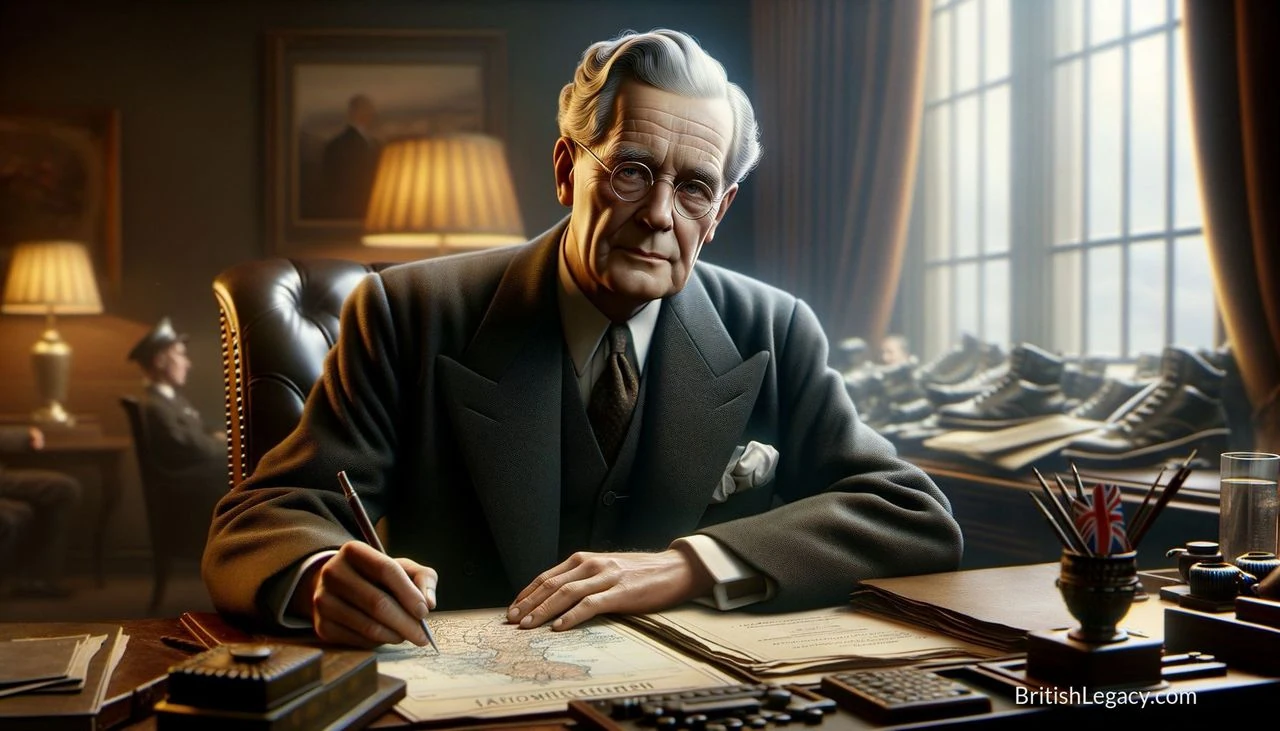
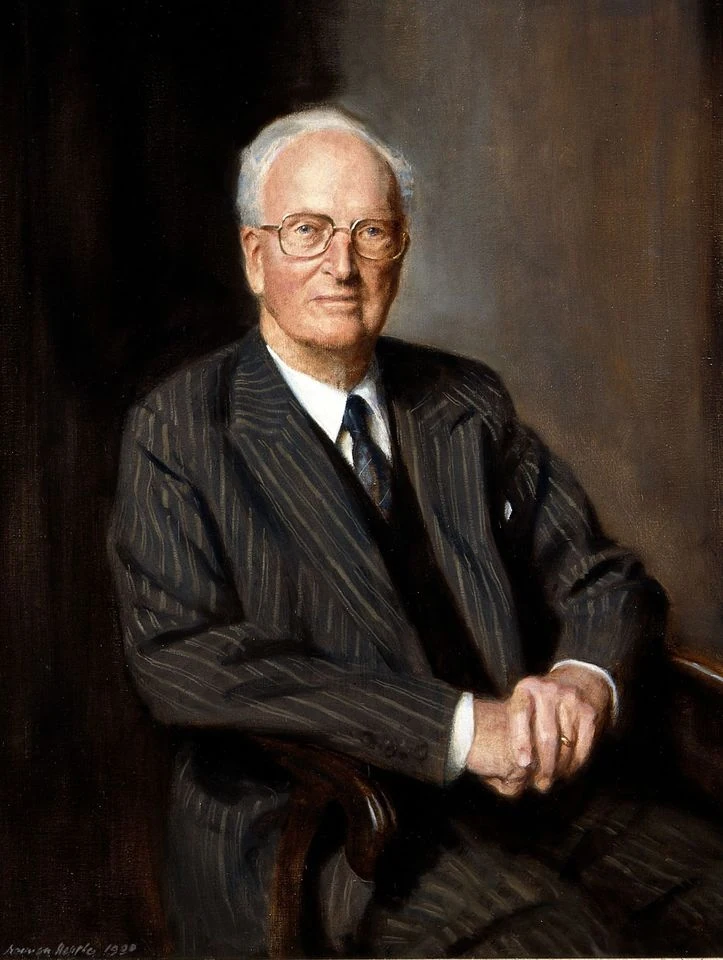
Oliver Franks’s career took him from moral philosophy to the centre of British wartime administration and post-war diplomacy. As a senior civil servant, he worked on replacing supplies lost at Dunkirk and in the Battle of the Atlantic. After the war, he led the British delegation to discussions on George Marshall’s proposals for European aid, became chairman of the Organisation for European Economic Co-operation and served as Britain’s ambassador to the United States. His later public service included chairing the inquiry into the events leading to the Falklands War.
From Oxford philosophy to wartime administration
Oliver Shewell Franks was born in Selly Oak, Birmingham, on 16 February 1905. He attended Bristol Grammar School and The Queen’s College, Oxford, where he studied Greats. His early career was academic: he became Professor of Moral Philosophy at the University of Glasgow, a post he held from 1936 to 1946.
The Second World War redirected his work towards government. Franks joined the Ministry of Supply and rose to become its permanent secretary by 1945. During the war, he helped replace supplies lost at Dunkirk and in the Battle of the Atlantic. That experience placed him close to the practical demands of keeping Britain supplied through military setbacks and a prolonged conflict. After the war, he continued as permanent secretary at the Ministry of Supply.
In 1931 he married Barbara Tanner at a Quaker meeting in Redland, Bristol. They had two daughters. The life he built alongside his public career remained connected to Oxford: after the war he served as provost of The Queen’s College from 1946 to 1948, before his work in government and diplomacy took him abroad.
Marshall aid and European cooperation
In 1947, Foreign Secretary Ernest Bevin asked Franks to head the British delegation to the European discussions on George Marshall’s proposals for American aid. The talks concerned how assistance could support the recovery of European economies after the war. Franks’s role was to lead Britain’s participation in those discussions; the evidence for his post-war work also records that he later became chairman of the Organisation for European Economic Co-operation (OEEC), which was established to organise European cooperation around economic recovery.
His involvement belonged to a wider shift in British policy: rebuilding after war required negotiation not only within the British government but with other European countries and the United States. Franks’s work connected the administrative experience he had gained in wartime supply with the diplomatic task of discussing economic assistance. He also helped found the North Atlantic Treaty Organisation, giving his post-war responsibilities a further institutional dimension.
Franks’s contribution is best understood through these specific roles rather than as sole architect of a continent-wide settlement. He headed the British delegation to discussions of Marshall’s proposals and went on to chair the OEEC. Those offices placed him among the officials working to turn proposals for recovery into international arrangements, while the actual task involved cooperation among governments.
Four years in Washington
Franks became British ambassador to the United States in 1948 and served until 1952. His appointment came as the relationship between Britain and the United States was an important part of post-war diplomacy. His work in Washington strengthened that relationship, and the ambassadorship made him a direct link between the two governments during a period of major political change.
The post followed his work on European aid rather than replacing it: in both settings he dealt with Britain’s relations with other countries and the practical terms of cooperation. Franks returned to England after his time in Washington. He became chairman of Lloyds Bank in 1954, serving in that role until 1962, and remained a director until 1975. From 1960 to 1962 he also chaired Friends Provident.
Oxford, public service and the Falklands inquiry
Oxford remained a major part of Franks’s later life. In 1962 he became provost of Worcester College, a position he held until 1976. He presented the BBC Reith Lectures in 1954, delivering six broadcasts under the title Britain and the Tide of World Affairs. They considered post-war politics and Britain’s changing relationships with the rest of the world. In 1960 he narrowly missed election as Chancellor of Oxford University, receiving 1,607 votes to Harold Macmillan’s 1,697.
His public responsibilities extended well beyond diplomacy and universities. Franks chaired a Commission of Inquiry at the University of Oxford in 1964–65 and was Chancellor of the University of East Anglia from 1965 to 1984. He also held leadership roles at the United Oxford Hospitals and the Wellcome Trust, among other institutions. Governments continued to call on him to chair inquiries.
In 1982, aged 77, Franks chaired the inquiry into events leading to the Falklands War. Its report examined the warning signals before Argentina’s invasion. The report ultimately exonerated Margaret Thatcher and her government from charges that they had failed to heed those warnings. The inquiry brought Franks’s long experience of public administration to a highly contentious question of government responsibility.
Honours and final years
Franks was appointed a Commander of the Order of the British Empire in 1942 and a Knight Commander of the Order of the Bath in 1946. He became a Privy Counsellor in 1949 and a Knight Grand Cross of the Order of St Michael and St George in 1952. In 1962 he received a life peerage as Baron Franks, of Headington in the County of Oxford. He was appointed to the Order of Merit in 1977 and became a Deputy Lieutenant for Oxfordshire in 1978.
He died in Oxford on 15 October 1992, aged 87. His career had moved across academic life, the civil service, diplomacy, finance and public institutions, with repeated returns to the work of examining difficult questions on behalf of government and society.
Why Oliver Franks deserves a place in British Legacy
Oliver Franks deserves a place in British Legacy for the identifiable part he played in Britain’s transition from wartime mobilisation to post-war cooperation. As permanent secretary at the Ministry of Supply, he worked through the demands of replacing losses at Dunkirk and in the Battle of the Atlantic. In 1947 he led Britain’s delegation to European discussions of Marshall’s aid proposals; he later chaired the OEEC and helped found NATO. These are concrete examples of public service across national and international institutions, rather than a claim that one diplomat rebuilt Europe by himself.
His British legacy also lies in the range of responsibilities he accepted at home. He served as a university provost and chancellor, led organisations in finance and public life, and returned to public service to chair the 1982 inquiry into the events preceding the Falklands War. The Reith Lectures show that he also addressed Britain’s changing place in world affairs through public broadcasting. Taken together, his record connects British academic life and administration with the negotiations, institutions and scrutiny that shaped the post-war period. It offers a useful account of how influence can be exercised through sustained work across government, diplomacy and civic institutions.
Sources
Adapted in part from Oliver Franks, Baron Franks by Wikipedia contributors, under CC BY-SA 4.0. Text has been edited and combined with the existing article; this adapted text is shared under the same licence. Contributor history.