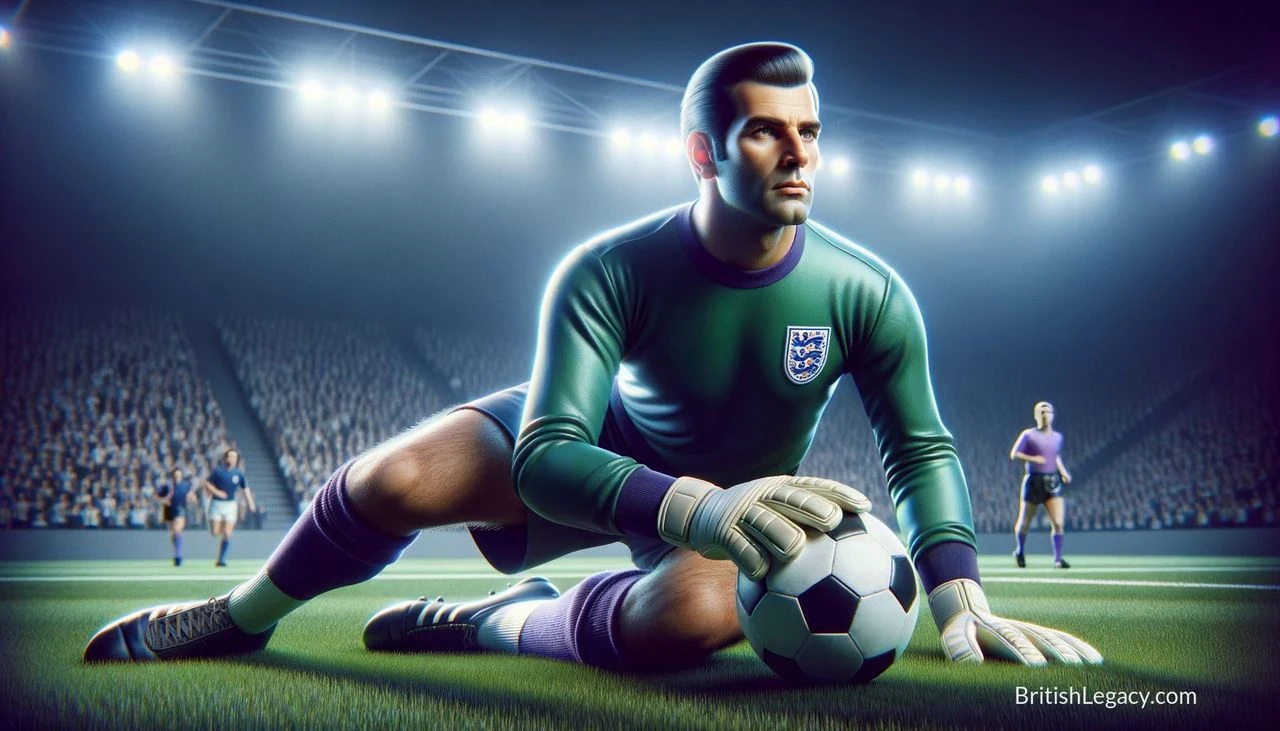
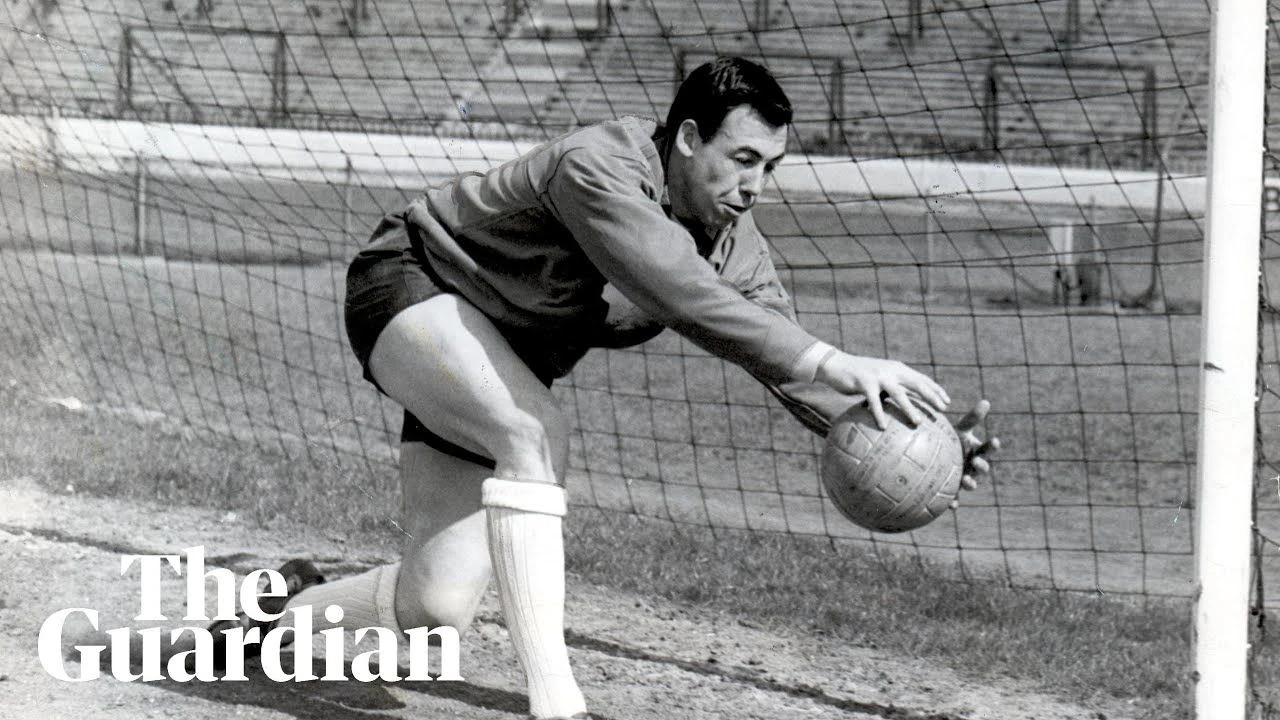
Gordon Banks’s most famous save lasted only a moment. At the 1970 World Cup in Mexico, Pelé’s header seemed certain to score; Banks reached it with his right hand and turned the ball over the crossbar. The image became inseparable from his name. But the save was one episode in a long career: Banks had already helped England win the 1966 World Cup, kept goal for Leicester City and Stoke City, and continued playing after losing the sight in his right eye in a car crash.
From Sheffield to Chesterfield
Banks was born in Abbeydale, Sheffield, on 30 December 1937, and grew up in Tinsley, a working-class part of the city. He left school at 15 and worked first for a coal merchant and then as a hod carrier. Football began to offer another direction. After playing for amateur sides Millspaugh and Rawmarsh Welfare, he joined Chesterfield’s youth team in 1953. He made his first-team debut in November 1958 and, after a season in which he became a regular, moved to Leicester City in July 1959.
At Leicester, Banks initially competed for a place and began the 1959–60 season in the reserves. An injury to the first-choice goalkeeper brought him into the senior side; after a later recall, he established himself as the club’s number one. He worked on weaknesses such as dealing with crosses, putting in extra training at a time when specialist goalkeeping coaches were not the norm. His development was not a simple rise from obscurity to instant success: he had to improve through practice, competition and experience.
Leicester reached the FA Cup final in 1961 and 1963, losing to Tottenham Hotspur and Manchester United respectively. Banks also helped the club win the League Cup in 1964, beating Stoke City over two legs in the final. Leicester returned to the League Cup final in 1965 but lost to Chelsea. Although he was an established England international and a World Cup winner, Leicester dropped him towards the end of the 1966–67 season and sold him to Stoke City in April 1967.
England’s 1966 World Cup
Banks made his England debut against Scotland in April 1963 and became the team’s first-choice goalkeeper. At the 1966 World Cup, hosted in England, he started every match. England kept clean sheets in the group stage, then beat Argentina 1–0 in the quarter-final and Portugal 2–1 in the semi-final. Eusébio’s penalty against Banks was the first goal England had conceded in 721 minutes of regular play. That run ended in the final, where West Germany scored twice; England won 4–2 after extra time to claim the country’s first World Cup.
The triumph was a team achievement, and Banks’s role was more than a single headline save. His place in goal was part of a settled defensive unit, and his performances helped England through a tournament in which he played every game. He also represented England at the 1968 European Championship, where the team finished third.
At Stoke, Banks found a new route to a major honour. After several seasons in which the club struggled, Stoke won the League Cup in 1972, beating Chelsea 2–1 in the final. Banks had helped them through a long cup campaign, including a semi-final replay against West Ham in which he saved Geoff Hurst’s penalty. That season brought individual recognition too: he was named Football Writers’ Association Footballer of the Year, the first goalkeeper to receive the award since 1956.
The save against Pelé
England met Brazil in the group stage of the 1970 World Cup. Jairzinho crossed from the right and Pelé sent a powerful header towards the corner. Banks later described the decision in front of him as a choice between trying to catch the ball and preventing Pelé from reaching a rebound. He used his right hand to turn it over the bar, then got back up to defend the resulting corner.
Pelé and commentators subsequently described the stop as one of the greatest saves in football. Banks himself recognised how strongly it overshadowed other parts of his career, once remarking that people would remember the save rather than his World Cup win. Its fame rests on the detail as much as the drama: the pace of the header, the position of the ball, and the judgement to parry it away from danger. Brazil won the match 1–0. Banks did not play in England’s quarter-final against West Germany, having fallen ill before kick-off; England lost 3–2 after extra time.
Injury, return and life beyond playing
In October 1972, a car crash severely injured Banks’s right eye. Despite treatment, the sight did not return, and the resulting loss of binocular vision ended his professional career in England the following summer. He did not immediately leave football altogether. In 1977 he joined the Fort Lauderdale Strikers in the North American Soccer League. Playing with sight in one eye, he was named the league’s Goalkeeper of the Year after the Strikers recorded its best defensive record. He also made a single appearance for St Patrick’s Athletic in Ireland.
Banks later moved into coaching and management. He coached at Port Vale and took charge of Telford United, leaving the game in 1980. His playing achievements continued to receive recognition: he was awarded an OBE in 1970 for services to football, named Football Writers’ Association Footballer of the Year in 1972, and inducted into the English Football Hall of Fame in 2002. Pelé included him among his selection of the world’s greatest living footballers in 2004. Banks died at his home in Madeley, Staffordshire, on 12 February 2019, aged 81.
Why Gordon Banks deserves a place in British Legacy
Gordon Banks deserves a place in British Legacy for what he contributed to English football at its defining international moment and for the quality of his work across a career that extended well beyond it. He started every match as England won the 1966 World Cup, a distinction that locates his achievement within the full campaign rather than reducing it to a trophy or a highlight. His club career also brought honours with Leicester and Stoke, including the 1972 League Cup, and recognition as the Football Writers’ Association’s leading player that year. These accomplishments show a goalkeeper valued over time by teammates, clubs and the game’s wider institutions.
The save against Pelé is an enduring image because it records skill under extreme pressure; it also opens onto the less familiar detail of Banks’s story. He developed through extra practice, adapted to new challenges after a serious injury, and returned to elite football in the United States despite losing sight in one eye. The account of his career therefore includes both achievement and adjustment. His place in British sporting history rests not on a vague claim about national character, but on specific contributions: England’s World Cup victory, major domestic honours, and a save that became a shared reference point for supporters and players across the world.
Sources
Adapted in part from Gordon Banks by Wikipedia contributors, under CC BY-SA 4.0. Text has been edited and combined with the existing article; this adapted text is shared under the same licence. Contributor history.