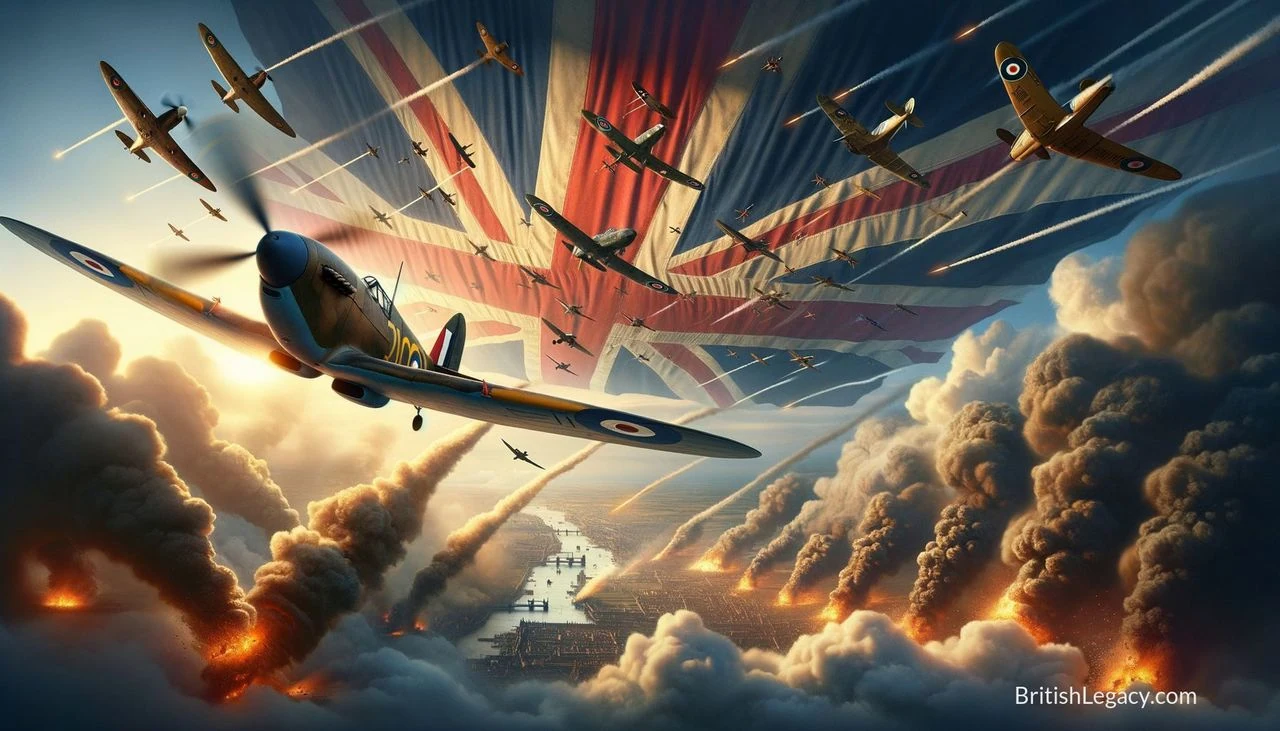
In the summer and autumn of 1940, Britain’s defence depended in part on whether the Royal Air Force could deny the Luftwaffe control of the skies. The Battle of Britain was a campaign of attacks on airfields and radar stations, fighting between aircraft over the Channel and the British countryside, and raids that brought destruction to cities. Its outcome mattered beyond the air battles: Germany needed air superiority before it could carry out Operation Sea Lion, its plan to invade Britain.
The invasion threat and the air campaign
After Germany’s rapid advances across Europe, Britain faced the prospect of invasion. Operation Sea Lion depended on securing air superiority over the Channel and the British Isles. The Luftwaffe therefore sought to neutralise the RAF, with Fighter Command at the centre of the defence. The campaign began in earnest in July 1940, when German aircraft attacked British airfields and radar stations as well as cities.
Air Chief Marshal Sir Hugh Dowding led Fighter Command. The British response relied not on fighters alone but on a network for detecting and directing them. Radar, then known as Radio Direction Finding, provided warning of approaching aircraft. The Royal Observer Corps and communications links also helped pass on information and direct fighter squadrons to where they were needed. These elements connected detection to action: warning mattered because it gave the RAF a chance to scramble and engage incoming aircraft.
The campaign’s aims and pressures changed over its course. The Luftwaffe attacked targets associated with the RAF’s ability to operate, while bombing also brought the war to British cities. The defence was therefore not a series of isolated encounters between pilots. It involved the airfields and radar installations under attack, the organisation that coordinated Britain’s response, and the threat that the raids posed to people on the ground.
Fighter Command and “The Few”
RAF pilots flew the Spitfire and Hurricane, among other aircraft, and fought German aircraft over the Channel and the countryside. Winston Churchill, then Prime Minister, gave the fighter pilots a lasting place in public memory when he referred to them as “The Few”. His words, “Never in the field of human conflict was so much owed by so many to so few”, expressed the gratitude associated with their service.
The phrase has endured as a shorthand for the pilots who took part in the air defence. But the campaign described by the source text also depended on work beyond the cockpit: radar warning, observation and communications helped Fighter Command deploy its squadrons. Remembering the pilots alongside those systems gives a fuller account of how the defence was organised, without diminishing the danger of the flying or the significance attached to the RAF’s effort.
In September, the Luftwaffe shifted its attacks towards London and other cities. The raids caused destruction and civilian casualties. The change also eased pressure on Fighter Command’s airfields, giving it some opportunity to regroup and replenish. The episode joined two consequences of the air campaign: the immediate danger to people in towns and cities, and the altered demands on the RAF’s forces and bases.
Operation Sea Lion and the outcome
By the end of October 1940, the Luftwaffe had suffered substantial losses in aircraft and pilots. Germany had not secured the air superiority required for Operation Sea Lion; the invasion plan was postponed and ultimately abandoned. The RAF’s defence helped prevent the planned invasion, and Britain remained able to continue its resistance in the war.
The battle also demonstrated the role of information and coordination in directing fighter forces. Radar, the Royal Observer Corps and communications networks formed part of the defence alongside the aircraft and pilots. The account therefore encompasses both combat and the systems used to identify incoming raids and deploy squadrons. It also includes the bombing of cities: the campaign’s military outcome did not spare civilians from destruction and casualties.
Why the Battle of Britain deserves a place in British Legacy
The Battle of Britain deserves a place in British Legacy because its outcome was directly connected to the defence of Britain in 1940. Operation Sea Lion depended on German air superiority; the Luftwaffe did not achieve it, and the invasion plan was abandoned. Fighter Command’s resistance was central to that result, supported by radar, the Royal Observer Corps and communications networks that helped turn warnings into deployments. The story is consequently not only one of fighter aircraft and pilots, but also of the people and systems involved in organising the defence.
The battle’s significance should also be remembered with attention to its costs and its public legacy. The shift towards bombing London and other cities brought destruction and civilian casualties, even as it eased pressure on Fighter Command’s airfields. Churchill’s words about “The Few” helped fix the RAF pilots in public memory, while the Spitfire and Hurricane remain closely associated with the campaign in the account of the battle. These specific details explain its continuing place in the history of Britain: the failure of the invasion plan, the coordinated air defence, the pilots’ service and the civilian experience of bombing. They make the battle a consequential episode of the Second World War, not simply a general story of national resolve.