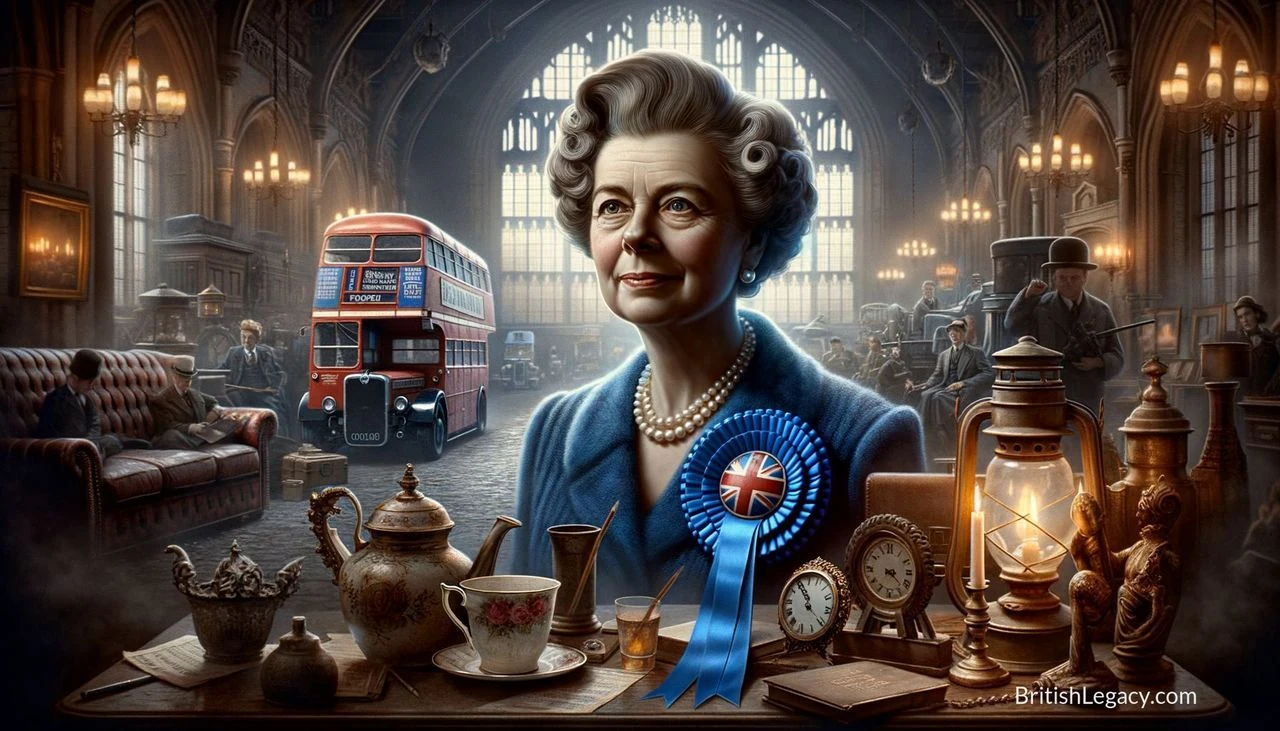
Margaret Thatcher entered Downing Street in May 1979 as Britain’s first woman prime minister. She left in November 1990, after three general-election victories and a leadership challenge within her own party. In those 11 years, her governments sold state-owned industries, changed the law governing trade unions, fought a war in the South Atlantic and altered the terms of British political debate. Her supporters saw a leader who restored economic confidence; her critics saw policies that imposed severe costs on workers and industrial communities. Both the scale of her changes and the divisions they exposed remain central to her place in modern British history.
Grantham, Oxford and the road to Parliament
Margaret Hilda Roberts was born in Grantham, Lincolnshire, on 13 October 1925. Her father, Alfred Roberts, owned a grocery and tobacconist’s shop and was active in local politics; her mother was Beatrice Ethel Stephenson. Margaret attended Kesteven and Grantham Girls’ School, then won a scholarship to study chemistry at Somerville College, Oxford. She graduated in 1947 and later received an Oxford MA. At university she became president of the Oxford University Conservative Association.
After Oxford, Roberts worked as a research chemist, first for British Xylonite and later for J. Lyons & Co. Her research at Lyons concerned an emulsifier used in food production; it became the subject of a scientific paper published in 1951. She also began pursuing a political career. As Conservative candidate for Dartford, she fought the 1950 and 1951 general elections, losing both to Labour’s Norman Dodds. In December 1951, she married Denis Thatcher. She trained in law and qualified as a barrister in 1953, the year their twins, Carol and Mark, were born.
After an unsuccessful attempt to win selection for another seat, Roberts was chosen as Conservative candidate for Finchley. She entered the House of Commons at the 1959 general election. Her first successful bill, which required local authorities to hold council meetings in public, became law in 1960. She held junior opposition roles before Edward Heath appointed her Secretary of State for Education and Science in 1970.
As education secretary, Thatcher made a decision that became more famous than many of her departmental responsibilities: she ended the provision of free school milk for most children aged seven to eleven. The change provoked protests and the press nickname “Margaret Thatcher, Milk Snatcher”. She later said the episode taught her how much political hostility a policy could generate for little political gain. After the Conservatives lost power in 1974, she challenged Heath for the party leadership. She won in 1975, becoming both Conservative leader and Leader of the Opposition—and the first woman to lead a major British political party.
Government, industry and economic change
The Conservatives won the 1979 general election, and Thatcher became prime minister on 4 May. Her governments sought to curb inflation and reduce the state’s role in the economy, drawing on monetarist ideas. They cut direct taxes on income while raising indirect taxes, raised interest rates to restrain inflation and imposed limits on public spending. The early 1980s brought recession and rising unemployment. Economic recovery began in 1982, but unemployment remained high, and manufacturing employment fell substantially during the decade.
Privatisation became one of the defining policies of the Thatcher governments. State-owned companies were sold, and the sale of council houses gave many tenants the opportunity to buy their homes at a discount. Supporters argued that these changes widened ownership and improved efficiency; critics challenged the terms of asset sales and the social consequences of restructuring. The results varied between industries, and privatisation did not always bring stronger competition: some utilities remained natural monopolies and required regulation.
Financial reform also changed the City of London. The government removed exchange controls in 1979, allowing capital to move more freely, and the 1986 “Big Bang” deregulated the London Stock Exchange. At the same time, the government sought to limit trade-union power through legislation. The miners’ strike of 1984–85 became the largest and most damaging confrontation between the government and the unions. After a year on strike, the National Union of Mineworkers returned to work without a settlement. Coal-pit closures continued, with heavy employment losses and lasting consequences for communities dependent on mining.
Her government’s record was not limited to economic liberalisation. It legislated on environmental protection, supported the creation of the Hadley Centre for Climate Research and Prediction, and helped establish the Intergovernmental Panel on Climate Change. In local taxation, however, the Community Charge—widely known as the poll tax—proved deeply unpopular. Introduced in Scotland in 1989 and in England and Wales the following year, it charged each adult resident the same amount. Public opposition culminated in a major London demonstration in March 1990, which deteriorated into rioting. John Major’s government later abolished the tax.
War, diplomacy and the “Iron Lady”
Thatcher’s foreign policy combined close relations with the United States and a prominent role in the later years of the Cold War. She formed a political partnership with President Ronald Reagan and supported a firm Western defence posture. The name “Iron Lady” began as a Soviet jibe after a 1976 speech attacking Soviet policy; Thatcher adopted the image herself. Yet she also responded warmly to Soviet leader Mikhail Gorbachev, whom she met in 1984, and later said that the Cold War had given way to a new relationship.
The Falklands War was the defining international crisis of her first term. After Argentina invaded the Falkland Islands on 2 April 1982, Thatcher chaired a small war cabinet and authorised a naval task force to retake them. Argentina surrendered on 14 June. The British victory strengthened her political position ahead of the 1983 election, but the conflict cost the lives of 255 British service personnel and three Falkland Islanders. Critics also questioned whether the islands’ defences had been neglected before the invasion.
Her government’s record elsewhere was more complicated. In 1984, Thatcher narrowly escaped the Provisional IRA’s bombing of the Conservative Party conference hotel in Brighton; five people were killed. The following year, she signed the Hillsborough Anglo-Irish Agreement, giving the Republic of Ireland an advisory role in Northern Ireland’s affairs and provoking strong opposition from unionists. In Europe, Thatcher supported British membership of the European Economic Community and the Single European Act, but increasingly resisted further political integration. Her 1988 Bruges speech set out that opposition. In 1990, disagreements over Europe and her leadership helped precipitate the challenge that ended her premiership.
Departure, remembrance and debate
Thatcher won three consecutive general elections, but by 1990 she faced falling support and growing disquiet among Conservative MPs. Geoffrey Howe’s resignation speech helped precipitate a leadership challenge by Michael Heseltine. Thatcher led the first ballot but did not win by the margin required to avoid a second. After consulting her cabinet, she withdrew. John Major succeeded her as Conservative leader and prime minister. Thatcher left the House of Commons at the 1992 general election and entered the House of Lords as Baroness Thatcher.
In later years she wrote memoirs, spoke in the Lords and continued to comment on British and international politics. Her husband Denis died in 2003. After a series of strokes and a decline in her health, she withdrew from public speaking. Thatcher died in London on 8 April 2013, aged 87, after a stroke. She received a ceremonial funeral at St Paul’s Cathedral, attended by Queen Elizabeth II and the Duke of Edinburgh, and her ashes were later interred at the Royal Hospital Chelsea beside her husband.
The political argument over her record has never resolved into a single verdict. Her governments changed the balance between state and market, weakened trade-union influence, expanded home ownership and reshaped the Conservative Party. They also presided over recession, high unemployment and the closure of industries on which many communities depended. Later Labour governments retained elements of the economic settlement she had advanced, while critics continued to challenge its effects on inequality, social cohesion and manufacturing. Her significance lies not in an uncontested claim to have made Britain stronger, but in the extent to which subsequent governments and voters had to reckon with the changes she made.
Why Margaret Thatcher deserves a place in British Legacy
Margaret Thatcher belongs in British Legacy because her life and premiership offer a clear account of how an individual political leader can alter the direction of a country. She was the first woman to lead a major British political party and the first woman to become prime minister. Those milestones mattered in a political culture in which women had rarely held its highest offices. Her path—from a scholarship student in Grantham, through scientific work and the Bar, to Parliament and the Conservative leadership—also makes visible the varied stages of a career often reduced to its most controversial years.
Her legacy is equally important for the questions it forces into view. Privatisation, financial deregulation, council-house sales and restrictions on trade unions changed British economic and public life; the miners’ strike and pit closures showed the human cost that could accompany those changes. The poll tax demonstrated the political danger of pursuing a policy despite widespread opposition. In foreign affairs, the Falklands campaign, the Brighton bombing and the Anglo-Irish Agreement show the pressures and consequences of decisions made by her governments. A British legacy entry should neither turn these events into uncomplicated triumph nor treat disagreement as a substitute for history. Thatcher’s record is worth preserving because it connects leadership and conviction with electoral power, policy consequences and enduring public debate.
Sources
Adapted in part from Margaret Thatcher by Wikipedia contributors, under CC BY-SA 4.0. Text has been edited and combined with the existing article; this adapted text is shared under the same licence. Contributor history.