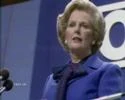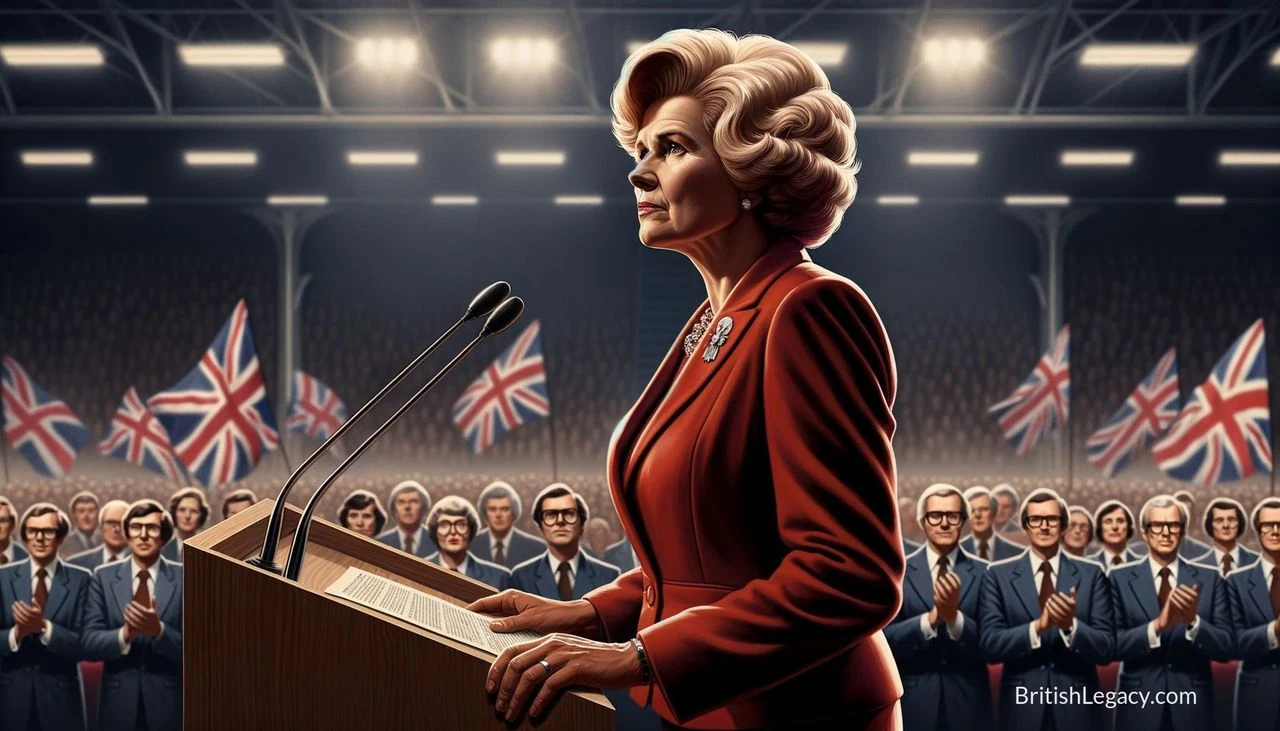
“You turn if you want to; the lady’s not for turning.” Margaret Thatcher delivered the line at the Conservative Party Conference in Brighton on 10 October 1980, in response to pressure for her government to reverse course. It became one of the most recognisable declarations of her premiership. The address itself ranged beyond that phrase: Thatcher discussed monetary policy, national unity, political liberty and the case for continuing a reform programme whose effects were already being fiercely debated.
A government under pressure
Thatcher had become Prime Minister in May 1979 after the Conservatives won the general election. Her government set out to tackle high inflation and what it regarded as the weaknesses of the British economy. Its approach emphasised monetarist policies, lower direct taxes, restraint in public spending and a reduction in trade union power. These measures marked a break with the post-war consensus around a substantial state role in the economy and society.
The results were not immediate or painless. The recession deepened, unemployment rose and the government’s popularity fell. Within the Conservative Party, some ministers doubted the direction of policy. The prospect of a reversal became a subject of public debate, and “U-turn” offered a shorthand for the possibility that Thatcher might change course.
Her speech answered that pressure directly. It was delivered to her own party conference, but Thatcher said her message was intended not only for those in the hall but also for “the people of our country”. She acknowledged that economic recovery would take time. Her argument was that the government should not abandon its programme before it had run its course.
What the speech argued
Thatcher began by recalling the Conservatives’ election victory and challenging the idea that government should always follow the immediate direction of public opinion. In her view, the difficulties Britain faced required a broad effort to bring the country through a period of change. She argued that, in an emergency, a simple majority might not be enough: the country needed the “wise and the wilful” to work together.
The speech connected political conviction with practical administration. Thatcher referred to public discussion of monetary policy and pointed to her Chancellor’s forthcoming remarks. She then distinguished between expressing principles and putting them into effect. Progress on what she called “nuts and bolts problems”, she said, would help the government tackle larger challenges. The argument was a defence of a governing programme, not merely a declaration of personal determination.
Other passages addressed unity and political tradition. Thatcher said minorities should have a voice in government, while also arguing that the country should become “one nation, one and indivisible”. She invoked what she called Britain’s traditional liberties, tracing them back to Magna Carta. Her address also referred to the country’s imperial past, presenting historical inheritance as part of a wider reflection on changing circumstances. These references gave her economic argument a broader political frame; they should be read as claims made in the speech, not as a neutral account of British history.
The famous line arrived after Thatcher referred to the media’s anticipated catchphrase. In the supplied text, she described the “U-turn” as a favourite phrase and answered: “You turn if you want to; the lady’s not for turning.” She added that she was speaking not only to the conference but to the public. The wording made the clash personal and memorable, but the point was about policy: she would not reverse the government’s direction simply because pressure for a change had grown.
A line becomes a political emblem
The supplied Wikipedia account identifies the playwright Ronald Millar as the speech’s writer. Its central line has often overshadowed its other arguments. In the address, it belongs to a sustained appeal for patience with economic reform and support for the government’s programme. Thatcher described the election victory as a mandate to act while warning that recovery would take time.
Her insistence did not settle the argument about her policies. By December 1980, her job approval rating had fallen to 23 per cent. Economic difficulties and debate over whether the government should change course continued. The early 1980s recession, rising unemployment and the effects of economic policy would remain central to assessments of her premiership. Later signs of recovery did not erase the serious costs or disagreements associated with that period.
The phrase’s endurance reflects its usefulness as a compact description of Thatcher’s public style: direct, combative and resistant to pressure. But it can also reduce a complicated political moment to a single performance of resolve. The speech asked her party to stand behind the programme; it did not establish that the programme was beyond criticism or that its effects were shared evenly.
Conviction, consequences and political memory
Thatcher’s record in office extended far beyond the arguments made at Brighton. She served as Prime Minister from 1979 to 1990, the first woman to hold the office, and led the Conservatives to three consecutive general-election victories. Her governments pursued privatisation, financial deregulation and changes to industrial relations. Those policies reshaped British politics and the economy, but their consequences remain contested. Supporters have credited them with changing the direction of the country; critics have pointed to unemployment, social division and lasting damage in communities affected by industrial decline.
Her influence also outlasted her premiership. The supplied Wikipedia account describes Thatcherism as a major shift away from the post-war consensus and notes that aspects of her programme influenced Labour under Tony Blair. Her legacy therefore cannot be measured only by the decisions of her own governments: it is also present in the arguments later parties adopted, revised or rejected.
The Brighton speech condenses some of those tensions. It shows the authority Thatcher claimed for her programme and the way she turned pressure into a test of resolve. It also belongs to a moment when the social and economic costs of that programme were a matter of acute dispute. Remembering the speech means holding both points in view: the force of its political declaration and the unsettled consequences of the policies it defended.
Why Margaret Thatcher deserves a place in British Legacy
Margaret Thatcher deserves a place in British Legacy because her premiership changed the terms of political debate in Britain. She led the country from 1979 to 1990, became its first woman Prime Minister and won three successive general elections. Her governments pursued an ambitious programme of economic and institutional change, including privatisation, financial deregulation and action to reduce trade union power. These were not marginal adjustments: they helped shape the arguments and policy choices of governments that followed, including Labour under Tony Blair.
The 1980 conference speech offers a focused way to examine that legacy. Its best-known line expressed a leader’s refusal to change course, while the surrounding address set out a larger claim about economic recovery, national unity and political authority. That resolve became a defining part of Thatcher’s public image. It must be considered alongside the recession, unemployment and social conflict of the period, and the continuing disagreement over the effects of her policies. British Legacy can preserve the speech not as a verdict that closes those debates, but as evidence of how Thatcher explained her choices and why they became consequential. Its place in the national story lies both in the words that endured and in the contested transformation they represented.
Sources
Margaret Thatcher — Wikipedia revision
Adapted in part from Margaret Thatcher by Wikipedia contributors, under CC BY-SA 4.0. Text has been edited and combined with the existing article; this adapted text is shared under the same licence. Contributor history.