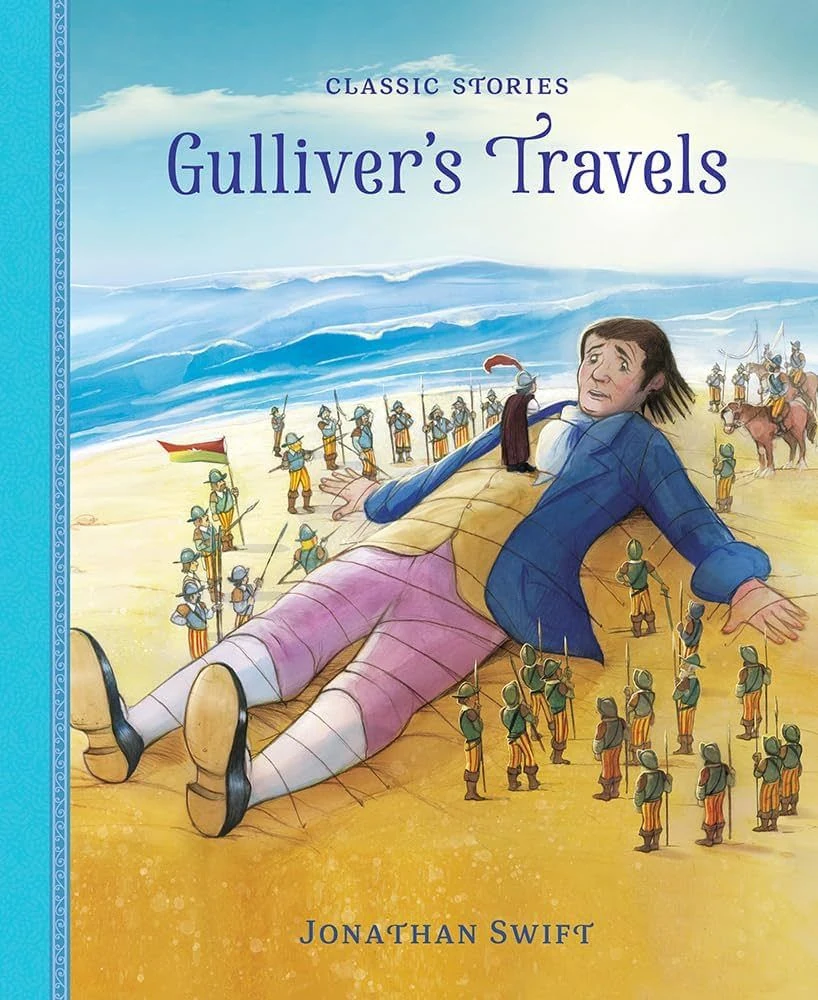
Gulliver’s Travels by Jonathan Swift
A Timeless Satire and More Than Just a Children’s Tale
Overview
“Gulliver’s Travels,” written by Jonathan Swift, stands as a paragon of British literature, distinguished for its trenchant satire and deep exploration of human nature. Initially published in 1726, this classic work narrates the voyages of Lemuel Gulliver to several fantastical lands. Through an ostensibly whimsical adventure, Swift employs his narrative to scrutinise the political and social mores of his time, making the book an enduring critique of human folly.
Summary
The novel is divided into four parts, each chronicling a different voyage of Gulliver. Every journey takes him to a unique and imaginative land, such as:
-
Lilliput - A land of miniature people where everything is proportionally small. It reflects on the pettiness of political conflicts, as depicted through the trivial wars and disputes of the Lilliputians.
-
Brobdingnag - In stark contrast, Gulliver finds himself among giants. This shift in perspective helps critique the nature of power and the imperfections of human beings under a magnifying glass.
-
Laputa, Balnibarbi, Luggnagg, Glubbdubdrib, and Japan - Encounters in these lands satirise various intellectual and philosophical pursuits, pointing out the absurdity in excessive reliance on abstract thought without practical application.
-
Houyhnhnms - A land where intelligent horses (Houyhnhnms) rule over degenerate humans called Yahoos. This sharp inversion comments profoundly on the nature of human civilisation and its vices, questioning what it means to be civilised.
Origins and Authorship
Jonathan Swift, an Anglo-Irish satirist, essayist, and cleric, wrote "Gulliver's Travels" during a time of political turmoil and intellectual enlightenment. Swift utilised his sharp pen to critique the societal norms and governmental practices of the 18th century. His experiences and roles as Dean of St Patrick’s Cathedral in Dublin, and his passionate involvement in political pamphleteering enriched his perspective, enabling him to imbue “Gulliver’s Travels” with nuanced and layered commentary.
Success and Legacy
Upon its publication, "Gulliver’s Travels" was an immediate success. It was not merely a satirical commentary but also gained popularity as an adventure story, catering to a broad spectrum of readers. Through the centuries, it has transcended its initial context, offering valuable insights into the human condition, power dynamics, and societal flaws that remain relevant today.
The novel's contribution to British legacy lies in its versatile engagement with readers. It has inspired numerous adaptations, including films, television series, and theatre productions. Moreover, it has influenced a myriad of literary works, emphasising the role of satire in literature.
Swift's novel continues to be a critical text in academic curricula worldwide, representing the richness of British literary tradition and the perennial significance of satire in societal critique.
For readers wishing to embark on Lemuel Gulliver's extraordinary adventures and explore Jonathan Swift's timeless critiques, "Gulliver’s Travels" is available for purchase on Amazon.
In conclusion, "Gulliver’s Travels" is much more than a fanciful tale of maritime odysseys. It is an intricate work of satire that challenges readers to reflect on their own societal structures, politics, and human nature. Swift's masterpiece continues to resonate as an instrumental part of British literary heritage, making it an essential read for those interested in understanding the depths of political satire and the timeless observations on human foibles.