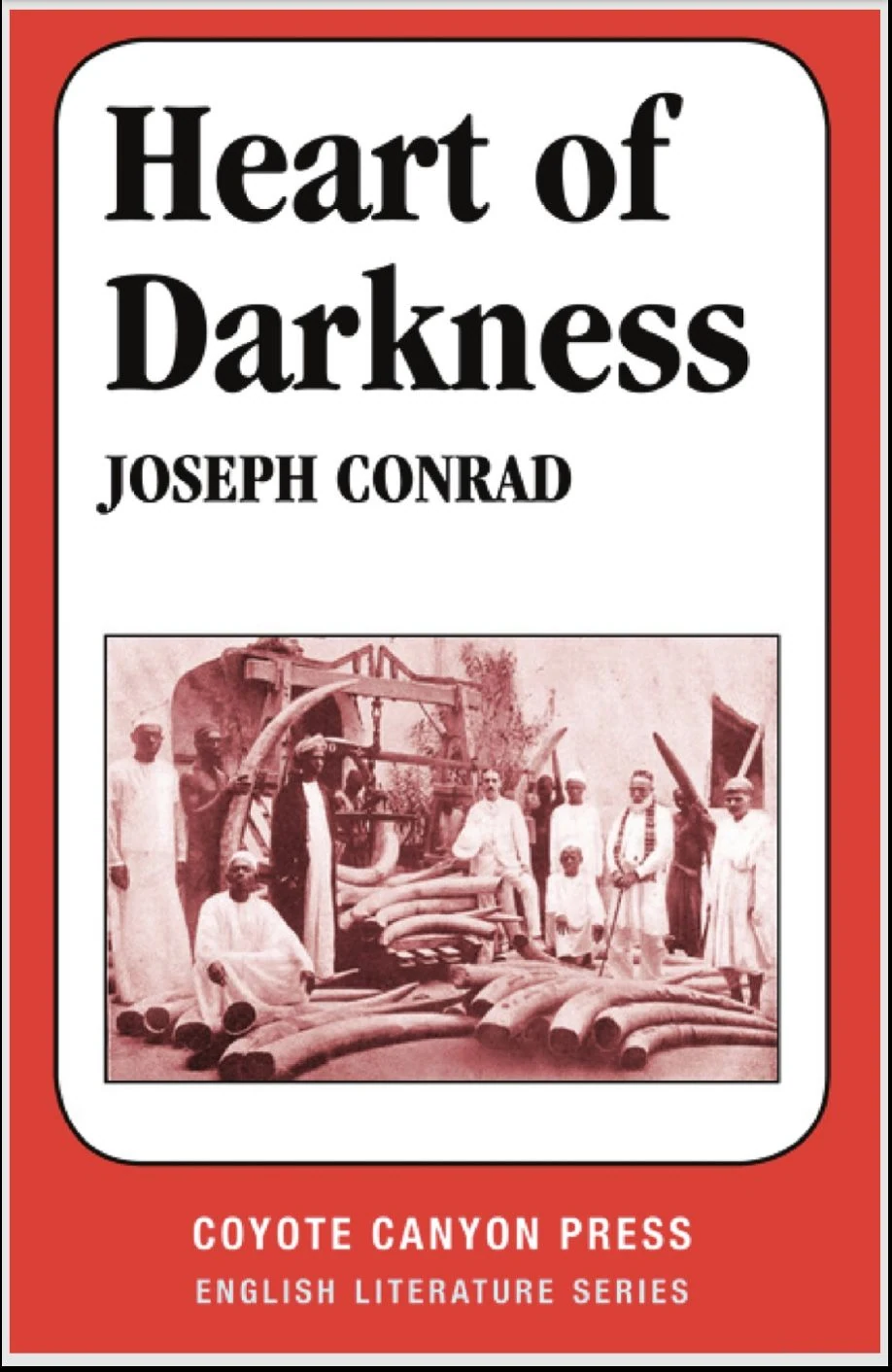
In Joseph Conrad’s Heart of Darkness, a story told on the Thames follows a river journey into the Congo Free State. Charles Marlow recounts his work as a steamer captain for a Belgian company and his search for Kurtz, an ivory trader at a remote station. The journey brings together adventure, colonial commerce and questions about who holds power—and whose account of that power is heard.
A tale carried from the Thames
The novella opens on the Thames, where Marlow speaks to companions aboard a boat. He recalls how, as a child, he was drawn to blank spaces on maps, particularly in Africa. That fascination leads him to take a job with a trading company and travel upriver. The story’s British frame is more than a place to begin: Marlow’s account asks listeners on a familiar European river to consider the history and conduct of European activity elsewhere.
Conrad first published Heart of Darkness as a three-part serial in Blackwood’s Magazine in 1899. It appeared in book form in 1902, alongside Youth: A Narrative and The End of the Tether. The difference matters: the work was not originally issued as a standalone book, and its later place in literary culture should not be mistaken for an immediate triumph.
Conrad’s journey and the making of the story
Conrad’s own experience supplied material for Marlow’s journey, though the novella is not simply a record of it. In 1890, Conrad worked for a Belgian trading company and travelled on one of its steamers on the Congo River. When the captain fell ill, Conrad took command and guided the vessel towards the company’s innermost station. Eight years later, he began writing the story, drawing on his travel journals. The overlap between author and narrator gives the journey a biographical grounding without making every episode or character a direct transcription of real life.
Conrad described the tale as a “wild story” about a journalist who becomes the manager of an interior station and makes himself worshipped by a local community. Kurtz is not a simple portrait of one historical figure: critics have proposed several possible models, and other readings treat him as a composite. The narrative’s concern is less a definitive identification than the authority Kurtz acquires and the damage connected with it.
The ivory route and Kurtz
Marlow’s journey begins at the company’s Outer Station, where he encounters the consequences of its operations. He sees sick African workers who had been employed on a railway, and meets the chief accountant, who describes Kurtz as a highly regarded agent. Marlow then travels to the Central Station, where his steamer has been wrecked. The work of repairing it delays him for months; when the journey resumes, it takes a further two months to reach Kurtz’s station.
The route is marked by uncertainty and violence. Fog stops the steamer, and it comes under attack; the helmsman is killed. At the Inner Station, Marlow hears from a Russian wanderer that Kurtz is ill and has acquired devoted followers. Around the station, Marlow sees posts bearing severed heads. Kurtz appears gravely unwell, and the manager says his methods have harmed the company’s business. Marlow later finds him trying to return to the station house after dark. The expedition, ostensibly organised around ivory, has become a study of unchecked authority and the gap between a company’s claims and its conduct.
On the return journey, Kurtz’s health worsens. He entrusts Marlow with papers, including a report, and dies after whispering, “The horror! The horror!” Back in Europe, Marlow keeps some of the papers from people who come to claim them. When he visits Kurtz’s fiancée, she asks for his final words. Marlow tells her that Kurtz spoke her name. This ending brings the story back to Europe, but does not settle what Marlow’s account means or what his omissions protect.
Reception and difficult interpretations
The book’s reputation developed over time. Its 1902 book publication, bundled with two other stories, attracted little critical comment, and Conrad did not regard it as especially notable. By the 1960s it had become a standard work in many English courses. That later prominence has not produced a single settled interpretation: the novella’s ambiguity has made it a subject of sustained critical discussion.
Its treatment of colonialism and race is part of that discussion, not a matter that can be resolved by calling the book an uncomplicated condemnation of empire. In a 1975 lecture, the Nigerian writer Chinua Achebe argued that Conrad’s portrayal dehumanised Africans and made Africa a foil for Europe. Other critics have challenged aspects of Achebe’s reading, distinguishing Marlow’s views from Conrad’s and pointing to the story’s scepticism about European claims to moral superiority. These disagreements should be understood as disagreements, rather than collapsed into a claim that the novella has one uncontested political meaning.
The narrative does represent African people largely through the perspectives of European characters. That limitation matters alongside the story’s exposure of colonial brutality. Taking its critique seriously need not mean treating its perspective as complete, or ignoring the objections raised by readers and writers whose work confronts the way Africa and Africans are represented.
From the page to other works
The story’s afterlife includes Francis Ford Coppola’s 1979 film Apocalypse Now, which relocates its central mission to Vietnam and Cambodia during the Vietnam War. Its commander, Captain Benjamin L. Willard, is assigned to find Colonel Walter E. Kurtz. The change of setting makes the film an adaptation rather than a retelling of Conrad’s colonial expedition, while retaining the pattern of a journey towards a powerful, isolated figure.
Other adaptations have taken different forms. Orson Welles made a radio version in 1938 and developed a film project that was never realised; he returned to the story on radio in 1945. A later BBC Radio 4 production adapted Welles’s screenplay, and the work has also been adapted for opera and stage. Its influence extends to literary responses: Chinua Achebe’s Things Fall Apart is described as a reply to Conrad’s representation of Africa, while other writers have recast the story’s characters and themes in new settings.
Why Heart of Darkness deserves a place in British Legacy
Heart of Darkness deserves a place in British Legacy because its British connection is specific and visible in the work itself: the story begins on the Thames, and Marlow’s account is framed as a conversation among people on that river. Conrad wrote in English, and the novella’s publication in Britain—first in Blackwood’s Magazine, then in a book issued by William Blackwood—places it within the history of English-language publishing. Those links do not make Conrad British-born; they explain why the work belongs in a discussion of Britain’s literary heritage.
Its legacy also lies in how it makes colonial power a subject for readers to examine. The trade in ivory, the company’s operations and Kurtz’s authority connect the expedition’s material purpose with its moral consequences. Yet the story’s account is not beyond criticism: Achebe’s challenge to its representation of Africans remains an important part of how the novella is read. That tension is valuable to a British literary history. It allows the work to be recognised for its narrative craft and enduring reach without turning it into a simple moral lesson or overlooking the limits of its perspective. Its publication, its Thames-side frame and the debate it continues to prompt give it a lasting, complicated place in that history.
Sources
Adapted in part from Heart of Darkness by Wikipedia contributors, under CC BY-SA 4.0. Text has been edited and combined with the existing article; this adapted text is shared under the same licence. Contributor history.