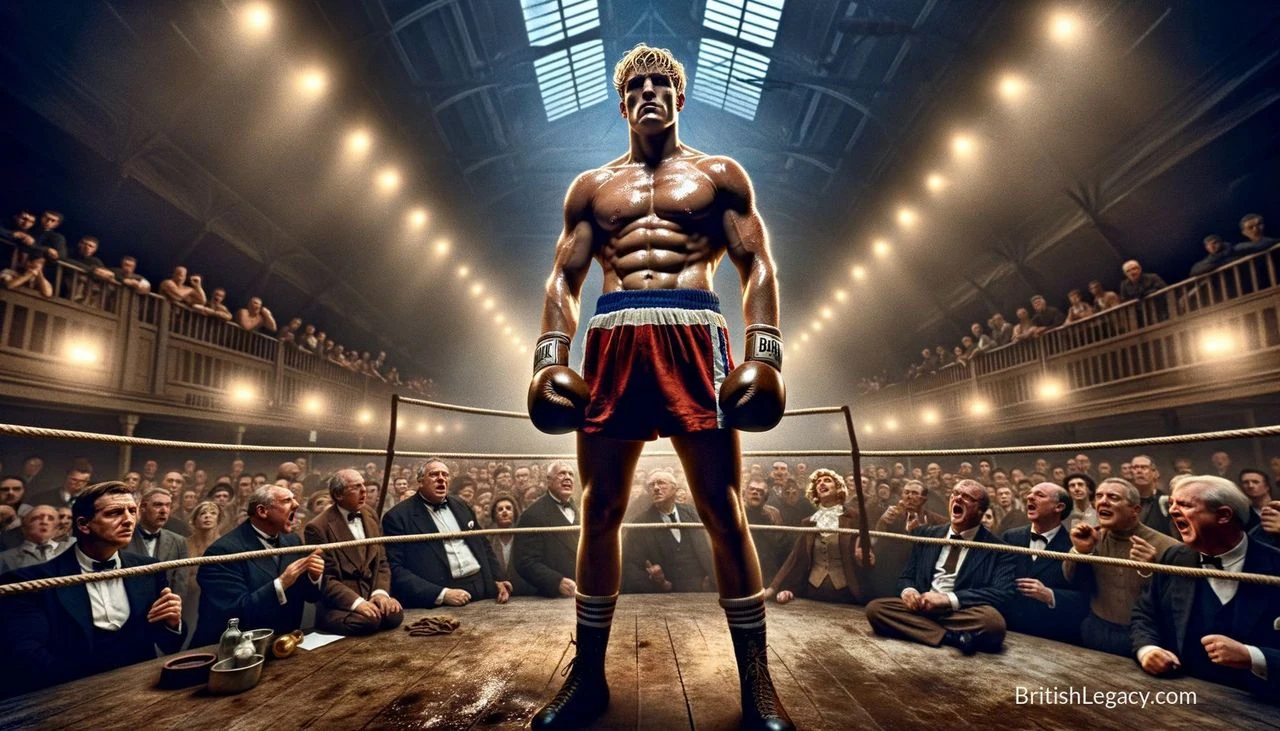
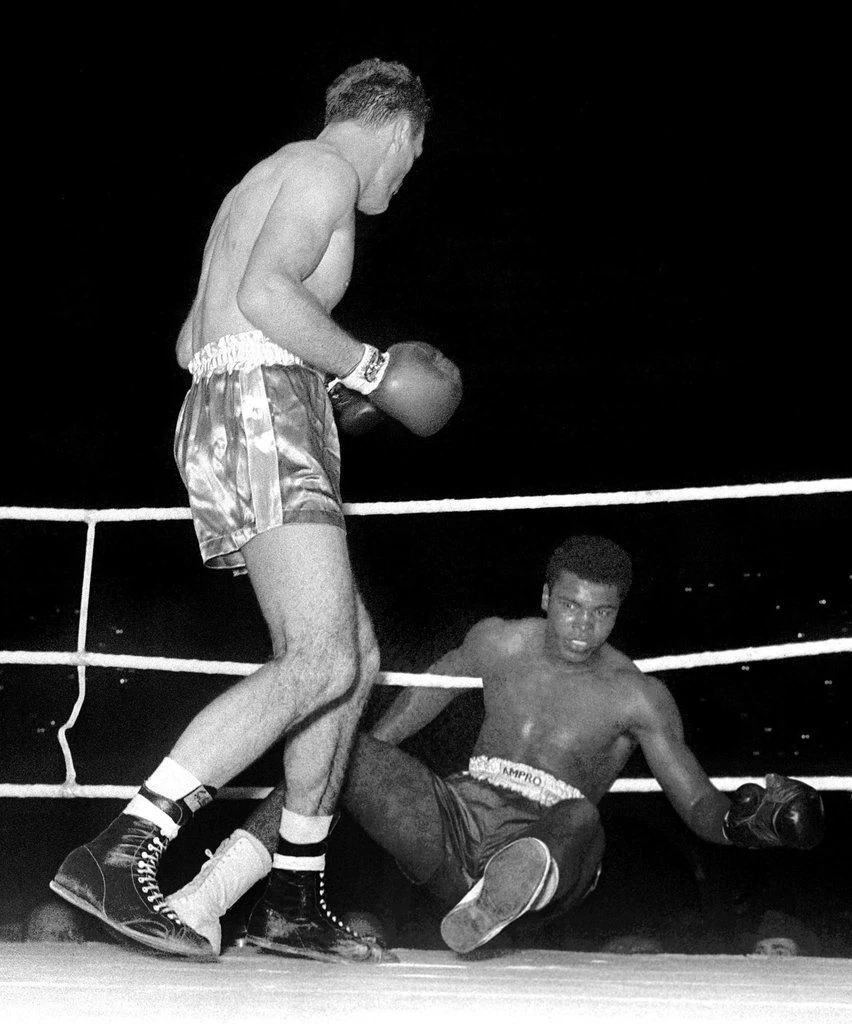
Henry Cooper’s most famous punch was a left hook that sent Cassius Clay down in the final seconds of the fourth round at Wembley in 1963. The knockdown briefly changed the balance of a bout the young American was expected to win; the fight itself ended in the next round, when a cut over Cooper’s eye forced the referee to stop it. That mixture of drama and defeat became central to Cooper’s public story. He was not a world heavyweight champion, but he held British, Commonwealth and European titles, won three Lonsdale Belts outright and remained a familiar figure in British life long after leaving the ring.
A boxer from south-east London
Cooper was born in Lambeth, London, on 3 May 1934. He grew up on the Bellingham Estate with his identical twin brother, George, and their elder brother, Bern. The family was evacuated to Lancing on the Sussex coast during the Second World War. As a boy, Cooper took on jobs including a paper round and collected golf balls to sell back to a clubhouse. Sport was a shared interest among the brothers: George and Henry played football and cricket as well as taking up boxing.
In 1949, Cooper began boxing as an amateur at Bellingham Boxing Club, based at Athelney Street School. He won 73 of his 84 amateur contests and claimed the English Amateur Boxing Association light-heavyweight title in 1952. He represented Great Britain at that year’s Helsinki Olympics, where he received a bye in the opening round and lost his next contest to the Soviet boxer Anatoly Perov on a 2–1 decision. Cooper won a second ABA light-heavyweight title in 1953, before National Service in the Royal Army Ordnance Corps.
Henry and George, who boxed professionally as Jim, turned professional together under manager Jim Wicks. Cooper’s career began with setbacks as well as wins. He lost early title challenges against Joe Bygraves, Ingemar Johansson and Joe Erskine, then beat the American heavyweight Zora Folley on points before losing their rematch by knockout. A cut-prone fighter, Cooper made his name through a forceful attacking style rather than defensive subtlety. Although left-handed, he boxed from an orthodox stance, placing his strong left hand forward. His left hook, known as “Enry’s ’Ammer”, was the defining weapon.
Titles, and a famous knockdown
Cooper’s breakthrough came in 1959. He took the British and Commonwealth heavyweight titles from Brian London over 15 rounds and received the final nine-carat gold Lonsdale Belt. He defended the belts against opponents including Dick Richardson and Joe Erskine, then defeated London again on points. A possible fight with world champion Floyd Patterson was discussed, but Cooper or his manager turned down the offer.
The bout with Clay took place at Wembley Stadium on 18 June 1963. Clay, then a contender for the world heavyweight title, was the quicker and more elusive boxer. Cooper’s face was cut during the third round, and blood ran into his left eye. At the end of the fourth, he landed the upward-angled hook that dropped Clay. Clay was hurt but got up; after a short interval, he attacked strongly in the fifth. Cooper’s corner threw in the towel, and referee Tommy Little stopped the contest with Cooper unable to continue because of the cut.
The bout became controversial in part because Cooper believed that a delay between rounds had denied him time to press his advantage. The surviving broadcast recording shows an interval six seconds longer than the regulation time; suggestions that the delay was longer have not been confirmed. Whatever the argument over the clock, the ending was clear: Clay won by technical knockout. The image of Cooper’s knockdown, rather than the result, endured in popular memory. The two met again in 1966, when Clay—by then world heavyweight champion and known as Muhammad Ali—stopped Cooper in the sixth round at Arsenal Stadium, Highbury.
Cooper continued to win major fights between those meetings. His titles and successful defences made him the only boxer to win three Lonsdale Belts outright. He added the European heavyweight title in 1968 with a win over Karl Mildenberger and defended it twice. In 1970, after vacating the British title while seeking a bout with world champion Jimmy Ellis, Cooper regained it by beating Jack Bodell on points. He also held on to his Commonwealth title.
The last fight and life in public
Cooper’s final contest came in May 1971 against Joe Bugner, who was 21 to Cooper’s 36. The British, European and Commonwealth titles were at stake. Referee Harry Gibbs awarded the fight to Bugner by a quarter of a point, a decision that drew boos from a crowd largely supporting Cooper. The unusual scoring margin was later abolished, partly amid the controversy. Cooper retired shortly afterwards. He eventually shook hands with Gibbs at a charity event, though the two had not spoken for many years.
His professional record comprised 55 fights: 40 wins, including 27 by knockout, 14 defeats and one draw. He had not won every title bout, and he had suffered losses throughout his career, but his run at the top gave him a lasting place in British heavyweight boxing. In 1967 and 1970, he became the first person to win the BBC Sports Personality of the Year award twice. He was appointed an Officer of the Order of the British Empire in 1969 for services to boxing.
Cooper’s public life extended well beyond the ring. In the 1960s he appeared in road-safety public information films promoting zebra crossings. After retiring, he appeared on the BBC quiz programme A Question of Sport and in advertisements, notably for Brut aftershave. He also appeared as boxer John Gully in the 1975 film Royal Flash and became a regular speaker at fundraising events. His popularity as an after-dinner speaker provided an income after he suffered substantial losses as a Lloyd’s of London Name in the 1990s, when members could face unlimited liability.
Cooper was married to Albina Genepri from 1960 until her death in 2008. He converted to her Catholic faith. In later life he lived in Hildenborough, Kent, and served as president of Nizels Golf Club. He died in Limpsfield, Surrey, on 1 May 2011, two days before his 77th birthday. His honours also included a papal knighthood in 1978 and a knighthood in the 2000 New Year Honours for services to boxing. He remains the only British boxer to have received a knighthood.
Why Henry Cooper deserves a place in British Legacy
Cooper’s place in British Legacy rests first on a substantial sporting record, not simply on one celebrated moment. He held the British and Commonwealth heavyweight titles, later won the European crown, and was the only boxer to win three Lonsdale Belts outright. His career ran through difficult early defeats, years of championship success and a final, close loss that prompted public argument about how a contest should be scored. The arc matters: Cooper’s reputation was earned over repeated fights and title defences, not created by a single night at Wembley.
His bouts with Clay and Ali gave British audiences a vivid encounter with a future world champion on home ground. Cooper’s knockdown did not reverse the result, and the distinction should remain clear; what it did was make a heavyweight contest at Wembley part of the country’s sporting memory. Beyond boxing, his appearances in road-safety films, television and advertising show how a sportsman could become a recognisable public figure across different parts of British life. His repeated BBC Sports Personality award and honours for services to boxing mark the esteem in which his sporting contribution was held. Cooper’s story is therefore a useful part of British sporting history: a Londoner who competed at the highest level, won major domestic and European titles, and carried his profile into public life without his ring record being reduced to a legend about one punch.
Sources
Henry Cooper — revision 1379644699
Adapted in part from Henry Cooper by Wikipedia contributors, under CC BY-SA 4.0. Text has been edited and combined with the existing article; this adapted text is shared under the same licence. Contributor history.