Henry Holland made his name by putting fashion-world personalities on T-shirts, then sending those shirts back into the fashion world. His rhyming slogans, bright prints and playful approach were a sharp contrast to the solemnity often associated with high fashion. The designs began as a pointed joke; they became the starting point for a British label that moved between runway collections, high-street retail and collaborations.
From journalism to Fashion Groupies
Holland was born on 26 May 1983 in Ramsbottom, Greater Manchester. He graduated from the BA Journalism course at the London College of Communication and worked on the fashion section of teenage magazine Sneak, as well as at Smash Hits and Bliss. That experience in youth publishing gave him a route into fashion culture before he established himself as a designer.
Before founding his own company, Holland drew attention with Fashion Groupies, a range of 1980s-inspired T-shirts built around catchy phrases. The best-known, “I’ll tell you who’s boss, Kate Moss”, made a celebrity name into the punchline and helped give the project its cheeky, knowing tone. In September 2006, he brought that wit directly into London Fashion Week: Gareth Pugh wore a Holland T-shirt reading “Get Yer Freak on Giles Deacon” at the end of his runway show, and Giles Deacon later wore one bearing the words “Uhu Gareth Pugh”. The shirts turned the customary designer’s bow into part of the joke.
Building House of Holland
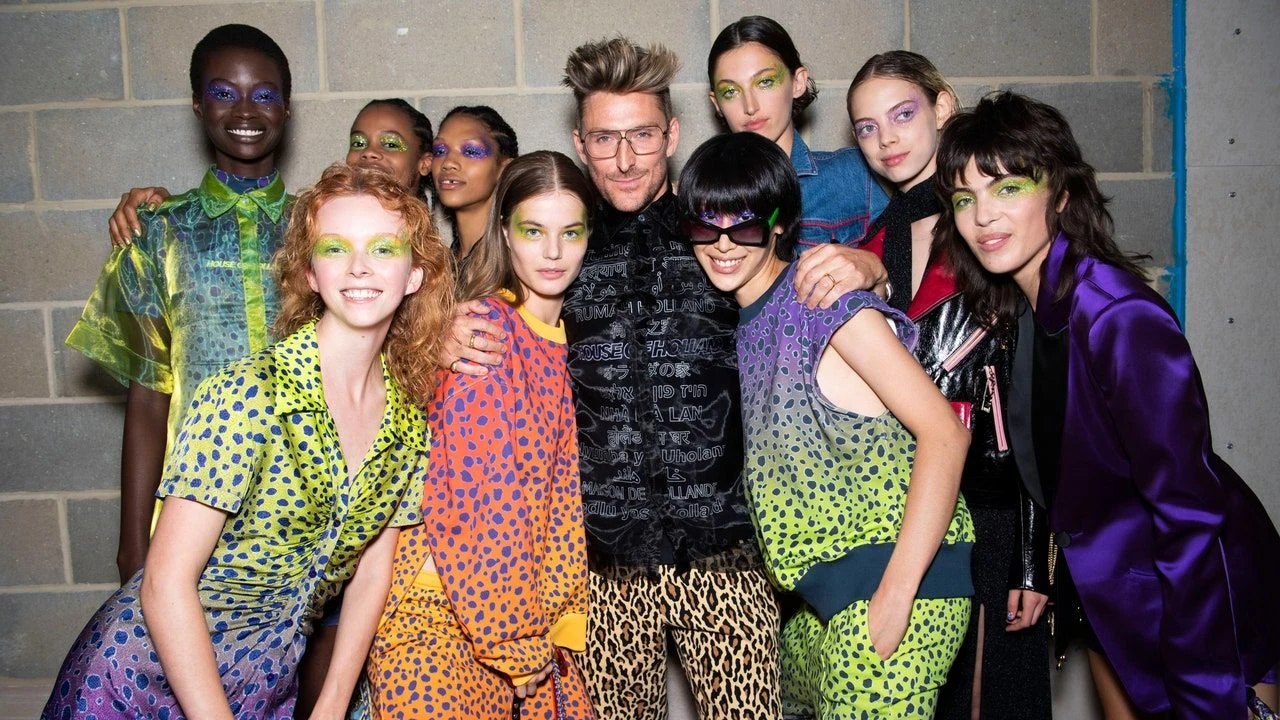
Holland expanded from T-shirts into a full collection and founded House of Holland in 2008. The label carried forward the elements that had made Fashion Groupies noticeable: bold lettering, colour, references to popular culture and an irreverent attitude towards fashion’s hierarchies. The effect was not simply to make clothes that looked conspicuous. Holland’s work brought the language of youth culture and fashion media into a designer label, and made humour one of its recognisable design tools.
His work with model Agyness Deyn became a notable part of the label’s public profile. In February 2009, singer MIA wore a black-and-white polka-dot tulle mini-dress from House of Holland’s spring/summer 2009 collection to the 51st Grammy Awards, while heavily pregnant. The striking appearance placed one of Holland’s designs before a large international audience.
Commercial partnerships broadened the label’s reach. Levi Strauss & Co introduced a denim collaboration with Holland in 2009. That September, he negotiated a deal with British retailer Debenhams for H! by Henry Holland, a fashion line sold in its stores from spring 2010. For spring/summer 2010, he also designed a pink wedding dress for Los Angeles boutique REVOLVE Clothing under the House of Holland label. These projects show the range of settings in which his design work appeared, from a fashion-house collection to retail collaborations and a retailer’s own line.
Collections, collaborations and television
Holland continued to carry his taste for witty names and graphic statements into later projects. His 2011 collection included T-shirts printed with acronyms, including “waysb”. In May 2012, he released a sunglasses collection with Le Specs. Called Henry Holland for Le Specs, it included models named “Muffin Top” and “Blinders”; its campaigns featured Iggy Azalea, Ioanna Gika and, for a third eyewear campaign, Adwoa Aboah. A separate commission for Magnum’s 25th birthday produced a 1960s-inspired dress: layers of fabric and sequins imitated cracked chocolate, and the work took more than three months to complete.
Television gave Holland another role in fashion communication. He co-presented the fashion and music series Frock Me with Alexa Chung and Gemma Cairney in autumn 2008 and spring 2010. In 2012, he appeared as a judge on Sky Living’s fashion design competition Styled to Rock. Executive-produced by Rihanna, the show gave unknown British designers the opportunity to create outfits for performers including Cheryl Cole, The Saturdays and Katy B. Holland later appeared as a guest judge on the second series of Glow Up: Britain’s Next Make-Up Star.
Administration and the end of the label’s business
On 5 March 2020, House of Holland was reported to have gone into administration. The business had seven employees, who were to be retained during and to assist with the administration. This is a more precise account of the company’s position than saying that the label simply ceased runway collections that year: the supplied information establishes the administration, not that particular description of its collections.
That distinction matters to the story of a fashion label. Holland’s design work travelled through collections, retail, collaborations and broadcasting, but the company behind the label also faced a formal business difficulty. The record of House of Holland is therefore not just a sequence of colourful designs or celebrity appearances. It includes the practical challenges of running a fashion business, as well as the creative work that made its name recognisable.
Why Henry Holland deserves a place in British Legacy
Henry Holland deserves a place in British Legacy for making a distinctive contribution to British fashion’s visual and verbal vocabulary. The Fashion Groupies shirts showed how a slogan could do more than decorate a garment: by naming fashion figures and turning their names into rhymes, Holland made the clothes part of a conversation about the industry itself. His 2006 T-shirts, worn by Gareth Pugh and Giles Deacon at the end of their London Fashion Week shows, are a particularly clear example. The joke circulated among designers, but it also gave audiences a direct, memorable way into fashion’s personalities and rituals.
House of Holland carried that approach beyond a single T-shirt idea. Its work reached customers through collaborations with Levi Strauss & Co and Debenhams, while projects with Le Specs and a Los Angeles boutique demonstrated the label’s use across different products and markets. Holland’s television work extended his involvement in British fashion culture beyond designing: on Styled to Rock, he helped bring emerging British designers before a wider audience. His legacy is not a claim that one designer transformed the whole industry. It is the more specific achievement of making graphic humour and pop-cultural reference central to a recognisable British fashion label, and of connecting that design language with retail, collaboration and public-facing fashion programmes.
Sources
Henry Holland (fashion designer), revision 1341788502
Adapted in part from Henry Holland (fashion designer) by Wikipedia contributors, under CC BY-SA 4.0. Text has been edited and combined with the existing article; this adapted text is shared under the same licence. Contributor history.