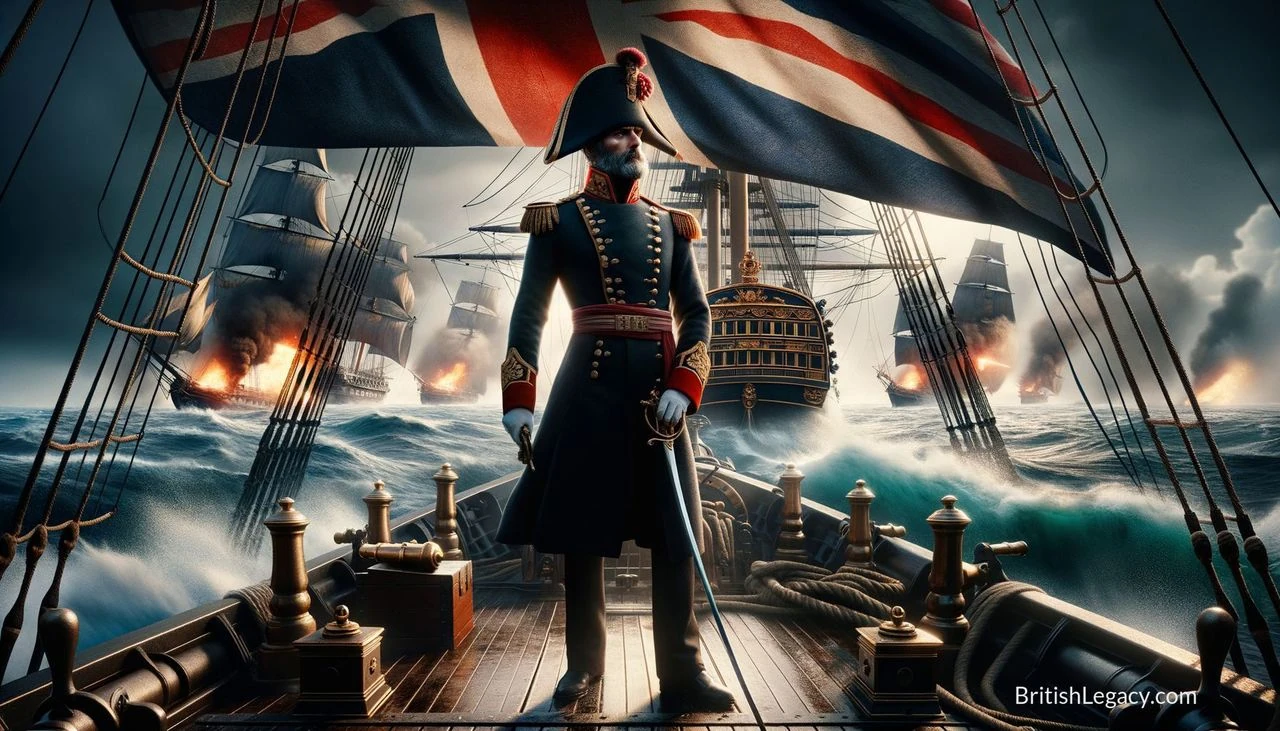
When the British fleet met the combined French and Spanish forces at Trafalgar on 21 October 1805, Admiral Horatio Nelson led from HMS Victory. His plan broke with the conventional line of battle, and the engagement ended in a decisive British victory. Nelson was fatally wounded during the fighting. His death made him a national hero, but his life was more complicated than the familiar image of an unerring commander: it included costly setbacks, political controversy and views on slavery that sit uneasily alongside his public commemoration.
A Norfolk childhood and an early start at sea
Nelson was born on 29 September 1758 at a rectory in Burnham Thorpe, Norfolk, the sixth of eleven children of the Reverend Edmund Nelson and Catherine Suckling. His maternal uncle, the naval officer Maurice Suckling, helped open the way to a life at sea. Nelson entered the navy in 1771, aged 12, serving aboard HMS Raisonnable as an ordinary seaman and coxswain before beginning officer training.
His first years brought experience across the Atlantic, the Caribbean and the East Indies. He served in the American Revolutionary War and, after passing his lieutenant’s examination in 1777, took command of the small vessel Little Lucy. In 1779 he was promoted to post-captain. The rapid rise in rank did not mean an unbroken string of successes: illness repeatedly interrupted his service, and a British expedition against Spanish positions in Central America, in which he served in 1780, ended in severe losses from disease.
In 1784 Nelson received command of HMS Boreas in the Caribbean, where he enforced the Navigation Acts and clashed with his superior over their interpretation. There he met Frances “Fanny” Nisbet, whom he married on Nevis in 1787. After the American war, a period of peace left him on half-pay and without a command. The outbreak of war between Britain and France in 1793 returned him to active service, this time in the Mediterranean.
Experience, injury and the Nile
Nelson served during the campaigns around Toulon and Corsica. At Calvi in 1794, debris from a nearby impact injured his right eye; he later said he could distinguish light from dark but no object. In 1797, at Cape St Vincent, he broke from the British line to engage Spanish ships. The action helped secure victory, though it also showed his willingness to take risks and act beyond the expected pattern of command.
That year, an assault on Santa Cruz de Tenerife failed. Nelson was shot in the right arm, which had to be amputated. He returned to Britain to recover, but was soon back at sea. In 1798, while pursuing the French expedition to Egypt, he found the fleet anchored in Aboukir Bay. At the Battle of the Nile, British ships attacked the French line from both sides. The French fleet was badly defeated, dealing a major blow to Napoleon’s plans in the East and establishing Nelson’s reputation as a formidable commander.
Nelson’s Mediterranean career also brought him into the politics of the Kingdom of Naples. In 1799 he backed the monarchy’s campaign against the Neapolitan republicans. His actions after the republic’s defeat—including the seizure of people who had surrendered under an agreed capitulation and his part in the execution of Admiral Francesco Caracciolo—remain controversial. They complicate any straightforward portrayal of Nelson as a hero defined only by courage and duty.
Copenhagen and the final campaign
In 1801 Nelson served in the Baltic against the Danish fleet at Copenhagen. During the battle, Admiral Sir Hyde Parker signalled that the British should withdraw. Nelson, directing the action aboard HMS Elephant, told his flag lieutenant that he could not see the signal, holding his telescope to his blind eye. The battle continued until Nelson called for a truce; negotiations followed, and the Danish fleet was defeated. The familiar story captures his defiance, but the engagement also involved serious British losses and a later armistice.
After the Peace of Amiens, Nelson returned to command when war resumed in 1803. He led the Mediterranean Fleet and blockaded the French at Toulon. When the French fleet escaped in 1805, he pursued it across the Atlantic and back, but did not bring it to battle. He then took command of the fleet blockading Cádiz, where French and Spanish ships had gathered.
Before Trafalgar, Nelson planned to attack in squadrons that would cut through the enemy’s line at several points, creating a close engagement. On the morning of 21 October, he sent the signal, “England expects that every man will do his duty.” A French marksman aboard Redoutable shot him during the battle. Nelson was carried below deck and died about three hours later, as the British victory became clear. The familiar words “Thank God I have done my duty” were reported by the ship’s surgeon; another account in the article records his last words as “God and my country”. They should not be presented as a single uncontested quotation.
Death, commemoration and contested memory
Nelson’s body was brought back to Britain, and he was buried in St Paul’s Cathedral after a state funeral on 9 January 1806. His death at Trafalgar secured his place among the country’s national heroes. Public commemoration followed in monuments, paintings, writing and song. Trafalgar Square was created in his memory, and Nelson’s Column, completed in 1843, remains its most recognisable memorial. The Britannia Monument at Great Yarmouth, in his home county of Norfolk, had been erected in 1819.
That commemoration has never been only about military achievement. Nelson opposed the abolitionist campaign and expressed support for the West Indian colonial system. In a 1805 letter, he denounced William Wilberforce and his allies. His views reflected his connections with the Caribbean plantocracy, but they are also part of his own record and should be included in accounts of his legacy.
Nelson’s monuments have also been viewed differently in places affected by British colonialism. The Nelson Pillar in Dublin was destroyed by Irish republicans in 1966. In 2020, after years of campaigning, the statue of Nelson in Bridgetown, Barbados, was removed from its central public square and placed in a museum. These episodes show how the meaning of a public memorial can change, and why Nelson’s legacy cannot be reduced to a single national story.
Why Horatio Nelson deserves a place in British Legacy
Nelson belongs in British Legacy because his career altered the course and public image of British naval power. His victories at the Nile, Copenhagen and Trafalgar were not interchangeable episodes of triumph: they came from different campaigns, required different judgements and carried different consequences. At Trafalgar, his decision to break the opposing line helped produce a decisive victory, while his death in the battle gave that achievement an enduring human focus. His signal, “England expects that every man will do his duty”, became one of the most widely remembered expressions associated with the Royal Navy.
His place in British history also offers a reason to examine commemoration rather than simply repeat it. Nelson’s injury and persistence in command help explain his appeal, while his actions in Naples and his opposition to abolition expose the limits of an uncomplicated heroic portrait. The monuments erected in Britain, and their later contestation elsewhere, connect his biography to debates about empire, slavery and public memory. Remembering Nelson well means holding these elements together: the strategic commander, the national symbol and the man whose record includes conduct and beliefs that deserve scrutiny. That fuller account makes his legacy more useful, not less significant, to readers of British history.
Sources
Horatio Nelson, 1st Viscount Nelson · Horatio Nelson, 1st Viscount Nelson
Adapted in part from Horatio Nelson, 1st Viscount Nelson by Wikipedia contributors, under CC BY-SA 4.0. Text has been edited and combined with the existing article; this adapted text is shared under the same licence. Contributor history.