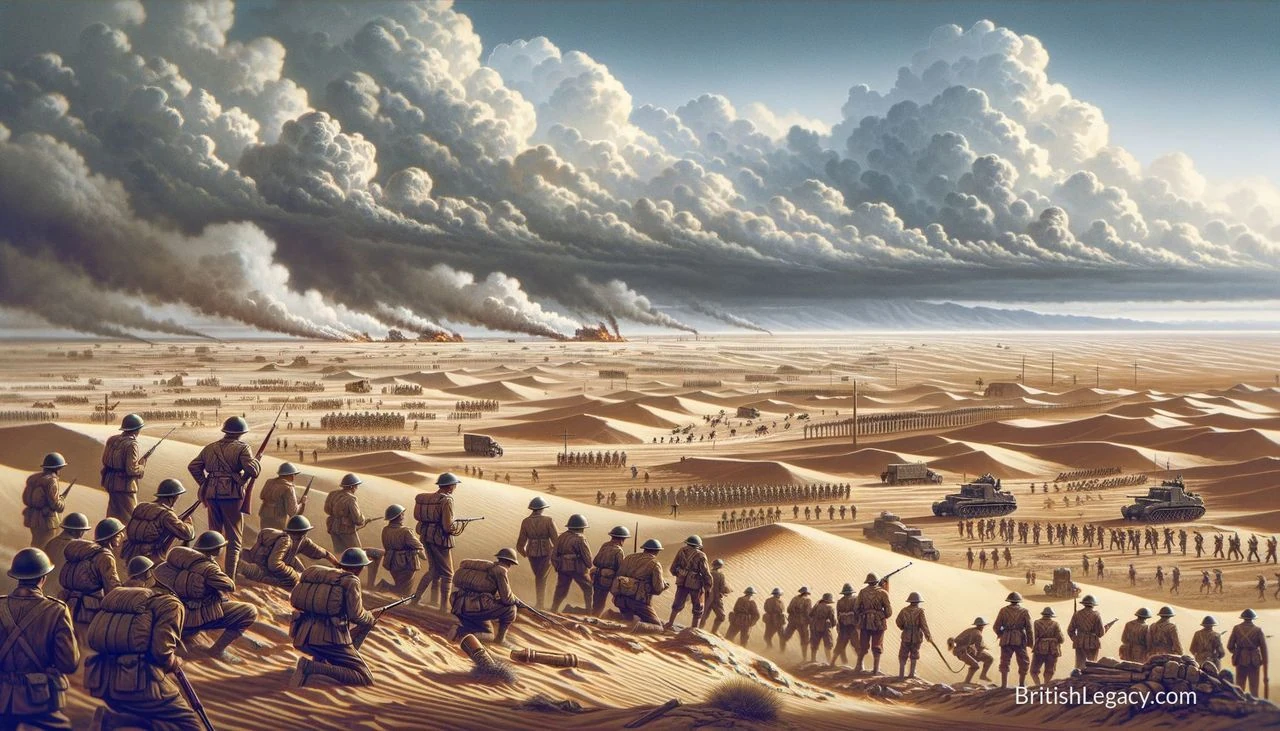
The Battle of El Alamein was fought in North Africa during the Second World War. The British-led Eighth Army opened its offensive on the night of 23 October 1942 with an artillery barrage against Axis defences. Tanks and infantry advanced as engineers worked to clear minefields. By 4 November, the forces commanded by German General Erwin Rommel were retreating.
A struggle in North Africa
By 1942, the North African campaign had become a contest for control of a strategically important region. Axis forces under Rommel had advanced, while British forces faced the task of stemming that progress and holding their position. The fighting took place in desert conditions, which challenged both sides as they contended for ground.
In the summer of 1942, Bernard Montgomery took command of the Eighth Army. The account of the battle places his appointment before a change in British preparations: Montgomery brought an emphasis on planning and discipline ahead of the offensive. The eventual attack required several kinds of action to work together. Artillery opened the assault; infantry and tanks moved towards the defensive lines; engineers cleared routes through minefields.
Operation Lightfoot and the advance
The offensive, known as Operation Lightfoot, began on the night of 23 October. The first artillery barrage signalled the start of the attack. Its initial purpose was to breach the Axis defensive positions and make a passage for further operations. The advance did not settle the battle at once: fighting continued over the ensuing days as the opposing forces faced one another in difficult desert conditions.
On 4 November, Rommel’s forces withdrew. The outcome is described as a major Allied victory in the North African campaign. The British account also presents it as the beginning of a sequence that would eventually lead to the expulsion of Axis forces from the region. That larger campaign outcome extended beyond the fighting at El Alamein itself; the battle’s defining events here are the opening assault, the effort to break the defences and the retreat in early November.
Victory, reputation and remembrance
The victory was associated with a strengthening of Allied morale. Winston Churchill is attributed the words: “Before Alamein we never had a victory. After Alamein we never had a defeat.” The quotation expresses the place El Alamein came to occupy in accounts of the war, though it should not be read as a literal record of every Allied engagement. The battle is also presented as a demonstration of the importance of co-ordinating land, air and sea operations, an approach that would feature in later Allied campaigns.
In British military memory, El Alamein stands for the service and sacrifice of those who fought. It has been commemorated in books, documentaries and memorials. The battle also helped restore the reputation of the British Army after earlier setbacks in North Africa, while Montgomery’s leadership became closely associated with the victory. Its place in the campaign is significant, but the battle should not be made to stand alone for the entire course of the war: its importance lies in the specific defeat of Axis forces at El Alamein and the change in momentum that the account associates with it.
Why the Battle of El Alamein deserves a place in British Legacy
El Alamein belongs in British history because the Eighth Army’s offensive was a major British-led operation in the Second World War’s North African campaign. Its chronology is clear: Montgomery took command in the summer of 1942; Operation Lightfoot began with an artillery barrage on 23 October; and Rommel’s forces were retreating by 4 November. The advance also depended on distinct, co-ordinated tasks, from infantry and tanks moving towards the Axis lines to engineers clearing minefields. Remembering those elements makes the account more meaningful than a simple declaration of victory.
The battle’s significance also lies in how it was remembered. The victory was linked to Allied morale and to renewed standing for the British Army after setbacks, while Montgomery’s command became part of its public story. Commemorations in books, documentaries and memorials keep the fighting and its human cost in view. El Alamein therefore merits a place in British Legacy not as a claim that one battle decided the whole war, but as a substantial engagement in which British forces halted an Axis advance, undertook a difficult offensive and helped shape the subsequent campaign in North Africa.