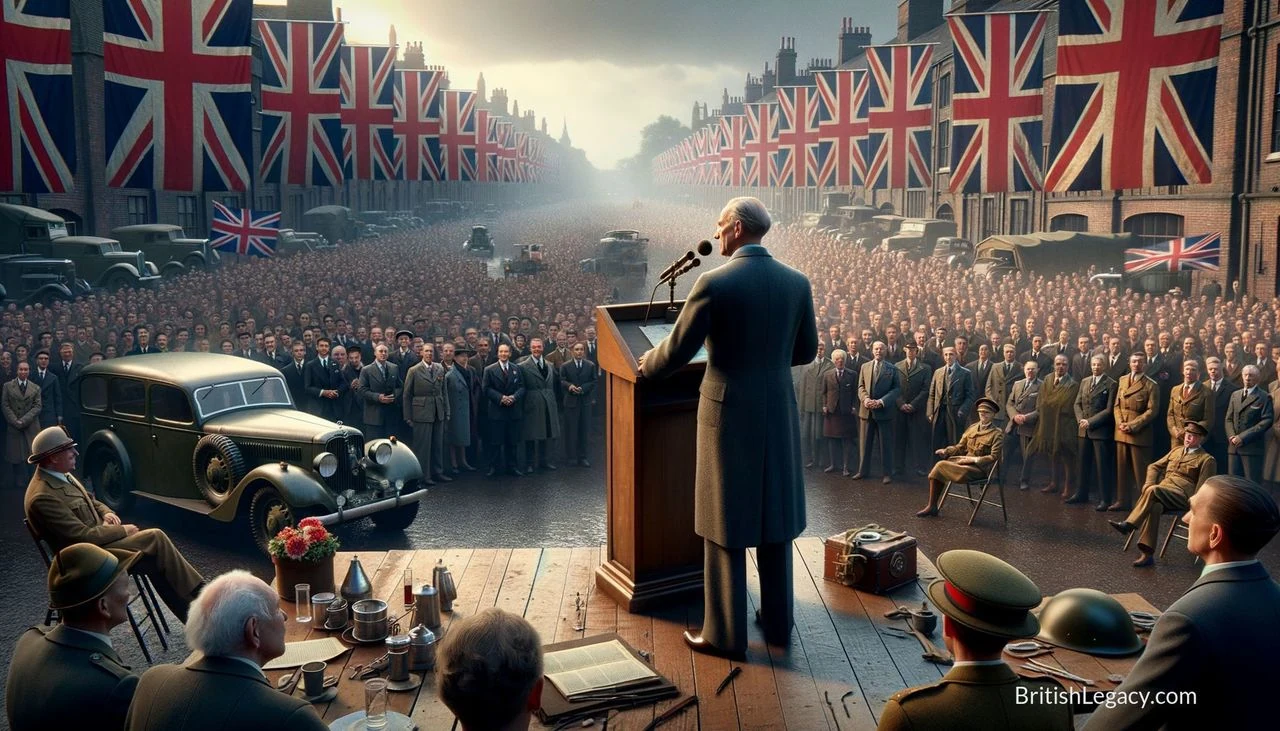
Winston Churchill’s place in British history was forged in war, but his career cannot be reduced to a handful of defiant speeches. He served as prime minister from 1940 to 1945 and again from 1951 to 1955, after decades in Parliament and government. He was also a soldier, journalist, historian and painter. His record includes social reforms and warnings about Nazi Germany, as well as decisions and imperial views that remain contested. The combination makes his life a story not just of leadership, but of the responsibilities and consequences of political power.
An aristocratic upbringing and a soldier’s start
Churchill was born at Blenheim Palace in Oxfordshire on 30 November 1874. His father, Lord Randolph Churchill, was a Conservative politician; his mother, Jennie Jerome, was American. He attended Harrow and the Royal Military College at Sandhurst, entering the British Army in 1895. His early service took him to India and Sudan, and he also travelled to Cuba. As a young officer, he wrote newspaper reports from conflict zones, turning military experience into a parallel career as a journalist and author.
In 1899 he went to South Africa as a correspondent during the Second Boer War. Captured after an armoured train was attacked, he escaped from a prisoner-of-war camp in Pretoria. The episode brought him public attention; after returning to Britain, he was elected Conservative MP for Oldham in 1900. His entry into politics was followed by a striking change of party: he crossed to the Liberals in 1904, then returned to the Conservatives in 1924.
Churchill’s ministerial career began in the Liberal government. He held posts including president of the Board of Trade and Home Secretary, and supported measures involving labour exchanges, minimum wages and prison reform. As First Lord of the Admiralty from 1911, he worked on naval preparedness. The 1915 Dardanelles campaign, which he had advocated, ended in failure and damaged his standing. He resigned from the government and served on the Western Front before returning to ministerial office in 1917. His later roles included Minister of Munitions, Secretary of State for War and Air, and Colonial Secretary.
Warnings before war
Out of government for much of the 1930s, Churchill repeatedly argued that Britain should rearm as Nazi Germany grew more powerful. He opposed appeasement and called for collective action to deter German expansion. His warnings did not make him universally popular, but the German occupation of Czechoslovakia in 1939 increased support for his position. When Britain declared war in September that year, Neville Chamberlain appointed him First Lord of the Admiralty.
After the Allies’ failure in Norway and the German invasion of Belgium, Luxembourg and the Netherlands in May 1940, Chamberlain resigned. Churchill became prime minister on 10 May and formed a coalition government that included leading Labour figures. His first speech as prime minister, delivered to the House of Commons on 13 May, promised “blood, toil, tears and sweat”. The words did not make the military situation less dangerous; they made clear that his government intended to continue the fight.
Leading Britain through the Second World War
The evacuation of Allied troops from Dunkirk ended in early June 1940. In his speech to the Commons on 4 June, Churchill set out the determination to resist, using the words “we shall fight on the beaches”. On 18 June, as France’s defeat left Britain facing the prospect of invasion, he warned that the Battle of Britain was about to begin and ended with the phrase “their finest hour”. On 20 August, he paid tribute to RAF airmen: “Never in the field of human conflict was so much owed by so many to so few.” These addresses helped define the public language of the crisis, but they were part of a wider effort involving government, the armed forces and the population.
Britain faced severe danger in 1940, but it was not alone throughout the war: it fought as part of an Allied coalition, whose membership and military contribution changed over time. Churchill cultivated the relationship with US President Franklin D. Roosevelt, and the two countries issued the Atlantic Charter in 1941. After Germany invaded the Soviet Union that June, Churchill backed the Soviet Union against the common enemy despite his longstanding opposition to communism. The United States entered the war after Japan attacked Pearl Harbor in December 1941. Churchill’s work with Roosevelt and Soviet leader Joseph Stalin helped coordinate the Allied effort, though their wartime partnership did not remove disagreements over strategy or the post-war settlement.
Churchill’s wartime leadership included decisions that have drawn serious scrutiny. The Bengal famine of 1943 caused millions of deaths; the effects of British policy on the death toll remain controversial. In 1945, he later expressed concern about the area bombing of Dresden and called for greater concentration on military objectives. Those episodes sit alongside his speeches and his role in the Allied victory, and are necessary to a fuller account of his premiership.
Defeat at the polls, return to office
Germany surrendered in May 1945. Churchill led the Conservatives into the July general election, but Labour won a landslide and Clement Attlee became prime minister. Churchill remained leader of the opposition. In a 1946 speech in the United States, he described an “iron curtain” dividing Europe and urged closer co-operation among democracies. He also advocated European unity, while initially insisting that Britain should not join a federal grouping.
The Conservatives returned to power in 1951, and Churchill became prime minister for a second time. Domestic policy included a major housebuilding programme: the government’s target was 300,000 new homes a year, and it achieved that goal. Foreign affairs and Britain’s relationship with the United States occupied much of his second term. He remained attached to the British Empire even as its power and reach were changing. Churchill resigned in April 1955, aged 80, and continued as an MP until 1964.
Writer, public figure and contested inheritance
Writing was not a sideline to Churchill’s public life. He published campaign reports, biographies, histories and memoirs, including the six-volume The Second World War and the four-volume A History of the English-Speaking Peoples. In 1953 he received the Nobel Prize in Literature. He also painted hundreds of pictures, often using the name Charles Morin, and spent time building walls and other structures at Chartwell, his home in Kent.
Churchill died at his London home on 24 January 1965, aged 90. He was given a state funeral, with his coffin lying in state at Westminster Hall before the service at St Paul’s Cathedral. He was buried at St Martin’s Church, Bladon, near Blenheim Palace. In London, his statue stands in Parliament Square, and the Cabinet War Rooms are now known as the Churchill War Rooms. Churchill College, Cambridge, was established as a national memorial.
His reputation also carries the weight of his imperialism and racial views. Churchill consistently defended the British Empire and opposed self-government in the colonies. His views and some of his comments about race have drawn criticism, as have particular wartime decisions. That criticism does not erase his part in resisting Nazi Germany, but it does challenge any uncomplicated portrait of him as a universal emblem of liberty. His record is best understood through both the achievements and the harms associated with his choices.
Why Winston Churchill deserves a place in British Legacy
Churchill deserves a place in British Legacy because his public career left a substantial mark on the country’s political and cultural history. As prime minister during the Second World War, he led a coalition government through the period when Britain faced the prospect of invasion and continued the struggle as part of the Allied war effort. His speeches gave memorable expression to that resistance, while his relationships with Roosevelt and Stalin helped shape the alliance that defeated Nazi Germany. Those achievements mattered not only in Parliament or diplomacy: they formed part of the national experience of war and its remembrance.
His place in British history also rests on work beyond the premiership. As a minister, he supported reforms concerning labour and prisons; as a writer, he produced histories and memoirs that earned the Nobel Prize in Literature; and as an opposition leader, he helped bring the phrase “iron curtain” into public discussion of post-war Europe. Yet a British legacy should be examined rather than simply celebrated. Churchill’s defence of empire and his record on decisions such as Bengal famine policy are part of the same history as his wartime leadership. Keeping both in view offers readers a more useful inheritance: an understanding of how political courage, power and responsibility can coexist, and why historical figures must be judged in the round.
Sources
Winston Churchill — Wikipedia, revision 1378790280 · Winston Churchill — Wikipedia
Adapted in part from Winston Churchill by Wikipedia contributors, under CC BY-SA 4.0. Text has been edited and combined with the existing article; this adapted text is shared under the same licence. Contributor history.