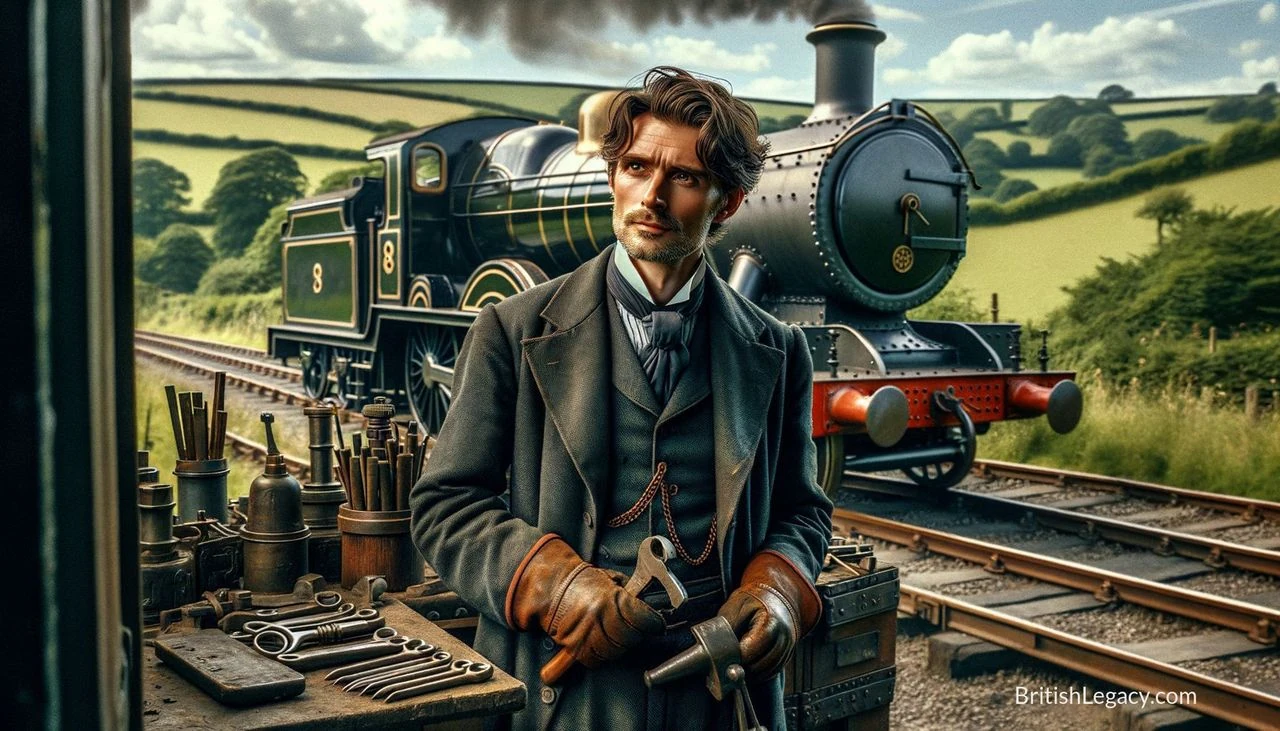
George Stephenson’s work began among the machinery of the coalfields, where he learnt to maintain engines and solve problems with the equipment to hand. It led to railways that carried passengers and goods by steam, and to a track gauge later adopted across much of the world. Known as the “Father of Railways”, he was not the only engineer to develop the locomotive. His particular contribution was to turn experience in the mining districts of north-east England into practical designs and railway routes that others could build upon.
Learning the work in the coalfields
Stephenson was born on 9 June 1781 in Wylam, Northumberland, west of Newcastle upon Tyne. His father, Robert, worked as a fireman at Wylam Colliery’s pumping engine; neither parent could read or write, and the family could not afford to send George to school. He began work in the pits and, at 17, became an engineman at Water Row Pit in Newburn. He paid for evening lessons in reading, writing and arithmetic, having remained illiterate until the age of 18.
In 1801 he became a brakesman at Black Callerton Colliery, controlling the winding gear. He later worked at Killingworth, where he advanced from brakesman to enginewright, responsible for the maintenance and repair of the colliery’s engines. In 1811, after improving a malfunctioning pumping engine at High Pit, he was promoted to the post. This practical command of steam-driven machinery formed the basis of his engineering career.
His work also brought him into contact with the dangers of mining. In 1815, Stephenson began developing a safety lamp that could burn in a gaseous atmosphere without setting off an explosion. He devised a lamp in which air entered through small holes that the flame could not pass through. At almost the same time, the scientist Humphry Davy was developing a different lamp. Their rival claims became contentious: a local inquiry supported Stephenson’s independent work, and a House of Commons committee in 1833 found that he had an equal claim to the invention. The dispute is part of his story as an engineer working outside the established scientific elite, not a reason to treat the competing designs as identical.
Locomotives, rails and routes
Stephenson designed his first locomotive in 1814 for the Killingworth wagonway. Named Blücher, it hauled coal and demonstrated the potential of locomotive traction on rails. The engines were heavy for the track available, so the work involved more than building a machine: engineers had to consider the rails, the distribution of weight and the line itself. Stephenson also worked with William Losh to improve cast-iron edge rails, which were prone to breaking under heavy loads.
In 1820, Stephenson was engaged to build the Hetton colliery railway. Opened in 1822, it combined locomotives with gravity on descending inclines and was the first railway to operate without animal power. The line reflected a recurring feature of his work: railway transport depended on a system of engines, track and gradients, rather than on the locomotive alone.
The Stockton and Darlington Railway, authorised in 1821, was initially planned for horse-drawn coal carts. After meeting its director Edward Pease, Stephenson persuaded the company to use steam locomotives. He surveyed the route with his son Robert, and the two were involved in the locomotive-manufacturing company Robert Stephenson and Company. Its first engine for the railway was originally named Active, then renamed Locomotion. On 27 September 1825, driven by George, it hauled a train carrying coal and flour; a passenger carriage was also attached for the opening journey. The event marked the beginning of passenger traffic on a railway worked by steam locomotive.
Stephenson chose a gauge of 4 feet 8½ inches for the Stockton and Darlington line. He recognised that separate railway routes might eventually connect and benefit from a common gauge. His choice became the standard gauge used by most of the world’s railways. It was a lasting infrastructure decision: unlike a locomotive, a track gauge shaped how later lines could join and operate with one another.
Rainhill and the Liverpool and Manchester line
The Liverpool and Manchester Railway tested Stephenson’s engineering on a larger scale. He argued that railways should be kept as level as possible, and the line required cuttings, embankments and viaducts. The route was altered after the original bill failed parliamentary scrutiny. One major obstacle on the revised alignment was Chat Moss, a peat bog that appeared incapable of supporting a railway. Stephenson’s solution was to spread a foundation of heather and branches over the bog, then build up the line on top.
As the railway neared completion, its directors held the Rainhill Trials in October 1829 to choose the locomotives for the line. Stephenson’s entry, Rocket, won the competition. Robert was responsible for its detailed design, while his father contributed suggestions through their correspondence. The design included a fire-tube boiler, an innovation associated in the account of its development with Henry Booth, treasurer of the railway. The Rocket’s success helped establish the locomotive’s reputation, but it was the result of engineering collaboration rather than the work of George alone.
The Liverpool and Manchester Railway opened on 15 September 1830. George drove Northumbrian in the opening procession, while Robert drove Phoenix; Rocket was driven by the assistant engineer Joseph Locke. The day was overshadowed by the death of MP William Huskisson, who was struck by Rocket and later died of his injuries. The railway nonetheless succeeded, and Stephenson became a prominent engineer for further railway projects.
Building a wider railway career
Stephenson moved to Leicestershire in 1830 to advise on the Leicester and Swannington Railway. He invested in the project and, recognising the coal potential of the adjoining Snibston estate, bought it. Mining there supplied coal to Leicester by rail, reducing the city’s reliance on canal-borne coal. He later moved to Tapton House in Derbyshire, where railway work and mining interests continued to occupy him.
He worked on a number of lines, including the North Midland, York and North Midland, Manchester and Leeds, and Birmingham and Derby railways. His preference for gentle gradients and routes with extensive civil engineering could make his plans more costly or circuitous than alternatives. On the proposed line between Lancaster and Carlisle, for instance, he favoured a longer route by the coast; Joseph Locke’s more direct route over Shap was built instead. Stephenson’s judgement was influential, but he did not prevail on every project, and disagreements with other engineers and railway boards marked his later career.
In 1847, he became the first president of the Institution of Mechanical Engineers. By then he was moving towards semi-retirement, overseeing mining interests in Derbyshire. He died at Tapton House on 12 August 1848, aged 67, and was buried at Holy Trinity Church in Chesterfield. His son Robert had also become a major railway engineer, extending the family’s place in the development of railway engineering.
Why George Stephenson deserves a place in British Legacy
Stephenson’s place in British history rests on a connected body of practical work, not on the claim that he invented the railway single-handedly. From the Killingworth locomotive and the Hetton line to the Stockton and Darlington and Liverpool and Manchester railways, he helped demonstrate how engines, rails, gradients and civil engineering could be combined into working transport systems. His solutions addressed the physical difficulties of railway construction, including fragile track and the unstable ground at Chat Moss. They helped move railways beyond isolated experiments and colliery use towards public routes carrying passengers and goods.
The gauge he chose for Stockton and Darlington became standard across much of the world, making compatibility between lines part of his legacy as well as locomotive development. Railways built in Britain connected coalfields, towns and ports, supporting the movement of raw materials and manufactured goods during the Industrial Revolution. Stephenson’s influence also reached beyond his own projects: he worked on numerous lines, and his son Robert became a leading engineer in his own right. Remembering George Stephenson in British Legacy means recognising both the material benefits of railway transport and the collaborative, sometimes disputed engineering that made it possible. His career also shows how a working knowledge of machinery, combined with continued learning, could shape infrastructure on a national and international scale.
Sources
George Stephenson — Wikipedia, revision 1377781242
Adapted in part from George Stephenson by Wikipedia contributors, under CC BY-SA 4.0. Text has been edited and combined with the existing article; this adapted text is shared under the same licence. Contributor history.