
Katharine Hamnett made the slogan T-shirt more than a fashion statement. In 1984, she used one to put opposition to nuclear missiles in front of Margaret Thatcher and the press. The image became the best-known expression of a career in which design and political communication repeatedly met: from the shirts adopted by pop stars to later campaigns on war, nuclear disarmament and the conditions under which clothes are made.
Training and an independent label
Born Katharine Eleanor Appleton in Gravesend, Kent, on 16 August 1947, Hamnett attended Cheltenham Ladies’ College and studied at Saint Martin’s School of Art. She began her fashion career by setting up the label Tuttabankem with Anne Buck in 1969. From 1975, she worked as a freelance designer in London and other international fashion centres, including Paris, Milan, New York and Hong Kong. In 1979 she founded her own clothes label, Katharine E. Hamnett.
Oversized T-shirts printed with large, block-letter slogans followed in 1983. Their directness suited a garment that could be seen at a distance and worn beyond the runway. “CHOOSE LIFE”, Hamnett’s first slogan shirt, was inspired by a Buddhist exhibit and intended as a comment against war, death and destruction. She later objected to anti-abortion activists in the United States appropriating the phrase, explaining that it was not designed to represent their position.
The shirts reached a mass audience through music and popular culture. George Michael wore “CHOOSE LIFE” in the video for Wham!’s “Wake Me Up Before You Go-Go”; Roger Taylor wore Hamnett’s “WORLDWIDE NUCLEAR BAN NOW” shirt in Queen’s “Hammer to Fall” video and at the first Rock in Rio festival. The format also influenced other slogan T-shirts: Paul Morley has said that his “FRANKIE SAY...” designs for Frankie Goes to Hollywood were consciously based on Hamnett’s work.
A message at Downing Street
Hamnett’s most famous political intervention came at a Downing Street reception marking the first London Fashion Week in 1984. She anticipated the opportunity to meet Thatcher and made a shirt reading “58% DON’T WANT PERSHING”, referring to opposition in the United Kingdom to the stationing of American Pershing II missiles in Europe. At the reception, she opened her jacket as she shook the prime minister’s hand, revealing the slogan to the photographers.
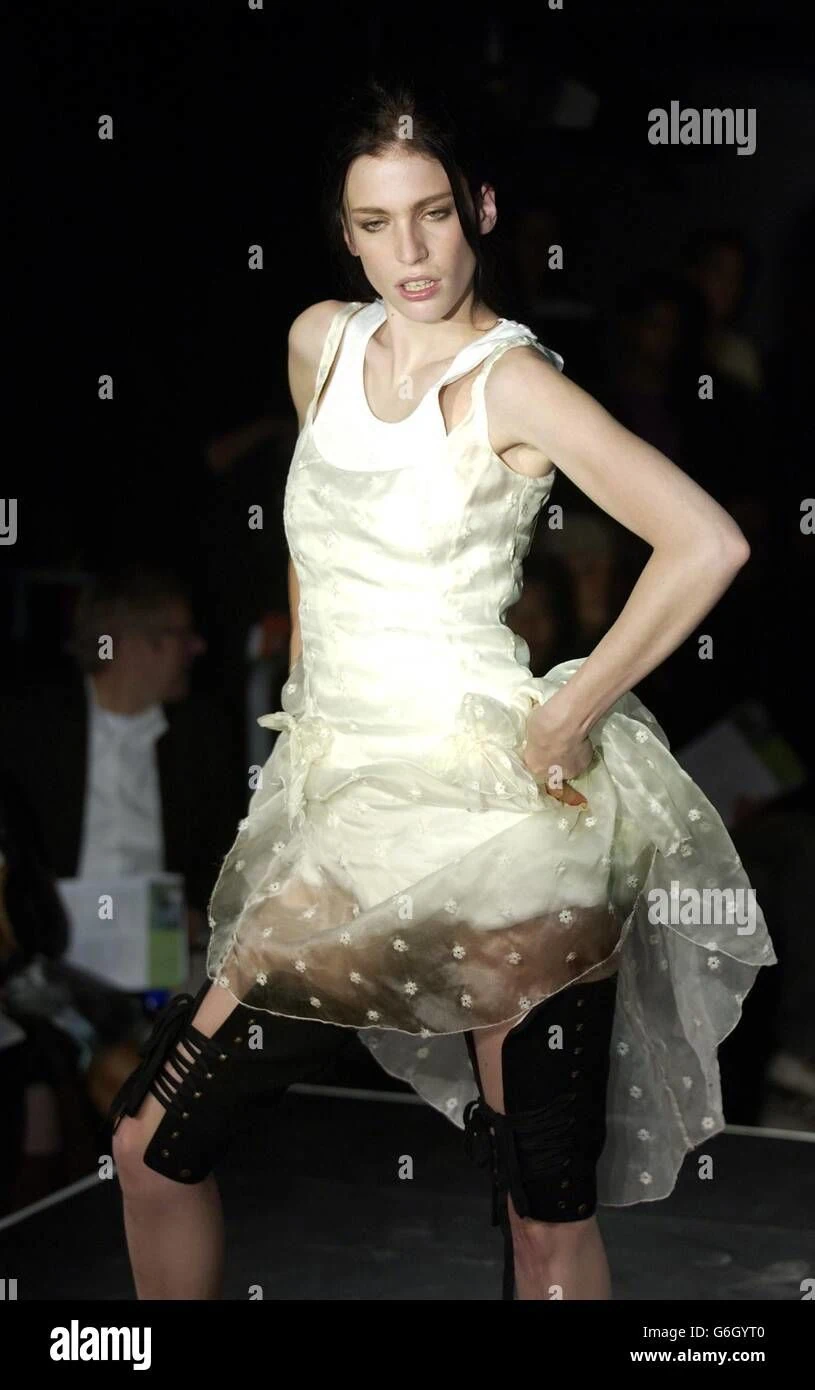
The shirt was designed for visibility and for the moment it would be photographed. Hamnett later said its typeface came from The Sun. The exchange brought a fashion designer’s protest into news coverage, but her activism continued well beyond that encounter. In 2003, models at a London fashion show wore “STOP WAR, BLAIR OUT” shirts in opposition to the looming invasion of Iraq. In 2013, Hamnett designed “EDUCATION NOT TRIDENT” and “NHS NOT TRIDENT” shirts for the Campaign for Nuclear Disarmament and joined its Easter demonstration at Aldermaston.
Her political designs also addressed other causes. In 2015, she created a “CHOOSE LOVE” shirt for the charity Help Refugees, now known as Choose Love. Her messages worked by compressing a position into a few conspicuous words, carrying it from the studio or catwalk into everyday public view.
From campaigning to production standards
Hamnett’s challenge to the fashion industry concerned not only what clothing said, but how it was made. From 1989, research into pesticide poisoning in cotton-growing regions and the prevalence of sweatshop labour in the textiles industry informed her efforts to press for changes. Disappointed with the results of existing arrangements, she ended most of her licensing deals. In 2005, she relaunched her line under stricter ethical guidelines covering manufacturing and agricultural practices.
That sequence gives substance to her later reputation as an advocate for more responsible fashion: she connected public criticism with decisions about her own business. It is distinct from claims that her work produced particular regulatory changes. The supplied account documents her lobbying and the changes she made to licensing and production standards, but does not establish that she secured specific government reforms.
Her activism sometimes involved direct interventions outside clothing. In 2014, she joined Nimrod Kamer in a stunt outside Hackney Town Hall aimed at persuading the borough’s mayor to ban the use of Monsanto’s Roundup weedkiller. Her public positions were not confined to a single cause or format; they ranged from anti-nuclear campaigning and opposition to war to labour and environmental concerns in the fashion supply chain.
Recognition, protest and a changing legacy
Hamnett received the first British Fashion Award and was voted Britain’s favourite designer by readers of Cosmopolitan in 1996. She was appointed a Commander of the Order of the British Empire (CBE) in the 2011 New Year Honours for services to the fashion industry. In February 2024, she relinquished the honour in protest at what she saw as the British government’s lack of action over the war in Gaza. She displayed a shirt reading “DISGUSTED TO BE BRITISH” and placed the CBE in a rubbish bin.
Her later political activity included endorsing Green Party candidate Caroline Lucas at the 2015 general election. In 2025, she announced that she had joined the Green Party and launched a T-shirt collaboration with its leader, Zack Polanski. These developments extend the relationship between her clothing and her campaigning: the garment remained both a commercial object and a means of making political positions visible.
Hamnett’s career has also included work beyond her own label. In 1984, she was involved in the founding of Tanya Sarne’s Ghost label. Her record is therefore not simply a sequence of provocative slogans. It encompasses fashion design, a business built under her own name, influence on the popular life of graphic T-shirts, and sustained efforts to change practices within the clothing industry.
Why Katharine Hamnett deserves a place in British Legacy
Katharine Hamnett’s place in British Legacy rests on the particular way she connected British fashion design with public argument. The “58% DON’T WANT PERSHING” shirt turned a meeting with the prime minister into a visible protest against nuclear missile deployment. Her slogan shirts travelled well beyond the fashion world: worn by performers such as George Michael and Roger Taylor, they carried messages into music videos, concerts and popular culture. That reach demonstrates how a designer could use a simple, reproducible form to give political language an everyday presence.
Her contribution also includes action on the industry behind the clothes. From 1989, she highlighted pesticide poisoning in cotton-growing regions and sweatshop labour, then ended most of her licensing arrangements and relaunched her line in 2005 under stricter guidelines for manufacturing and agriculture. Those choices offer a concrete account of ethical fashion as more than a brand claim: they connect criticism to the organisation of production. Her later campaigns, including work for nuclear disarmament and the 2015 “CHOOSE LOVE” shirt, show that she continued to use design as a vehicle for causes. Together, these achievements make her story relevant to British Legacy as an account of a British designer whose work joined commercial fashion, popular communication and political commitment.
Sources
Katharine Hamnett — Wikipedia revision 1375185418
Adapted in part from Katharine Hamnett by Wikipedia contributors, under CC BY-SA 4.0. Text has been edited and combined with the existing article; this adapted text is shared under the same licence. Contributor history.

.jpg)