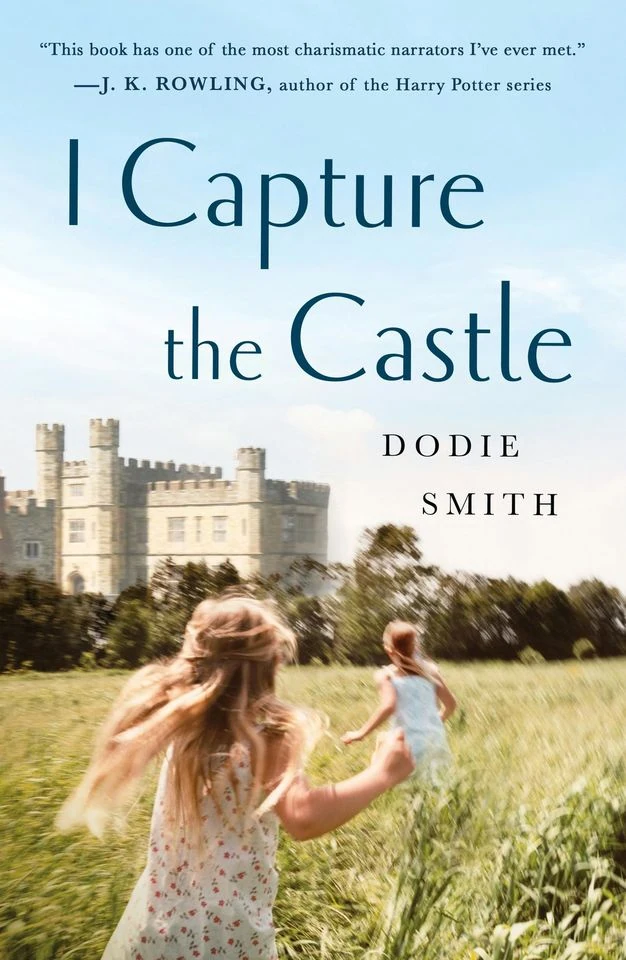
In Dodie Smith’s I Capture the Castle, seventeen-year-old Cassandra Mortmain tries to capture everything around her in a journal. Her family lives in a beautiful but decaying castle, short of money and increasingly forced to sell its furniture. Cassandra’s father, James, once made his name as a novelist; now he has not written for years. When two wealthy American brothers arrive as the family’s new landlords, money, love and ambition begin to pull the Mortmains in different directions. Published in 1948, Smith’s first novel turns this family’s predicament into an intimate coming-of-age story, told in Cassandra’s observant voice.
A castle, a journal and a family in need
The novel is set in Suffolk and London during the 1930s. Its story unfolds between April and October of a single year, chiefly through Cassandra’s first-person journal. She is an aspiring writer, intent on recording the events and feelings of daily life. That method makes her more than a guide to the plot: her hopes and misunderstandings shape what the reader sees, while the act of writing becomes part of her attempt to make sense of change.
Ten years before the story begins, James Mortmain took a forty-year repairing lease on the castle, hoping its surroundings would cure his writer’s block. His first book, Jacob Wrestling, was an innovative and difficult modernist novel that brought him an international reputation. The family has since relied on its royalties, which are dwindling. By the time Cassandra writes, they are selling furniture to buy food.
James’s family includes his second wife, Topaz, an artist’s model; his daughters Rose and Cassandra; and his son Thomas. Rose, twenty-one, hopes to marry a rich, handsome man and escape their poverty. Cassandra is seventeen and keeps her journal; Thomas, fifteen, has won a scholarship to a good school. Stephen Colley, eighteen, is the son of the Mortmains’ late maid and works for the family. Unpaid by them, he hires himself out to a local farmer to help support the household. Their different ages, prospects and resources give the family’s financial strain a daily, personal scale.
The Cotton brothers and the changing household
The Mortmains’ new landlords are Neil and Simon Cotton, two wealthy American brothers who have arrived at nearby Scoatney Hall. Neil, raised in California by his English father, wants to become a rancher in the United States. Simon, brought up in New England, is scholarly and serious, and admires the English countryside. As the elder brother, he is heir to the Cotton fortune.
The brothers are eager to meet James, whose book they admire, and are intrigued by the eccentric family. Their first visit goes badly: Rose flirts with Simon, hoping to secure the marriage that would rescue her from poverty, and the brothers decide to have no further dealings with the Mortmains. After an episode involving a fur coat, the breach is mended, and the families become friends. Topaz and Cassandra then set about helping Rose attract Simon; their plan succeeds, and Rose becomes engaged to him.
The shifting relationships expose the unequal weight of money in the family’s choices. Rose speaks openly of marriage as a route out of want, while Cassandra’s feelings become more complicated. When Rose and Topaz go to London with Mrs Cotton to buy Rose’s wedding clothes, Cassandra and Simon spend an evening together and kiss. Cassandra becomes preoccupied with him, and her affection is tangled with guilt because he is engaged to her sister. Rose’s letters describe the luxuries of London but say little about Simon, sharpening Cassandra’s doubts about the match.
First love and an open ending
Stephen sees that Cassandra is unhappy and offers to marry her. She refuses because she does not love him, but encourages him as he begins to find work as a model and film actor. Meanwhile, Cassandra and Thomas try to break their father’s writer’s block by imprisoning him in a medieval tower. Their drastic plan belongs to the novel’s eccentric domestic comedy, but it also reflects how closely the family’s hopes remain tied to James’s ability to write.
Rose and Neil have meanwhile fallen in love, a development Stephen notices before the others. The pair elope, leaving Simon heartbroken. Before Simon returns to the United States, he visits Cassandra. She stops a conversation at a moment when she thinks he may be about to propose, believing that he is still in love with Rose. The ending remains unresolved: Simon has promised to return, and Cassandra closes her journal by reaffirming her love for him. Her choice to stop writing gives the novel a conclusion without settling what will happen next.
Writing from away, remembering England
Smith wrote I Capture the Castle during the Second World War after she and her husband, Alec Beesley, moved from England to Pennsylvania. Beesley was a conscientious objector. Smith was already an established playwright; this was her first novel, written before she became famous for the children’s book The Hundred and One Dalmatians. The novel’s account of English countryside life was thus written while she and her husband were living in the United States, but the supplied evidence does not establish that homesickness alone explains the setting or the book’s creation.
The story’s English locations and its attention to the material circumstances of the Mortmains are central to its character. The family’s castle suggests beauty and inherited status, yet its decay and their dwindling income make those appearances precarious. The Cotton brothers’ wealth offers a sharp contrast, but it does not make the Mortmains’ emotional lives any simpler. Through Cassandra’s journal, social position, money and love are experienced together, as part of the same household story.
Smith adapted the novel as a two-act play with musical notes in 1954. A planned Walt Disney film with Hayley Mills as Cassandra was announced in 1963 but did not proceed. After legal manoeuvring in the late 1990s, the story reached the screen in a 2003 BBC Films production directed by Tim Fywell. Later adaptations included a BBC Radio 4 dramatisation broadcast in 2015 and a staged musical premiere at Watford Palace Theatre in 2017. The novel was listed at number 82 in the BBC’s 2003 The Big Read survey and appeared on BBC News’s 2019 list of 100 most inspiring novels. Author Armistead Maupin cited it as an influence on his diary-structured novel Maybe the Moon.
Why I Capture the Castle deserves a place in British Legacy
I Capture the Castle merits a place in British Legacy because it gives the pressures of class and poverty a particular English setting and a close, human point of view. The Mortmains occupy a castle but cannot rely on its grandeur: their income is dwindling, and they sell furniture to buy food. James’s literary reputation has not restored the family’s security. Across from them are the Cotton brothers, whose wealth opens possibilities that the Mortmains cannot take for granted. These contrasts make status and money more than background detail; they shape Rose’s hopes, Cassandra’s dilemmas and the family’s everyday life.
The novel’s form matters too. Cassandra records her changing feelings and the people around her in a journal, so its coming-of-age story is built from observation, uncertainty and the decision to keep writing. The unresolved ending leaves her future open rather than making maturity a neat arrival. Smith’s story has also travelled beyond the novel: it was adapted for stage, film, radio and musical theatre, and was recognised in BBC listings. Its British connection rests not on a general claim about national character, but on its English setting, its attentive depiction of a family living with scarce resources, and the life its story has found in British cultural adaptations and recognition.
Sources
I Capture the Castle — revision 1372087508
Adapted in part from I Capture the Castle by Wikipedia contributors, under CC BY-SA 4.0. Text has been edited and combined with the existing article; this adapted text is shared under the same licence. Contributor history.