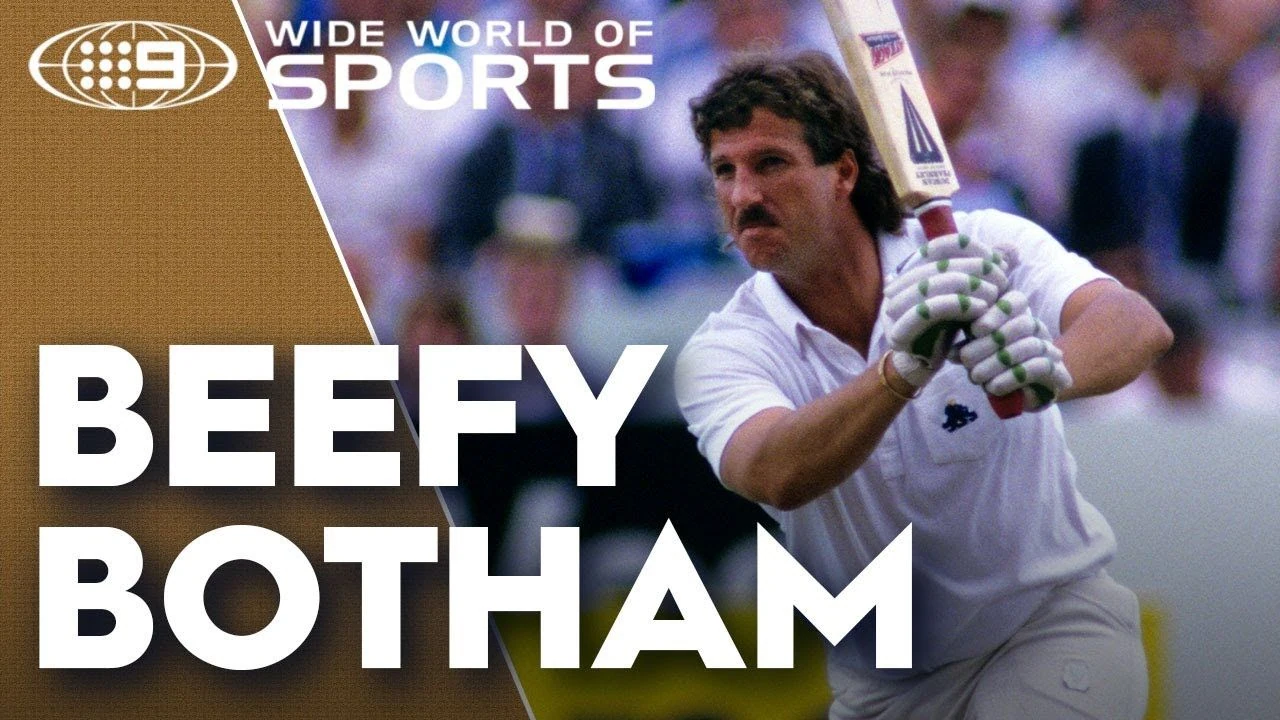
Ian Botham’s defining Test innings began with England facing defeat. At Headingley in 1981, after Australia had built a substantial lead, England followed on and slipped to 135 for seven. Botham, still at the crease as the recognised batting ran out, made 149 not out. England went on to win by 18 runs, with Bob Willis taking eight wickets in Australia’s second innings. The result became the defining episode of a career in which batting, fast-medium bowling and an appetite for changing a match made Botham one of England’s most prominent all-rounders.
A sporting choice, and a place in Somerset’s side
Born in Heswall, Cheshire, on 24 November 1955, Ian Terence Botham grew up in Yeovil after his family moved there before his third birthday. Both his parents played cricket, and he was drawn to the game early. At school he played cricket and football; as a teenager he had to choose between a possible football apprenticeship and a cricket career. He chose cricket, joining the ground staff at Lord’s in 1972 while Somerset retained his contract.
His early progress was not immediate or inevitable. Botham spent time practising at Lord’s and playing for Somerset’s younger sides. Tom Cartwright, a former England cricketer and Somerset player, helped him learn the fundamentals of swing bowling. Botham made his senior debut for Somerset in 1973, aged 17, and became a regular in the county side the following season. His first-class career began in May 1974; a month later, after being struck in the mouth by a bouncer and losing four teeth, he stayed at the crease to help Somerset win a close one-day cup match against Hampshire.
In 1976, his first first-class century and a season of more than 1,000 runs helped bring selection for England’s one-day side. He made his international one-day debut against the West Indies that August. The following summer, in his Test debut against Australia at Trent Bridge, he took five wickets in the first innings. The match was the start of a 102-Test career that brought 5,200 runs and 383 wickets.
England’s all-rounder
Botham’s role depended on doing more than one job. A right-handed batter and right-arm fast-medium bowler, he could take wickets through swing and changes of pace, while his batting ranged from patient support to forceful attacks. In 1980, against India in Bombay, he became the first player to score a century and take ten wickets in a Test match: he made 114, then finished with match figures of 13 for 106. The performance captured the unusual scale of what he could contribute in both disciplines.
His record extended well beyond Tests. He played 116 one-day internationals, scoring 2,113 runs and taking 145 wickets. He also represented England at three Cricket World Cups: the team lost the 1979 and 1992 finals and reached the semi-final in 1983. Botham’s first-class career included Somerset, Worcestershire and Durham, as well as a season with Queensland in Australia.
His international career had difficult periods as well as its celebrated peaks. Botham captained England in 12 Tests in 1980 and 1981, without a victory, and his form suffered. He resigned after the second Test against Australia in 1981; Mike Brearley returned as captain before the Headingley match. Botham’s subsequent performances in that series turned a poor start into an extraordinary recovery. At Edgbaston, he took five wickets for one run in 28 balls as England beat Australia by 29 runs. At Old Trafford he scored 118, and England won the series 3–1. Botham was named player of the series after scoring 399 runs, taking 34 wickets and holding 12 catches.
He later held the world record for the most Test wickets, from 1986 until Richard Hadlee passed his total in 1988. Botham’s final Test was against Pakistan in 1992; he retired from cricket during the following season, with his last match for Durham against Australia in July 1993. In 2009, he was inducted into the ICC Cricket Hall of Fame.
County cricket, football and broadcasting
Botham’s county years included major team successes. Somerset won the Gillette Cup and Sunday League in 1979, and the Benson & Hedges Cup in 1981 and 1982. With Botham as captain, the county won the NatWest Trophy in 1983. After leaving Somerset, he joined Worcestershire, helping the club win the County Championship in 1988 and 1989 and the Sunday League in 1987. He joined Durham in 1992, the year the county entered the County Championship.
Cricket was not his only sport. Botham played football as a centre-half for Yeovil Town and Scunthorpe United between 1978 and 1985, making 11 Football League appearances for Scunthorpe. After retiring from cricket, he became a broadcaster and worked for Sky Sports as an analyst and commentator. The public profile built on his playing career continued through television and his writing about cricket.
Fundraising beyond the boundary
Botham’s charity work grew from an encounter during his early career. In 1977, while receiving treatment for a broken toe in Taunton, he took a wrong turn at the hospital and reached a children’s ward. The experience prompted a lasting commitment to raising money for leukaemia research. In 1985 he undertook his first long-distance charity walk, a 900-mile journey from John o’ Groats to Land’s End. Over 12 walks, he raised more than £12 million for charitable causes, with blood cancer research a principal beneficiary.
In 2003, Botham became the first president of Bloodwise, a UK blood cancer charity. His public fundraising also extended to other causes: in 2014 he designed one of a series of Paddington Bear statues auctioned to raise money for the National Society for the Prevention of Cruelty to Children. These projects gave his public presence a purpose separate from sport: a familiar figure could draw attention and donations to causes that had first affected him through personal experience.
Honours and public service
Botham was appointed an Officer of the Order of the British Empire in 1992 for services to cricket and charity. He was knighted in 2007 for services to charity and cricket. The honours recognised both the sporting record and the fundraising that had become a major part of his work after retirement.
In 2020, he was created Baron Botham, of Ravensworth in North Yorkshire, and took his seat in the House of Lords. In 2021, he was appointed the UK’s Trade Envoy to Australia. These later roles followed a career whose public reach had already extended from county grounds and England tours to broadcasting and charitable campaigns.
Why Ian Botham deserves a place in British Legacy
Botham’s place in British sporting history rests first on what he achieved for England. His 102 Tests produced 5,200 runs and 383 wickets, but the figures alone cannot explain the reach of his career. In the 1981 Ashes, his 149 not out at Headingley helped give England a chance after a collapse; the team’s 18-run win, and its later 3–1 series victory, made that comeback a landmark in the contest with Australia. At Edgbaston he again helped turn a match through a concentrated spell of bowling, while his 1980 performance against India demonstrated that he could make a decisive contribution with bat and ball in the same Test. These are specific achievements, not simply a reputation for flair.
His legacy also includes work beyond the boundary. After the hospital visit that first brought him face to face with children affected by leukaemia, Botham raised more than £12 million through long-distance walks and other charity efforts. His presidency of Bloodwise connected that public fundraising to a continuing campaign for blood cancer research. His later recognition for services to cricket and charity reflects the two strands of his public life: sporting performance and practical fundraising. For British Legacy, Botham’s story shows how a prominent athlete could use the attention earned on the field to bring support to causes outside it, while leaving a record of defining performances in England’s national game.
Sources
Ian Botham — revision 1379198622 · Ian Botham
Adapted in part from Ian Botham by Wikipedia contributors, under CC BY-SA 4.0. Text has been edited and combined with the existing article; this adapted text is shared under the same licence. Contributor history.