
Ian Wright was 21 when he signed for semi-professional Greenwich Borough, and nearly 22 when Crystal Palace gave him his first professional contract. Within a few years, he was scoring in an FA Cup final; soon afterwards, he became Arsenal’s leading scorer. That route—from Sunday-league football to the top flight—was only the beginning of a career that would also make him a familiar voice and face on British television and radio.
A late start in professional football
Ian Edward Wright was born in Woolwich, London, on 3 November 1963, and grew up in Brockley. He played for the amateur Sunday-league side Ten-em-Bee from his teens until he was 21, becoming the league’s leading scorer. Trials at Southend United and Brighton & Hove Albion did not lead to professional offers. In 1985, Greenwich Borough signed him as a semi-professional, paying him £30 a week.
After a season at Greenwich, Wright was spotted by a Crystal Palace scout following a recommendation from Dulwich Hamlet manager Billy Smith. Palace manager Steve Coppell gave him a trial, then signed him to a professional contract in August 1985. He scored nine goals in his first season and soon formed a productive striking partnership with Mark Bright, who joined the club the following year.
The pair helped Palace win promotion to the top flight through the play-offs in 1989. Wright scored 24 Second Division goals that season and 33 in all competitions. A shin injury interrupted his first impact in the First Division, but he returned to prominence in the 1990 FA Cup final against Manchester United. Coming on as a substitute, he equalised and then put Palace ahead in extra time. The match ended 3–3; Palace lost the replay 1–0.
Wright reached 100 Palace goals as the club finished third in the top flight in 1990–91, its highest league position. He also scored twice in the club’s Full Members’ Cup win over Everton. Across six seasons, he scored 117 goals in 277 appearances in all competitions, becoming Palace’s record post-war goalscorer. The club later named him its Player of the Century.
Record-breaking years at Arsenal
Arsenal signed Wright in September 1991 for £2.5 million, then a club-record fee. He scored on his debut in a League Cup tie against Leicester City and followed it with a hat-trick on his league debut against Southampton. By the end of his first season, his 29 league goals for Arsenal and Palace had made him the top scorer in the top flight.
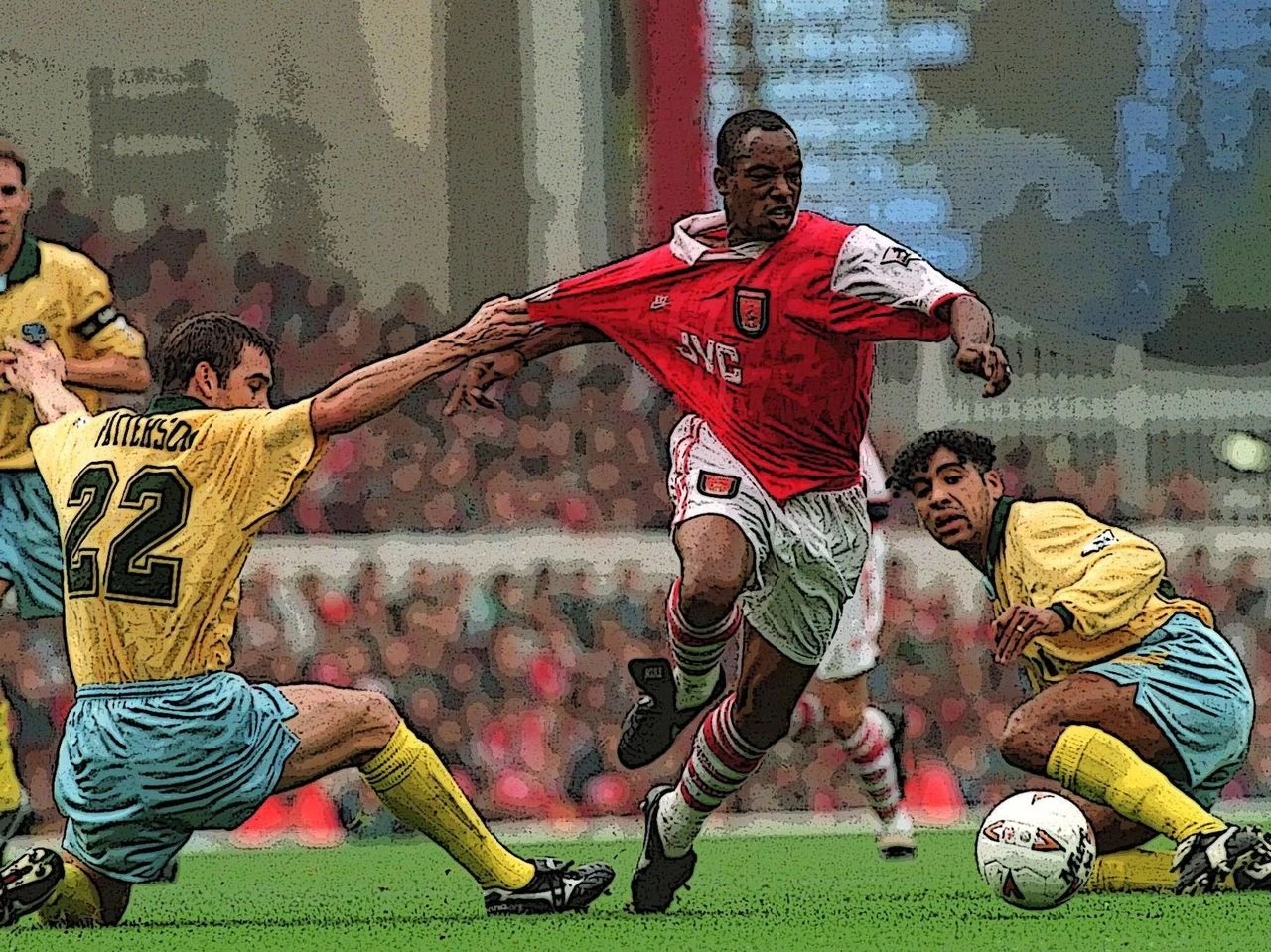
Wright became Arsenal’s leading scorer for six consecutive seasons. In 1993, he scored in both the FA Cup final and replay against Sheffield Wednesday as Arsenal completed a domestic cup double, winning the League Cup as well. He helped the club reach the 1994 European Cup Winners’ Cup final, but suspension kept him out of the match, which Arsenal won against Parma. He was also part of the side that won the Premier League and FA Cup double in 1997–98.
On 13 September 1997, Wright broke Cliff Bastin’s Arsenal scoring record with a hat-trick against Bolton Wanderers. He finished his Arsenal career with 185 goals in 288 appearances, including 11 hat-tricks. Thierry Henry passed his club record in 2005; Wright remains second in Arsenal’s all-time scoring list in the account used here. His scoring record combined with his speed, agility and finishing made him one of the defining forwards of the club’s 1990s teams.
After seven years at Arsenal, Wright moved to West Ham United in 1998. He later had short spells with Nottingham Forest, Celtic and Burnley, retiring from playing in 2000. His career took in clubs in England and Scotland, and the source account records 501 league appearances and 287 league goals across seven clubs. He also scored in his first matches for Nottingham Forest and Celtic.
England and life beyond the pitch
Wright made his England debut in February 1991, under manager Graham Taylor. He earned 33 caps and scored nine goals, but despite his club form was not selected for a major international tournament. He scored four times in England’s 7–1 World Cup qualifying win over San Marino in 1993, and later contributed to the team’s qualification campaign for the 1998 World Cup. An injury kept him out of the finals in France.
After retiring, Wright developed a broad broadcasting career. He presented television programmes including Friday Night’s All Wright and They Think It’s All Over, and worked as a football pundit on BBC, ITV and BT Sport coverage. He has also presented and co-presented radio programmes, including the BBC Radio 5 Live football phone-in 606. His role in football broadcasting extended his public presence well beyond the clubs for which he had played.
Wright’s work has included more than studio analysis. In 2009, he presented Football Behind Bars, a television series about a football programme for young men at Portland Young Offenders Institution. In March 2023, he announced that he would not appear on the next broadcast of Match of the Day in solidarity with Gary Lineker, who had stepped back from presenting amid a dispute over comments on government immigration policy. Wright made his final appearance on the programme in May 2024.
He has also written about football and his own life. His first autobiography, Mr Wright, appeared in 1996; an updated autobiography, A Life in Football, was published in 2016. In 2021, he co-wrote the young-adult novel Striking Out with Musa Okwonga. He was appointed MBE in the 2000 New Year Honours for services to football, inducted into the Premier League Hall of Fame in 2022, and appointed OBE in the 2023 Birthday Honours for services to football and charity. In 2023, he was made a Freeman of the City of London.
Why Ian Wright deserves a place in British Legacy
Wright’s playing career matters not simply for its goal totals, but for the distance between its starting point and its achievements. He moved from amateur Sunday-league football to a semi-professional contract, then earned his place at Crystal Palace and Arsenal through sustained scoring. At Palace, his partnership with Mark Bright helped take the club into the top flight, and his goals made him central to its 1990 FA Cup run. At Arsenal, he became the club’s record scorer and won major domestic honours, including the Premier League and FA Cup double. Those milestones connect his individual record to the fortunes of two London clubs and their supporters.
His later work in broadcasting gives that sporting legacy a wider British dimension. Through television and radio, Wright has continued to explain and discuss football for audiences well beyond the grounds where he played. His career also includes programmes that took football into a young offenders institution, and a public decision to stand with a fellow presenter during a dispute over political speech. The honours he received—from an MBE and OBE to the Premier League Hall of Fame—recognise different parts of that contribution. Wright’s story is therefore one of sporting achievement and lasting public engagement, built first on a late but remarkable arrival in professional football.
Sources
Ian Wright — revision 1379319129 · Ian Wright
Adapted in part from Ian Wright by Wikipedia contributors, under CC BY-SA 4.0. Text has been edited and combined with the existing article; this adapted text is shared under the same licence. Contributor history.
_(cropped).jpg)