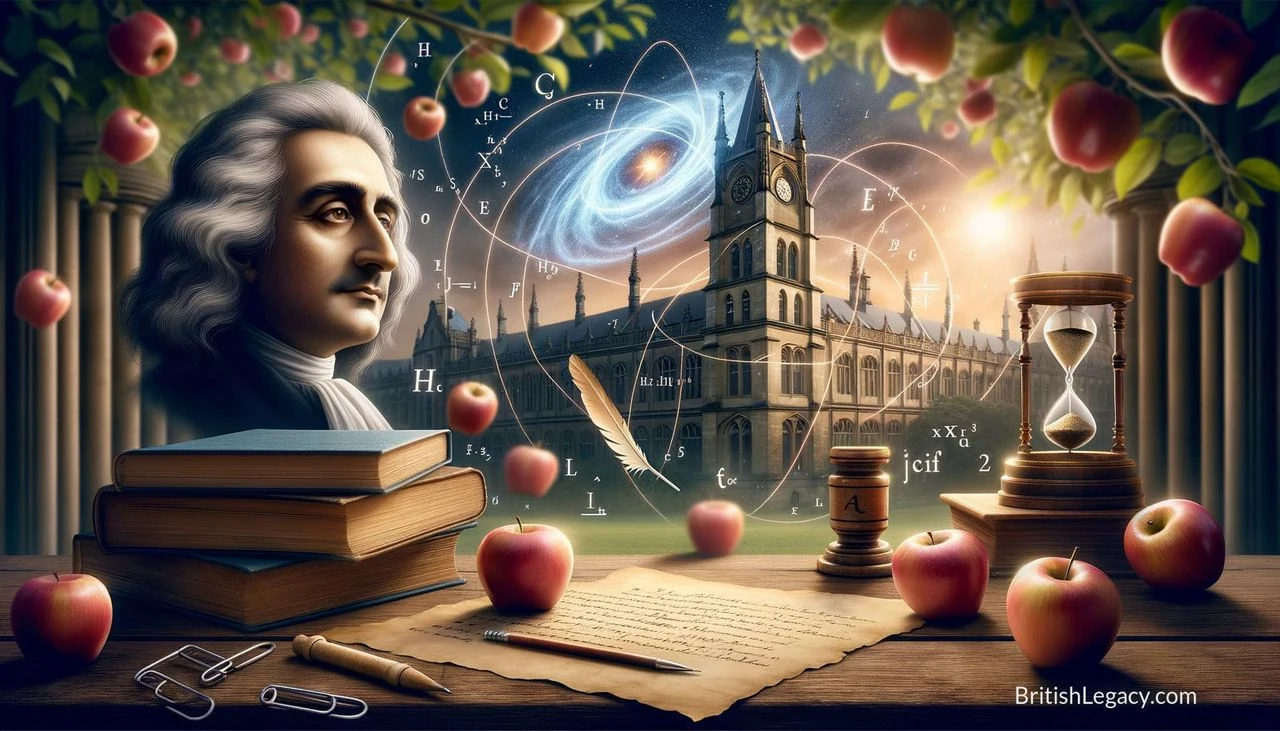
Isaac Newton’s ideas connected events that had seemed to belong to different worlds: an object falling on Earth, the Moon’s orbit and the paths of planets. In Philosophiæ Naturalis Principia Mathematica, published in 1687, he set out laws of motion and universal gravitation that offered a shared mathematical account of terrestrial and celestial movement. The work became a foundation of classical mechanics, while his experiments with light, contributions to calculus and later service at the Royal Mint show a thinker whose interests ranged far beyond one famous theory.
A Lincolnshire childhood and Cambridge beginnings
Newton was born at Woolsthorpe Manor in Lincolnshire on 25 December 1642, according to the Julian calendar then used in England. In the Gregorian calendar, the same day was 4 January 1643. His father had died before his birth. When Newton was three, his mother, Hannah Ayscough, remarried and left him in the care of his maternal grandmother, Margery Ayscough. He attended The King’s School in Grantham, where he studied Latin and Greek and developed practical interests that included making models and sundials.
In 1661 he entered Trinity College, Cambridge. The university’s teaching followed Aristotle, but Newton also read newer philosophical and astronomical works. He pursued mathematics independently and, by the middle of the decade, had begun work that led towards calculus. After taking his BA in 1665, he returned to Woolsthorpe when Cambridge temporarily closed during the Great Plague. Over the following period he developed ideas in mathematics, optics and gravitation that would shape much of his later work.
Light, mathematics and a new account of motion
Newton’s investigations into light began with a problem in optics. Experiments with prisms led him to argue that white light contains different colours, rather than acquiring colour through refraction. He showed that a prism could separate white light into a spectrum and that the colours could be brought together again. His work also addressed the limitations of refracting telescopes, in which lenses produce colour distortion. He built a reflecting telescope using mirrors instead; the Royal Society saw it in 1671, helping bring his optical work to wider attention. He later published Opticks in 1704.
Newton developed calculus independently of the German mathematician Gottfried Wilhelm Leibniz. The two men’s work arose separately, and both are credited with formulating the subject. Newton had developed his methods earlier, but Leibniz’s notation proved more convenient and became widely adopted. Newton’s mathematical work also included the generalised binomial theorem and methods for solving problems involving curves and motion.
The most influential account of his mechanics appeared in the Principia. Its three laws describe how bodies respond to forces: an object persists in its state of rest or uniform motion unless acted on; a change in motion depends on the force applied; and every action has an equal and opposite reaction. Newton combined these laws with universal gravitation, proposing that masses attract one another. He used the theory to account for the motion of the Moon and planets, connect the movement of objects on Earth with celestial motion, and explain phenomena including tides and cometary paths.
The familiar apple story belongs to the history of how Newton’s ideas were later recounted, rather than providing a complete account of the discovery. Newton’s acquaintances recorded that he spoke of seeing an apple fall and wondering why it descended towards the ground. The significant question was how terrestrial gravity might extend beyond the Earth and affect the Moon. Newton’s notebooks show him grappling with that problem, but his account of universal gravitation depended on mathematical reasoning developed over time, not a single moment of inspiration.
Scholar, Royal Society president and public servant
Newton became Lucasian Professor of Mathematics at Cambridge in 1669, succeeding Isaac Barrow. He was elected a Fellow of the Royal Society in 1672 and served as its president from 1703 until his death. In 1687, the publication of the Principia established his reputation beyond the university. He was knighted by Queen Anne in 1705, during a royal visit to Trinity College.
His public career also took him into national administration. Newton became Warden of the Mint in 1696 and Master of the Mint in 1699, moving to London and eventually retiring from his Cambridge duties. He treated the posts as working responsibilities rather than sinecures. During the Great Recoinage, he investigated counterfeiting and pursued prosecutions, while also taking an interest in the accuracy and production of coinage. His work at the Mint connected his mathematical and practical habits with the security of England’s currency.
Newton’s activities were not confined to mathematics and public office. He spent substantial time studying theology, alchemy and ancient chronology. His religious views were unorthodox, and much of his writing on theology and alchemy remained private during his lifetime. These interests formed part of a broader intellectual world in which natural philosophy, religion and the study of matter were not yet neatly separated into modern disciplines.
Death, burial and continuing recognition
Newton died in London on 31 March 1727, aged 84; in the Julian calendar, the date was 20 March. He was buried in Westminster Abbey, the first scientist to receive that distinction. The monument erected there commemorates his work in mathematics, astronomy and optics. His influence is also reflected in the SI unit of force, the newton, and in the continuing use of Newtonian mechanics where speeds are much lower than the speed of light and gravitational fields are comparatively weak.
The Principia did not remain the final account of physical law: relativity later superseded Newtonian mechanics in settings where its approximations no longer suffice. Yet those laws remain useful across many practical problems. The work’s historical importance lies not in making every later question disappear, but in bringing terrestrial and celestial motion into one mathematical framework that could be tested and applied.
Why Isaac Newton deserves a place in British Legacy
Newton’s place in British history rests on work that began in England and changed the study of nature far beyond it. At Cambridge, he developed mathematical methods and investigated light; in the Principia, he connected motion on Earth with the movements of bodies in the heavens. His account of universal gravitation and his laws of motion supplied a durable framework for classical mechanics. His reflecting telescope and optical experiments also show that his achievement was not limited to abstract mathematics: he built instruments, tested ideas and published accounts that other scholars could examine.
His British legacy includes public service as well as scientific influence. Newton held senior posts at Cambridge and the Royal Society, then spent decades at the Royal Mint, where he worked on coinage and the prosecution of counterfeiters. These roles placed mathematical learning within institutions that shaped education, scientific exchange and national administration. His ideas helped establish a tradition of treating nature as something that could be investigated through observation, experiment and mathematical description. Their continuing use in engineering and physics, within their proper limits, is a concrete measure of that achievement. Remembering Newton in British Legacy therefore means recognising both the reach of his science and the English intellectual and institutional settings in which he worked.
Sources
Isaac Newton — Wikipedia, revision 1379624142 · Isaac Newton — Wikipedia
Adapted in part from Isaac Newton by Wikipedia contributors, under CC BY-SA 4.0. Text has been edited and combined with the existing article; this adapted text is shared under the same licence. Contributor history.