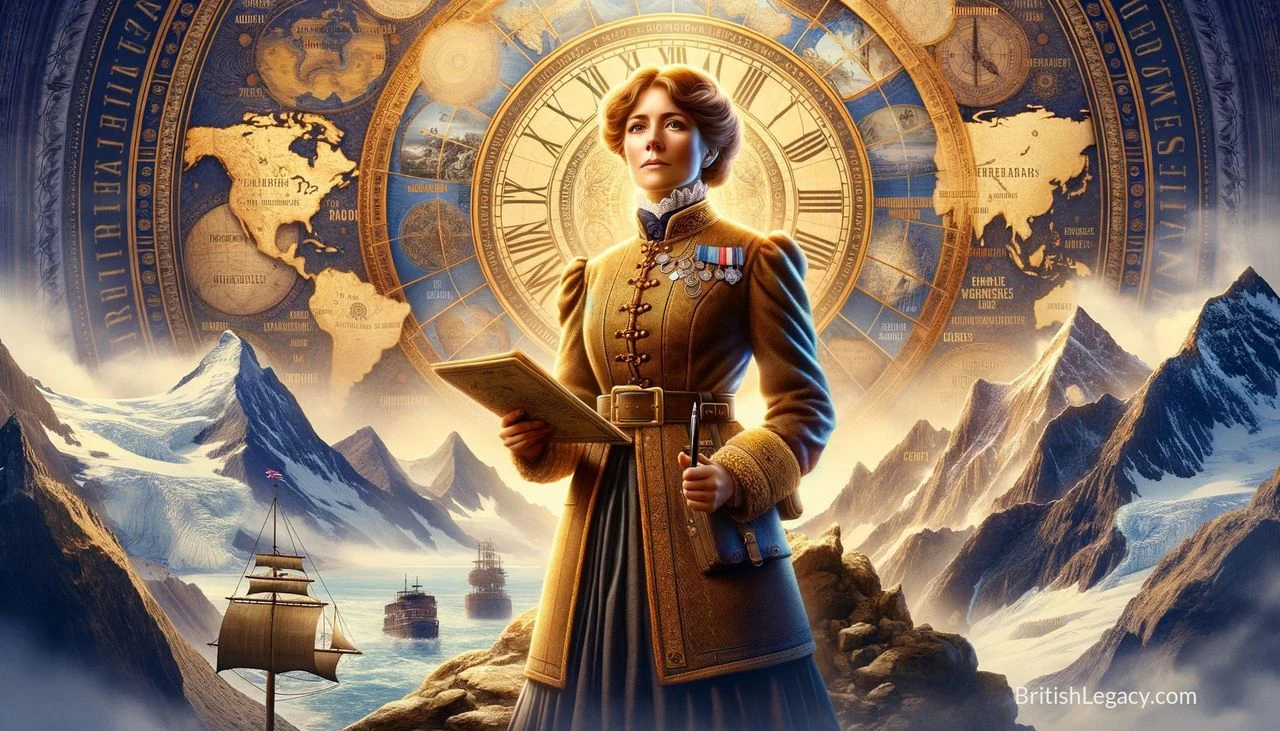
Isabella Bird did not wait for good health or convention to make travel easy. In 1854, on medical advice to take a sea voyage, she went to the United States; the letters she wrote there became her first book. Over the next five decades, her journeys took her across North America, the Pacific and Asia. She turned observation into popular travel writing, and in later life helped establish a hospital for women in Kashmir. In 1892, she became the first woman elected a fellow of the Royal Geographical Society.
A Yorkshire childhood and a first voyage
Bird was born Isabella Lucy Bird on 15 October 1831 at Boroughbridge Hall in Yorkshire. Her father, the Reverend Edward Bird, was a clergyman and keen botanist; her mother, Dora Lawson, taught Isabella and her younger sister, Henrietta, a range of subjects. The family moved repeatedly as Edward took up new posts. Bird became an avid reader and began writing early: at 16, she published a pamphlet on free trade and protectionism, followed by contributions to periodicals.
Her childhood was marked by poor health, including a spinal condition, headaches and insomnia. Doctors recommended an outdoor life; she learned to ride and row, and in 1850 underwent an operation to remove a fibrous tumour near her spine. The operation brought some relief, but illness recurred. After doctors advised a sea voyage, she travelled to the United States in 1854 with relatives. Her father gave her £100 and permission to stay away for as long as it lasted. The letters she sent home formed The Englishwoman in America, published in 1856 by John Murray, who became her long-term publisher and a close friend.
From Hawaii to the Rocky Mountains
Bird left Britain again in 1872, travelling first to Australia, which she disliked, and then to Hawaii, then widely called the Sandwich Islands in Europe. She climbed Mauna Kea and Mauna Loa. Her affection for the islands informed a book published in 1875, The Hawaiian Archipelago.
From Hawaii she went to Colorado, drawn by reports that its air might help people in poor health. In 1873 she rode more than 800 miles in the Rocky Mountains, wearing practical clothes and riding astride rather than sidesaddle. The press made much of her appearance: she threatened to sue The Times for saying she dressed like a man. Her letters to Henrietta first appeared in The Leisure Hour and were later gathered as A Lady's Life in the Rocky Mountains (1879), one of her best-known books.
In the Rockies, Bird also wrote about Jim Nugent, known as “Rocky Mountain Jim”, an outlaw who was both violent and poetic. She described him as “a man any woman might love but no sane woman would marry”; that passage was removed from the letters before publication. Bird eventually left the region and Nugent, who was shot dead less than a year later.
Journeys through Asia and the Middle East
Bird's travels in Asia began in 1878. She visited Japan, China, Korea, Vietnam, Singapore and Malaya, and wrote about journeys that differed in region and purpose. Her books included Unbeaten Tracks in Japan (1879), The Golden Chersonese and the Way Thither (1883), Korea and Her Neighbours (1898) and The Yangtze Valley and Beyond (1899). Her work drew on direct observation, but travel in the period depended on the labour of others. In China, for example, a changing group of Chinese men carried her for 1,200 miles.
Bird married John Bishop in February 1881. After his death in 1886, she inherited money and, following a serious decline in her health, reconsidered the character of her earlier travels. She studied medicine and resolved to travel as a missionary. Nearly 60, she set off for India, arriving in February 1889. She visited missions and travelled in Ladakh, Iran, Kurdistan and Turkey. On journeys between Baghdad and Tehran, she accompanied British soldiers whose commanding officer was conducting survey work; Bird carried a revolver and a medicine chest supplied by Henry Wellcome's London company.
In Kashmir, the maharajah gave Bird land for a hospital with 60 beds and a dispensary for women. Working with fellow Englishwoman Fanny Jane Butler, she helped found the John Bishop Memorial Hospital, named for her husband and supported by funds he had left in his will. In 1891, Bird travelled through Baluchistan to Iran and Armenia and explored the source of the Karun River. That year she also addressed a House of Commons committee about the persecution of Christians in Kurdistan, on which she had made representations to the Ottoman grand vizier.
Books, photography and recognition
Bird wrote across a wide geographical range, from North America and the Pacific to Persia, Japan and China. Her publications included Six Months in the Sandwich Islands (1874), Journeys in Persia and Kurdistan (1891), Among the Tibetans (1894), Chinese Pictures (1900) and articles on places including Ireland, the Hebrides and Morocco. Letters, magazine writing and books brought her accounts to readers who might never make such journeys themselves. She also worked as a photographer and naturalist; her 1900 book on China included notes on photographs she had made there.
Institutions recognised her work in stages. In 1890, she became the first woman to receive an honorary fellowship of the Royal Scottish Geographical Society. In 1892, she was elected the first female fellow of the Royal Geographical Society. She joined the Royal Photographic Society in 1897. Her final major journey was also in 1897, up the Yangtze and Han rivers; she then travelled among the Berbers in Morocco. A few months after returning, she fell ill and died at her Edinburgh home on 7 October 1904. She was buried in Dean Cemetery, and had been planning another journey to China.
Why Isabella Bird deserves a place in British Legacy
Bird's place in British history rests on more than the distance she travelled. She made sustained observation the basis of a substantial body of writing: from the letters that became The Englishwoman in America to books on Hawaii, the Rocky Mountains, Japan, Korea and the Yangtze. Her accounts brought detailed descriptions of places and encounters to British readers, while her career crossed forms of work—as a writer, photographer and naturalist—rather than fitting neatly into a single label. Her election in 1892 as the first woman fellow of the Royal Geographical Society gives that record a clear institutional milestone. It marked a change in who could be recognised within a prominent British geographical organisation.
Her legacy also includes practical work beyond publishing. In Kashmir, Bird and Fanny Jane Butler helped establish a hospital and dispensary for women, using land provided by the maharajah and money left by Bird's husband. That work links her journeys to a specific service, rather than treating travel as an end in itself. Her books also preserve accounts shaped by the people who enabled her movement: in China, for instance, a succession of local men carried her over a great distance. Remembering Bird well means recognising both her independence and the labour behind Victorian travel. For British Legacy, she matters as a Yorkshire-born author whose writing widened readers' knowledge of the world, whose professional recognition challenged an institutional barrier, and whose later travels helped support medical provision for women in Kashmir.
Sources
Isabella Bird (revision 1375500069) · Isabella Bird
Adapted in part from Isabella Bird by Wikipedia contributors, under CC BY-SA 4.0. Text has been edited and combined with the existing article; this adapted text is shared under the same licence. Contributor history.