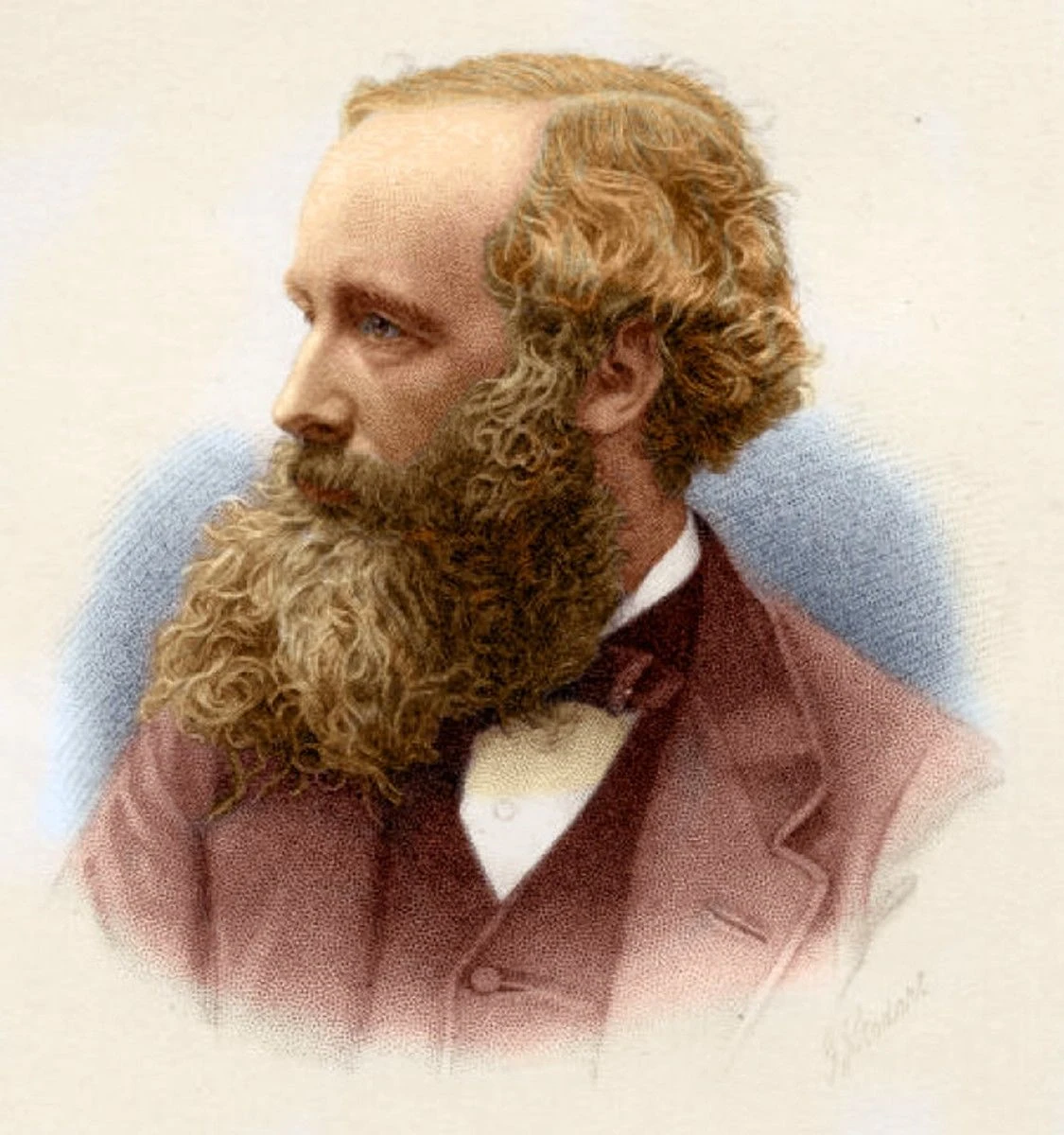
James Clerk Maxwell did not invent the radio, the colour photograph or the modern theory of gases. His achievement was to make discoveries in seemingly separate fields part of a larger, intelligible picture. By showing that electricity, magnetism and light belong to the same physical system, he gave later scientists and engineers a framework from which new technologies could develop. His work also reached into colour vision, the behaviour of gases and the stability of Saturn’s rings.
Born in Edinburgh in 1831, Maxwell studied and worked across Scotland and England, from Edinburgh and Aberdeen to London and Cambridge. At the Cavendish Laboratory, where he became the first professor of physics in 1871, he helped establish a new centre for experimental science. His life was short, but the reach of his ideas extended well beyond his own century.
A Scottish education and an early gift for mathematics
Maxwell was born on 13 June 1831 at 14 India Street, Edinburgh, to John Clerk Maxwell and Frances Cay. The family later spent much of its time at Glenlair in south-west Scotland. His mother began his education, but died when he was eight; his father and aunt then oversaw his schooling. At ten, Maxwell entered the Edinburgh Academy. He showed an early interest in geometry and, while still a pupil, wrote a paper on curves that was presented to the Royal Society of Edinburgh on his behalf because he was considered too young to present it himself.
He attended the University of Edinburgh from 1847, pursuing his own investigations alongside his formal classes. He experimented with polarised light and stressed blocks of gelatine, work that led him to observe photoelasticity: the coloured patterns that reveal stress within a material. In 1850 he moved to Cambridge, first studying at Peterhouse and then Trinity College. He graduated in mathematics in 1854, ranking second in the final examination and receiving the Smith’s Prize.
Maxwell’s interests were already broader than mathematics alone. At Edinburgh he had begun studying colour and how people perceive it. At Cambridge he continued that work, investigating how combinations of coloured light could produce other colours. The question of how to turn this principle into an image would become one of his most visible demonstrations of scientific thinking.
Fields, waves and the meaning of light
Maxwell took the Chair of Natural Philosophy at Marischal College, Aberdeen, in 1856. There he worked on the stability of Saturn’s rings as well as other problems in physics. His analysis showed that a single solid ring could not be stable and concluded that the rings must consist of many small particles orbiting independently. The reasoning earned him the Adams Prize in 1859. Later observations confirmed the essential particle-based picture.
In 1860, after Marischal College merged with King’s College, Maxwell moved to King’s College London. The five years he spent there were central to his work on electricity and magnetism. Earlier scientists, including Michael Faraday, had established important experimental findings, but the relationship between electrical and magnetic effects still needed a coherent account. In papers including “On Physical Lines of Force”, Maxwell developed a mathematical description of fields and the way they interact.
His conclusion was consequential: changing electric and magnetic fields could travel through space as waves, and the calculated speed of those waves corresponded to the speed of light. Maxwell argued that light itself was an electromagnetic disturbance. His theory therefore connected optics with electricity and magnetism, and implied the existence of other electromagnetic waves. It made wireless communication theoretically possible long before practical radio was built. Maxwell did not make a radio set; he supplied a way to understand the physical processes later technologies would use.
His work took a fuller form in A Treatise on Electricity and Magnetism, published in 1873. The equations now associated with his name express relationships among electric and magnetic fields. Their modern, more compact form was developed later by Oliver Heaviside. Maxwell’s contribution was the underlying unification: a theory that could account for light and electromagnetic effects within one framework.
Colour, gases and the workings of machinery
Maxwell’s interest in colour led to a practical demonstration as well as a theory of perception. In 1861, at a lecture in London, he presented a colour image made through three-colour analysis and synthesis. Photographer Thomas Sutton photographed a tartan ribbon through red, green and blue filters; the images were then projected through corresponding filters. The result was imperfect because the photographic plates of the time did not respond equally well to all colours, but the experiment demonstrated how three filtered images could combine to reproduce colour. The principle became important in later colour photography and displays.
Maxwell also helped develop statistical mechanics, which relates the visible behaviour of matter to the motion of its many small particles. His account of the distribution of molecular speeds in a gas, later known as the Maxwell–Boltzmann distribution, gave scientists a way to describe how gas molecules behave as a population. His work on gases and heat included the thought experiment now called Maxwell’s demon, which explores the relationship between information and the second law of thermodynamics.
Other investigations included elasticity, measurement and control. In “On governors”, published in 1868, Maxwell analysed devices that regulate the speed of steam engines. His mathematical treatment helped establish a foundation for control engineering. He also used dimensional analysis—the comparison of physical quantities through their dimensions—and contributed to the development of a coherent system of measurement. Across these subjects, he sought the underlying rules that could explain complex behaviour.
The Cavendish Laboratory and Maxwell’s final years
In 1865 Maxwell left King’s College London and returned to Glenlair. He continued to publish on subjects including heat, motion and the control of machinery. In 1871 he returned to Cambridge as the first Cavendish Professor of Physics, taking responsibility for the development of the Cavendish Laboratory. He helped oversee the building and the acquisition of its apparatus, shaping an institution intended to support experimental work as well as teaching. The University of Cambridge history and the Cavendish Laboratory history both record his place at the beginning of that institution’s story.
Maxwell was elected a Fellow of the Royal Society in 1861. He died in Cambridge on 5 November 1879, aged 48, after developing abdominal cancer. He was buried at Parton in Galloway, near the region where he had grown up. His death ended a relatively brief career, not the development of the ideas he had set in motion: subsequent scientists built on his theories of fields, light and matter.
Why James Clerk Maxwell deserves a place in British Legacy
Maxwell deserves a place in British Legacy because his life and work connect specific places and institutions across Scotland and England. Born and educated in Edinburgh, he held a professorship in Aberdeen, developed his electromagnetic theory at King’s College London and returned to Cambridge to help establish the Cavendish Laboratory. His story is not simply one of a Scottish scientist working in Britain; it shows how ideas and scientific work moved between universities and research centres that shaped the country’s intellectual life.
His lasting achievement was to give later generations a powerful account of how electricity, magnetism and light are related. That theoretical work helped make possible the understanding behind wireless communication and other technologies based on electromagnetic waves, without confusing Maxwell’s contribution with the inventions that followed. His work on colour also joined theory to experiment: the 1861 demonstration offered an early proof of how filtered images could be combined to reproduce colour. Alongside these achievements, his studies of gases, Saturn’s rings and control systems show a mind working across very different problems. Maxwell’s legacy is therefore both practical and foundational: he changed how nature could be described, and provided tools that others could use to extend that understanding.
Sources
James Clerk Maxwell — Wikipedia · James Clerk Maxwell — Wikipedia, revision 1372490849
Adapted in part from James Clerk Maxwell by Wikipedia contributors, under CC BY-SA 4.0. Text has been edited and combined with the existing article; this adapted text is shared under the same licence. Contributor history.