
Jason Robinson’s career crossed rugby’s divide. He first became a leading player with Wigan in league, then made a second international career in union, winning 51 England caps and five for the British & Irish Lions. His speed, acceleration and side-step made him a threat in both codes. The defining moment came in the 2003 Rugby World Cup final: Robinson scored England’s only try against Australia before England won 20–17 after extra time.
From Hunslet to Wigan
Born Jason Thorpe Robinson in Leeds on 30 July 1974, he began playing rugby league at Hunslet Boys Club and Hunslet Parkside. He wanted to join his home-town professional club, Leeds, but it was not interested in signing him at the time. In 1991, when he was 17, he signed for Wigan. He established himself in the first team as a teenager. Though he was initially touted as a possible half-back or loose forward, he played on the wing in a career that would become closely associated with pace and the ability to beat defenders.
Robinson was soon appearing in major matches. He played in Wigan’s 1992 Lancashire Cup final victory over St Helens and scored in the club’s 1993 Regal Trophy final win against Bradford Northern. In 1993, Wigan defeated Widnes in the Challenge Cup final; later that year, aged 19, Robinson made his first appearance for Great Britain, selected on the wing against New Zealand.
He played in Wigan’s 1994 World Club Challenge victory over the Brisbane Broncos. The following year, after recovering from a foot injury, he scored twice in the Challenge Cup final against Leeds and received the Lance Todd Trophy as man of the match. He also played for England in the 1995 World Cup final, which Australia won. Wigan’s successes continued: Robinson scored the club’s only try in the first Super League Grand Final, in 1998, and was named in the competition’s Dream Team in 1998, 1999 and 2000.
Learning a second code
Robinson’s move into union began before his permanent switch. In 1996, Wigan and Bath played a two-match cross-code series. He scored twice in Wigan’s match under league rules and also appeared in the union fixture, which Bath won. After rugby union’s ban on players who had played league ended, Robinson joined Bath on a short-term contract during the following off-season. He made 14 appearances between September 1996 and January 1997.
After Wigan lost the 2000 Super League Grand Final to St Helens, Robinson signed for Sale Sharks. He cited feeling that he had nothing left to prove in league and wanting the opportunity to represent England and the British Lions in union. He made his Sale debut against Coventry in November 2000. His first-hand experience of league did not prevent him adapting to the new code; speed, acceleration and the ability to find space remained important parts of his game.
Robinson made his England union debut as a substitute against Italy in February 2001. That year he joined the British & Irish Lions tour of Australia. He was among the outstanding players in the Lions’ first Test victory in Brisbane, where he beat Australian full-back Chris Latham with a side-step, and scored again in the final Test. His representative career thus spanned Great Britain and England in league, followed by England and the Lions in union.
World Cup winner and England captain
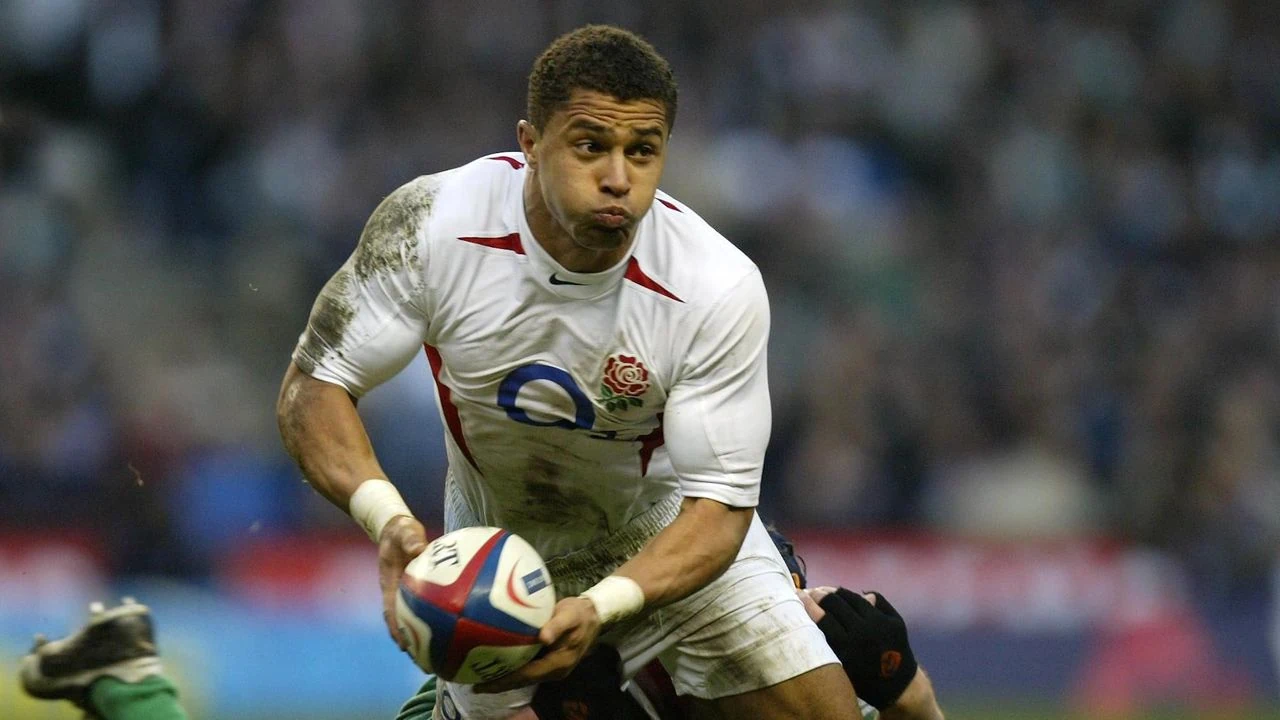
Robinson played in all seven of England’s matches at the 2003 Rugby World Cup. In the final against Australia, he scored England’s only try. England won 20–17 after extra time, and Robinson’s try became the most visible moment of his union career. The achievement belonged to a wider tournament campaign in which he featured in every match.
He continued to make an impact in the England side. Playing at centre in the opening match of the 2004 Six Nations against Italy, he scored three tries and was named man of the match. In 2005, after Jonny Wilkinson was injured, Robinson was appointed captain for the autumn internationals. He became the first former professional rugby league player and the first mixed-race player to captain England. In his first match as captain, he scored a hat-trick of tries in a 70–0 win over Canada.
In September 2005, Robinson announced his retirement from international union, saying that he wanted to spend more time with his family. He continued playing for Sale and helped lead the club to its first Premiership title in the 2005–06 season. He returned to the England set-up for the 2007 Six Nations after a 15-month absence, scoring twice against Scotland in his first match back and once against Italy the following week.
Last matches and honours
In April 2007, Robinson announced that he would leave club rugby at the end of the season, while remaining available for England’s summer matches and the World Cup. His last match for Sale was at home against Bath on 13 April. In the final play, he received the ball 30 metres out and scored the match-winning try; his conversion attempt narrowly missed.
At the 2007 World Cup, a hamstring injury forced him off during England’s group-stage defeat by South Africa. He returned for the quarter-final against Australia, which England won 12–10, and played in the semi-final victory over France. The semi-final was his 50th England cap, and he led the team out. His final England appearance came in the final, a defeat by South Africa, when injury again ended his participation. He later played for the Barbarians at Twickenham. In 2010, he came out of retirement to play for Fylde, making three appearances before announcing his final retirement in July 2011.
His honours came in both codes. With Wigan, they included the World Club Challenge, Challenge Cup and league titles. In union, he was part of England’s 2003 World Cup-winning team and its Six Nations Grand Slam side that year. With Sale, he won the Premiership in 2005–06 and the European Challenge Cup in 2002 and 2005. Robinson, already an MBE, was appointed an Officer of the Order of the British Empire in the 2008 New Year Honours. In 2017, he received the Lifetime Achievement Award at the British Ethnic Diversity Sports Awards.
Why Jason Robinson deserves a place in British Legacy
Robinson’s place in British rugby is grounded in achievements across its two professional codes. He became a major player for Wigan, represented Great Britain in league and then built a substantial union career with Sale, England and the British & Irish Lions. His change of code was not a brief experiment: he made 51 England union appearances, played in two World Cups and captained his country. His club honours also crossed the divide, from Wigan’s league successes to Sale’s Premiership title and European Challenge Cup wins.
The 2003 final supplies the clearest single measure of his contribution. Robinson scored England’s try in a 20–17 extra-time victory over Australia, helping secure the country’s first men’s Rugby World Cup title. His captaincy added another significant distinction: he was the first former professional league player and the first mixed-race player to lead England. These records and results are more than a list of accolades; they show how a player developed in English rugby league could transfer his ability to union and succeed at the highest level. Robinson’s career gives British Legacy a specific sporting story about skill across codes, achievement for English clubs and service to the national side.
Sources
Jason Robinson (rugby), revision 1376158059
Adapted in part from Jason Robinson (rugby) by Wikipedia contributors, under CC BY-SA 4.0. Text has been edited and combined with the existing article; this adapted text is shared under the same licence. Contributor history.
.jpg)