
Jenson Button’s route to the Formula One World Championship began in a go-kart and took him through a succession of teams, cars and racing cultures. In 2009, he won the title with Brawn GP, a team formed from the remains of Honda’s withdrawn operation. His six victories in the first seven races gave him a lead he held through a changing season. Button’s career did not end with that championship: across 18 seasons in Formula One, he won 15 Grands Prix, took 50 podiums and later claimed a title in Japan’s Super GT series.
From Somerset karting to the top of single-seater racing
Born in Frome, Somerset, on 19 January 1980, Button was the son of former rallycross driver John Button. He began karting at eight, first racing at Clay Pigeon Raceway. His father taught him the basics of car control, including on a wet track, and Button soon began to collect results. In 1991 he won all 34 races in the British Cadet Kart Championship. Further karting success included three British Open titles and, in 1997, the European Super A Championship, where he became both the youngest driver and the first Briton to win it.
Button moved to single-seater cars in 1998. In his first season of car racing, he won the British Formula Ford Championship with nine victories and the season-ending Formula Ford Festival at Brands Hatch. He finished third in the 1999 British Formula 3 championship, winning three races, and was named the top rookie. That year’s Autosport BRDC Award brought a test in a McLaren Formula One car.
Williams signed Button for the 2000 season after a test against Formula 3000 driver Bruno Junqueira. At 20, he became Britain’s youngest Formula One driver, a record previously held by Stirling Moss. Button scored points in his second race, in Brazil, and finished eighth in the championship. A move to Benetton followed in 2001; the car was uncompetitive, and he finished 17th. The team became Renault in 2002. Button improved to seventh, but was told that Fernando Alonso would take his place the following season. He joined British American Racing (BAR) for 2003.
Learning to win with BAR and Honda
At BAR, Button established himself among the leading drivers. In 2004 he took ten podiums, including a second place at Imola after securing his first pole position, and finished third in the drivers’ championship. A contract dispute over a proposed move to Williams ended with a ruling that kept him at BAR. The next season brought further conflict over his future, but he remained with the team after Williams agreed to release him.
BAR became Honda in 2006. Button won his first Grand Prix at the rain-affected Hungarian race, on his 113th start, having started 14th. He finished fourth or fifth in each of the next five races and ended the season with another podium in Brazil. The following two years were harder: Honda’s cars lacked pace, and Button scored six points in 2007 and three in 2008. When Honda withdrew from Formula One in December 2008, his prospects for the next season depended on whether the team could find a buyer.
The Brawn GP season
In early 2009, Ross Brawn led a management buyout of Honda’s team, which was renamed Brawn GP. Button signed to drive for the new operation, accepting a pay cut. The Brawn BGP 001 proved fast in pre-season testing. Its aerodynamic package included a double diffuser, a design also used by Toyota and Williams, which helped those cars gain an early advantage.
Button won six of the first seven races, matching a record at the time. As rival teams developed their own cars, that dominance faded; in the following ten races he averaged sixth. At the Brazilian Grand Prix, he finished fifth, scoring enough points to secure the drivers’ championship with one round left. He closed the season with third place in Abu Dhabi. Brawn GP also won the constructors’ championship.
The title joined two parts of the story: a driver who had developed through British karting and junior categories, and a team whose survival depended on a rapid change of ownership and identity. Button’s work in the opening races created a points advantage; his later results were enough to protect it as the competition caught up.
McLaren and a second racing life
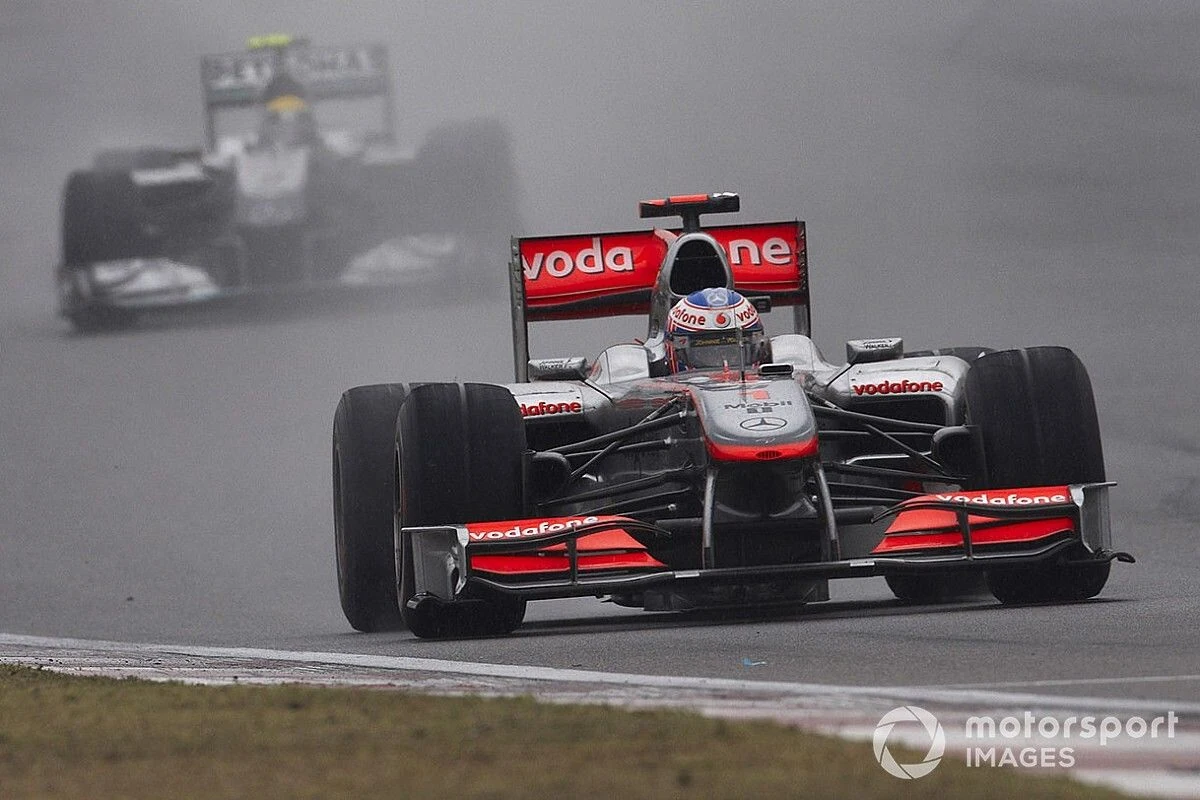
Button moved to McLaren for 2010, partnering Lewis Hamilton. He won in Australia and China in changeable conditions, then finished fifth in the championship. In 2011 he was runner-up after three victories, including wins in the rain-affected Canadian and Hungarian Grands Prix. He won again in 2012, taking victories in Belgium and Brazil, and finished fifth overall. His final full-time Formula One season was 2016. He returned once, at the 2017 Monaco Grand Prix, standing in for Fernando Alonso.
Button’s style was often described as smooth: he used measured steering and throttle inputs and could make the most of a damp or slippery track. That approach did not suit every condition. On cool circuits, generating enough tyre temperature could be difficult, particularly over a single qualifying lap. His career therefore involved adapting as well as relying on a natural strength. The shift from karting to single-seaters, from Honda to Brawn, and then to a new team at McLaren demanded different responses at different stages.
He continued racing beyond Formula One. In 2018, driving for Team Kunimitsu with Naoki Yamamoto, he won Japan’s Super GT title in the GT500 class. The pair took a victory at Sportsland Sugo and entered the final race level on points with their closest rivals; Button held off Ryō Hirakawa to win the championship by three points. He also competed in endurance racing, including the World Endurance Championship, and made three NASCAR Cup Series starts in 2023.
His work around the sport has included analysing selected races for Sky Sports F1 and serving as a Williams senior adviser from 2021. Button was appointed an MBE in the 2010 New Year Honours for services to motorsport. Frome has named a street and a footbridge after him and awarded him the freedom of the town; the University of Bath awarded him an honorary doctorate in engineering in 2016.
Why Jenson Button deserves a place in British Legacy
Button’s place in British sporting history rests first on a clearly defined achievement: he won the 2009 Formula One World Championship, after beginning his racing career in Somerset and progressing through British Formula Ford and Formula 3. His six wins from the opening seven races gave him the advantage that shaped the title fight. The achievement was not simply a run of early victories. When other teams improved, Button continued to score the points needed to clinch the championship in Brazil, with one race still to come. His 15 Grand Prix wins and 50 podiums show that the title sat within a long career at the sport’s highest level.
That career also offers a more specific legacy than a generic story of sporting success. Button won with different teams and in different circumstances: his first Grand Prix victory came with Honda in 2006, he became champion with Brawn GP, and he later won races for McLaren. After Formula One, he took a title in Super GT, demonstrating that his ability transferred to another series and racing environment. His British connection is concrete, rooted in his Somerset birthplace and the junior racing pathway through which he advanced, rather than in abstract claims about national character. His honours, including the MBE and recognition in Frome, mark the public significance of a career that combined a world title with sustained achievement across several forms of motor racing.
Sources
Adapted in part from Jenson Button by Wikipedia contributors, under CC BY-SA 4.0. Text has been edited and combined with the existing article; this adapted text is shared under the same licence. Contributor history.
.jpg)