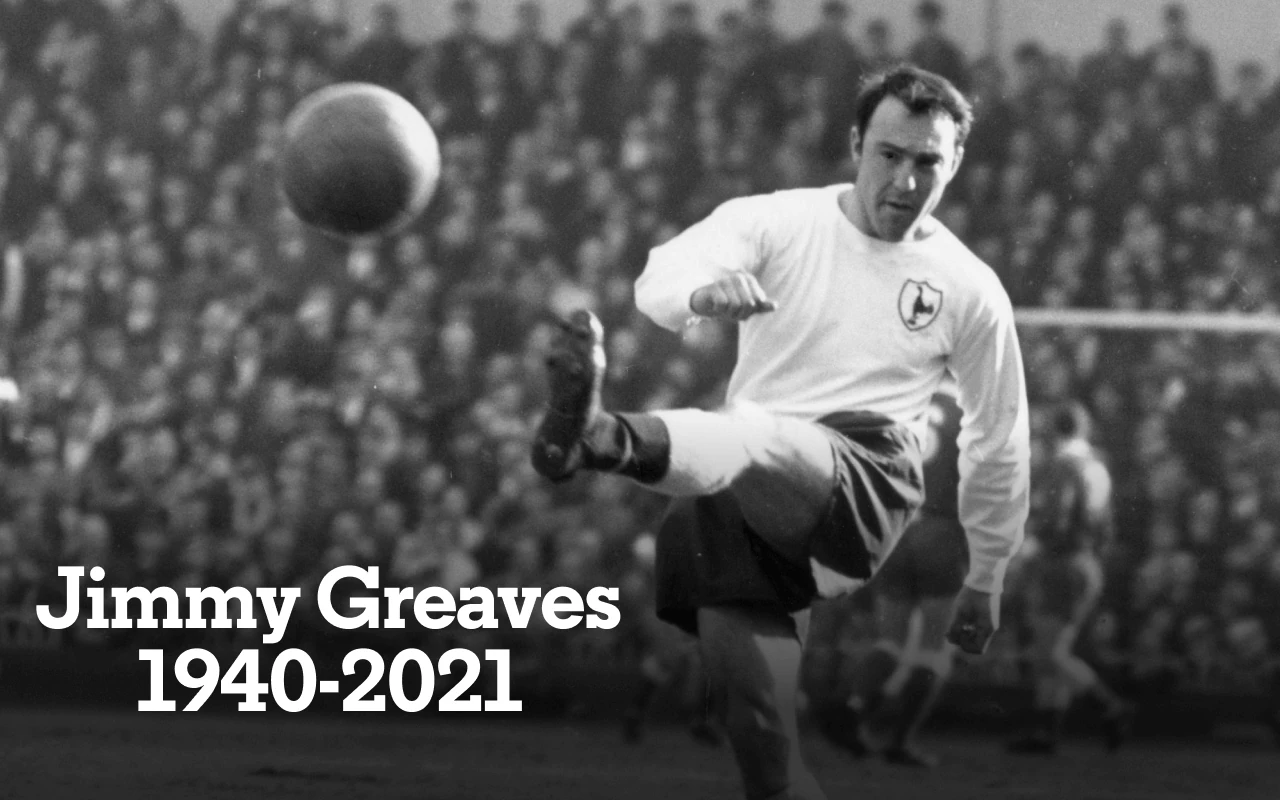
Jimmy Greaves made scoring look simple. A forward with pace, close control and a sharp sense of position, he became the leading scorer in English top-flight history and one of England’s most prolific internationals. His career ran from Chelsea and AC Milan to Tottenham Hotspur and West Ham United; after retiring from league football, he returned to the game at non-league level and became a familiar voice on television. His story includes major honours and remarkable numbers, but also the disappointment of missing the 1966 World Cup final and a struggle with alcoholism that he later overcame.
A prolific young forward at Chelsea
James Peter Greaves was born in Manor Park, Essex, on 20 February 1940 and grew up in Hainault. Chelsea signed him as an apprentice in 1955. He scored heavily for the youth side, turned professional in 1957 and made his First Division debut that August, aged 17, against Tottenham Hotspur. He scored in a 1–1 draw.
Greaves quickly became Chelsea’s leading scorer. His league totals included 32 goals in 1958–59 and 41 in 1960–61, when he finished as the First Division’s top scorer. Across his Chelsea career he scored 124 league goals in 157 appearances; including other competitions, his tally was 132 goals in 169 appearances. He was already among the game’s most productive forwards, but Chelsea’s inconsistency and his own growing dissatisfaction preceded a move abroad.
Italy, then a defining spell at Tottenham
AC Milan signed Greaves in 1961. He scored nine league goals in ten appearances, but his stay was brief. He was unhappy in Italy and did not settle under the club’s strict training regime. Tottenham signed him in December for £99,999, a fee deliberately set just below £100,000 to spare him the pressure of becoming British football’s first £100,000 player.
He announced himself with a hat-trick on his first-team debut for Spurs, a 5–2 win over Blackpool. In his first season, he helped the club win the 1961–62 FA Cup, scoring in the final against Burnley. A year later, he scored twice in Tottenham’s 5–1 victory over Atlético Madrid in the European Cup Winners’ Cup final. Tottenham became the first British club to win a European trophy.
Greaves remained a prolific scorer throughout his time in north London. He finished top of the First Division scoring list six times, including in 1962–63, when he scored 37 league goals. He also helped Spurs finish second in the league that season. The club won another FA Cup in 1966–67, and Greaves was the competition’s leading scorer, though he did not score in the final.
His Spurs totals depend on what is counted. Wikipedia’s account gives him 268 goals in 381 appearances in all competitions, including two goals in the 1962 Charity Shield; the club’s own total excludes those Shield goals, giving 266. Either way, the record captures the sustained scale of his contribution. His 357 goals in the First Division remain the highest total in the history of English top-flight football.
England: goals and the 1966 final
Greaves scored 44 goals in 57 appearances for England, including six hat-tricks, a national-team record. He played at the 1962 World Cup in Chile, scoring against Argentina, and was a regular in England’s side before the 1966 tournament.
He played in all three of England’s group matches at the 1966 World Cup. An injury in the game against France required 14 stitches, and Geoff Hurst replaced him for the quarter-final. Hurst kept his place through the final, where England beat West Germany 4–2. Greaves was fit again, but manager Alf Ramsey did not change the winning team. Because only the players on the pitch at the final whistle initially received medals, Greaves did not receive his World Cup medal until 2009, after FIFA changed its rules.
Greaves played only three more times for England after the tournament. His last cap came in 1967, and he retired from international football the following year. He had also been called up for the 1968 European Championship, where England finished third, but remained an unused substitute.
West Ham, a return to football and recovery
In March 1970, Greaves moved to West Ham United as part of the deal that took Martin Peters to Tottenham. He scored twice on his debut, but his motivation and fitness declined. He later described drinking more heavily towards the end of his playing career, and his last First Division appearance came in May 1971. His record in the competition stood at 357 goals.
After leaving West Ham, he spent several years away from football and struggled with alcoholism. He returned to playing in 1975 with Brentwood, then joined Chelmsford City and Barnet before making appearances for Woodford Town. His time at Barnet included a player-of-the-season award. He retired for good in 1980 and became sober, remaining so for the rest of his life.
A second career in front of the camera
Greaves became a newspaper columnist in 1979 and moved into television as a football pundit. He appeared on programmes including Star Soccer, World of Sport and On the Ball, where he formed a partnership with former Liverpool player Ian St John. From 1985 to 1992, the pair presented Saint and Greavsie, a popular Saturday lunchtime football programme. Greaves’s light touch and direct observations offered a different kind of television analysis from the more formal style that later became common in football broadcasting.
His public recognition also reflected his service to the game. Greaves was appointed a Member of the Order of the British Empire in the 2021 New Year Honours. After suffering strokes in 2012 and 2015, he died at his home in Little Baddow, Essex, on 19 September 2021, aged 81.
Why Jimmy Greaves deserves a place in British Legacy
Greaves’s place in British sporting history rests first on what he achieved on the pitch. His 357 First Division goals remain an English top-flight record, built across seasons with Chelsea, Tottenham and West Ham rather than in one brief burst of form. At Spurs, he helped win two FA Cups and the 1963 European Cup Winners’ Cup, a landmark for British club football. For England, 44 goals in 57 appearances and six hat-tricks made him one of the national side’s most effective forwards. These are measurable achievements, grounded in longevity as well as a high scoring rate.
His legacy also reaches beyond statistics and trophies. The injury that kept him out of the 1966 final placed him at the heart of England’s most celebrated football triumph while leaving him to watch rather than play. His medal came decades later, following a change in FIFA’s rules. After his top-flight career, Greaves returned to football at a lower level while confronting alcoholism, and later became one of the country’s best-known television football voices through Saint and Greavsie. Together, those chapters give his career its particular breadth: elite achievement, public disappointment, recovery and a sustained contribution to how football was discussed and enjoyed in Britain.
Sources
Jimmy Greaves — Wikipedia, revision 1377715507
Adapted in part from Jimmy Greaves by Wikipedia contributors, under CC BY-SA 4.0. Text has been edited and combined with the existing article; this adapted text is shared under the same licence. Contributor history.