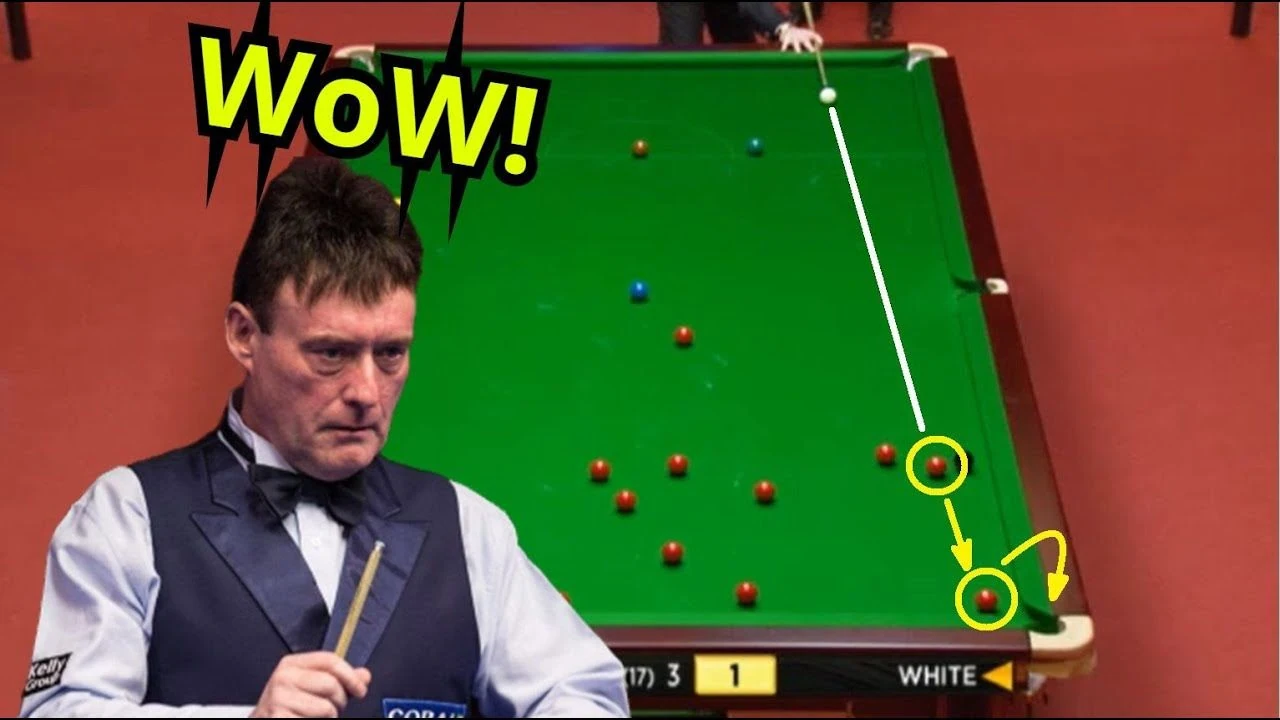
Jimmy White’s snooker career is often told through the title that escaped him. He reached the World Championship final six times and lost on each occasion. Yet that record captures only part of the story: White also won the Masters, the UK Championship and ten ranking titles, and his swift, attacking play made “The Whirlwind” one of snooker’s most recognisable names.
A young player in Tooting
James Warren White was born in Tooting, London, on 2 May 1962. He attended Ernest Bevin School and spent increasing amounts of time at Zan’s, a local snooker hall. There he met Tony Meo, who became both a rival in money matches and a friend. White later credited Alex Higgins, whom he first watched in an exhibition when he was 13, with inspiring him to play. He described his own style as modelled on Higgins’s: “I was only the Whirlwind because he was the Hurricane.”
White’s progress through amateur snooker was rapid. He won the British Under-16s Championship in 1977, the English Amateur Championship in 1979 and the World Amateur Snooker Championship in 1980. He turned professional after that last victory. At the Crucible Theatre in Sheffield, he made his World Championship debut in 1981, losing in the first round to Steve Davis. A year later, he reached the semi-finals, where Alex Higgins beat him 16–15 in a deciding frame. White had led 15–14; Higgins took the penultimate frame with a break of 69 after White missed a red.
Major wins and the Crucible finals
White’s first Masters title came in 1984, when he beat Terry Griffiths 9–5 in the final. That year he also reached his first World Championship final. Against Davis, he recovered from 4–12 to close to 16–17, but could not complete the comeback and lost 16–18. He and Higgins won the World Doubles Championship later that year.
His first ranking title followed at the 1986 Classic, where he beat Cliff Thorburn 13–12. White rose to world number two in the rankings for the 1987–88 and 1988–89 seasons. In 1990, he reached the World Championship final again, this time losing 12–18 to Stephen Hendry. His third final, against John Parrott in 1991, ended 11–18. Those defeats were not the whole of his work in the period: White won the British Open in 1987 and 1992, and the European Open in 1992, among other ranking events.
In the 1992 World Championship, White made the tournament’s second-ever maximum break, becoming its first left-handed player to record a 147. He reached the final and led Hendry 14–8, but Hendry won ten consecutive frames to take the title. White returned to the final in 1993 and lost 5–18. In 1994, he came closest to changing the pattern. After falling behind, he recovered to lead Hendry 13–12 and forced a deciding frame. Leading 37–24, White missed the black; Hendry made a break of 58 and won the match 18–17.
White’s sixth final came in 1991, when Parrott beat him 18–11. The six appearances, between 1984 and 1994, left him without a world title, but they sit alongside major successes rather than replacing them. In 1992 he won the UK Championship, beating Parrott 16–9. His tenth ranking title came at the 2004 Players Championship, where a 9–7 final victory over Paul Hunter secured his first ranking-event win since 1992.
A career beyond its peak years
White’s results later became less consistent. He fell out of the world’s top 16 in 1997, though he returned to that group and continued to make deep runs at major events. At the 1998 World Championship, he beat Hendry 10–4 in the first round and Darren Morgan 13–3 before losing to Ronnie O’Sullivan in the quarter-finals. In 2004, his Players Championship victory briefly lifted him back into the top ten.
After finishing the 2016–17 season outside the top 64, White lost his professional tour place after 37 years. He remained on tour through invitational cards, and later earned further cards on merit and by invitation. His later career has included a separate run of success on the World Seniors Tour. He won the World Seniors Championship in 2010, 2019, 2020 and 2023, the last victory giving him a record fourth title. At the 2023 German Masters, he became the first player over 60 to reach the last 16 of a ranking event since Eddie Charlton in 1992.
White has also worked as a snooker commentator and pundit. His appearances beyond competition have included the television documentary series Gods of Snooker and the 2009 series I’m a Celebrity...Get Me Out of Here!, in which he finished third. The range of his career is reflected in his place in the World Snooker Tour Hall of Fame, which he joined in 2017, and in his appointment as an MBE in the 1999 New Year Honours for services to snooker.
Why Jimmy White deserves a place in British Legacy
Jimmy White’s place in British sporting history does not depend on rewriting the outcome of his six World Championship finals. His record is compelling because it holds both failure at the sport’s biggest event and achievement across a long professional career. The Masters, UK Championship and ten ranking titles show the level he reached; the six finals show how persistently he returned to the Crucible’s defining contest. His 1992 maximum break, a landmark in the championship’s history, adds a precise measure of technical distinction to a story often reduced to near-misses.
White’s contribution also reaches beyond his own trophy record. His fast, attacking style, shaped in part by his admiration for Alex Higgins, helped make him an enduring figure for audiences and a model for later players: Stephen Hendry, Mark Williams and Ronnie O’Sullivan have each spoken of looking up to him when they were young. His continued competition into his sixties, including a record fourth World Seniors Championship, gives that legacy a further dimension. For British Legacy, White represents not a generic triumph-over-adversity story, but a specific sporting achievement: a player whose major victories, expressive style and longevity kept him at the centre of snooker’s public life, even without the world title that so often defines its champions.
Sources
Adapted in part from Jimmy White by Wikipedia contributors, under CC BY-SA 4.0. Text has been edited and combined with the existing article; this adapted text is shared under the same licence. Contributor history.