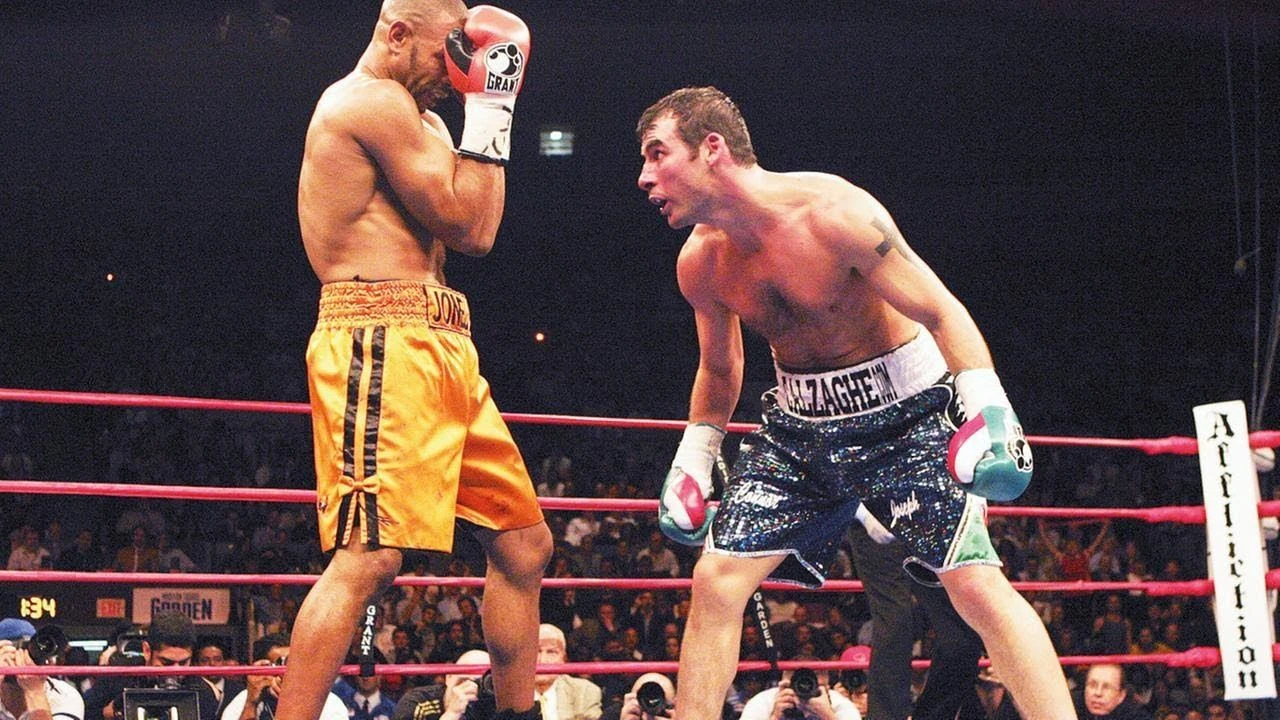
Joe Calzaghe’s professional record tells a simple story: 46 fights, 46 wins, no defeats. The route to it was more demanding. Raised near Newbridge in south Wales, he spent more than a decade holding the World Boxing Organization (WBO) super-middleweight title, unified world titles in that division and finished his career with victories over Bernard Hopkins and Roy Jones Jr at light-heavyweight. His British story is also a Welsh one: Calzaghe was born in London, but Wales became the place where he learnt to box and built his championship career.
From Hammersmith to the Newbridge gym
Joseph William Calzaghe was born in Hammersmith, London, on 23 March 1972. His father, Enzo, was Italian and his mother, Jackie, was Welsh. After time in Italy, the family returned to Britain and lived with Calzaghe’s maternal grandmother in Markham, a former mining town in Caerphilly. They later settled in Pentwynmawr, near Newbridge, where Calzaghe attended the local primary school.
He first took an interest in boxing at eight, when he was given a children’s boxing toy; his father made a punchbag from an old carpet. At ten, Calzaghe joined Newbridge Amateur Boxing Club. Football had occupied him before then, but boxing soon took precedence. He went on to Oakdale Comprehensive School and later described being bullied as a teenager. He left school without sitting his GCSEs.
Calzaghe’s amateur record included four schoolboy ABA titles and three consecutive senior British ABA championships, won between 1990 and 1993 in three weight categories: welterweight, light-middleweight and middleweight. In 120 amateur contests, he reportedly recorded 110 wins and ten defeats. His final two losses in the ring came in 1990, against Michael Smyth in the Welsh ABA final and Adrian Preda at the European Junior Championships.
A fast start in the professional ranks
Calzaghe turned professional in 1993. He made his debut at Cardiff Arms Park on 1 October, stopping Paul Hanlon in the first round. Thirteen fights later, he had won the vacant British super-middleweight title, stopping the previously unbeaten Stephen Wilson at the Royal Albert Hall in October 1995. He defended that belt against Mark Delaney the following year and continued to build a record with a mixture of quick stoppages and longer contests.
In 1996, Calzaghe joined promoter Frank Warren’s stable. A planned opportunity to challenge WBC champion Robin Reid did not materialise. A bout with WBO champion Steve Collins was arranged, but Collins withdrew injured, was stripped of his title and retired. Instead, Calzaghe met former two-time WBO champion Chris Eubank for the vacant belt in Sheffield on 11 October 1997.
Calzaghe knocked Eubank down in the opening seconds and won a unanimous points decision. It began a WBO reign that lasted more than ten years. Early defences included a close split-decision win over fellow Briton Robin Reid in 1999 and victories against experienced former champions and contenders. The Reid fight was among the closest of Calzaghe’s unbeaten career. He continued defending the title as his opposition and reputation grew.
Unifying the super-middleweight division
Calzaghe’s long run as champion became more than a succession of defences. In 2006, he faced IBF title-holder Jeff Lacy in Manchester. Calzaghe dominated over twelve rounds, winning a unanimous decision and taking the IBF belt as well as The Ring magazine and lineal titles. A point was deducted from him in the eleventh round for an illegal punch, but the decision was clear. The result established him as the first super-middleweight recognised by The Ring as champion of the division.
He defended against Sakio Bika, then met Peter Manfredo Jr at Cardiff’s Millennium Stadium in 2007. Calzaghe won by a third-round stoppage in front of 35,000 spectators; the speed of the referee’s intervention drew criticism from Manfredo and some American commentators. Later that year, Calzaghe faced undefeated WBA and WBC champion Mikkel Kessler in another Cardiff unification bout. A unanimous decision gave Calzaghe the WBA and WBC titles alongside his WBO and Ring championships. His super-middleweight defences reached 20, a division record he shared with Sven Ottke.
Descriptions of Calzaghe as undisputed champion need some care: he had relinquished the IBF title before the Kessler fight. He nevertheless held the WBO, WBA and WBC belts together, and the Ring title, after beating Kessler. His record-setting reign, and his ability to adapt across opponents, made him a central figure in the division through the 1990s and 2000s.
Two American victories and an unbeaten retirement
In April 2008, Calzaghe moved up to light-heavyweight to fight Bernard Hopkins in Las Vegas. It was his first bout in the United States. Hopkins knocked him down in the opening round, but Calzaghe increased the pace, landed combinations and won a split decision to take The Ring light-heavyweight title. The result was disputed by Hopkins, who believed he had won; the judges’ cards were two for Calzaghe and one for Hopkins.
Calzaghe’s final professional contest was against Roy Jones Jr at Madison Square Garden in New York on 8 November 2008. After being knocked down in the first round, he took control and won by unanimous decision, with all three judges scoring the fight 118–109. He announced his retirement on 5 February 2009, with a final record of 46 wins, including 32 by knockout, and no losses. He retired while still a world champion.
In 2007, Calzaghe became the first Welsh winner of the BBC Sports Personality of the Year Award since David Broome in 1960. He was appointed a CBE in the 2008 Queen’s Birthday Honours, having previously been made an MBE, and in 2009 became the first recipient of the Freedom of Caerphilly County Borough. The International Boxing Hall of Fame inducted him in 2014.
After the final bell
After retiring, Calzaghe established Calzaghe Promotions with his father. He also promoted the Beat Bullying campaign, drawing on his own account of having been bullied as a young person. In 2010, he took part in Soccer Aid, scoring for the Rest of the World team in its charity match against England. He appeared as himself in an episode of the Welsh television comedy drama Stella in 2012.
These activities followed a career whose public profile had extended well beyond the ring. Calzaghe’s prominence in Wales grew during the period often associated with Cool Cymru, and his nickname, “the Pride of Wales”, reflected his adopted home and sporting identity, rather than his birthplace. He was also known as the “Italian Dragon”, a reference to his family heritage.
Why Joe Calzaghe deserves a place in British Legacy
Calzaghe deserves a place in British Legacy for achievements that can be stated precisely. He became a world champion in two weight classes, held the WBO super-middleweight title for more than ten years and defended it 20 times. He unified the WBA, WBC and WBO super-middleweight titles with his win over Mikkel Kessler, and later beat Bernard Hopkins and Roy Jones Jr at light-heavyweight. He finished with a 46–0 record and retired as a reigning world champion. These milestones place a Welsh-raised boxer from south Wales among the most accomplished British fighters of his era.
His career also matters because of the setting in which it took shape. Calzaghe was born in London, but the Newbridge club was where he began boxing, and Cardiff became a major stage for his title career. His championship bouts brought world-level boxing to Welsh audiences, while his 2007 BBC Sports Personality of the Year award made him the first Welsh winner since 1960. His later promotion of an anti-bullying campaign connected his own experience to a public cause. Taken together, these details give his legacy substance beyond an unbeaten record: a long Welsh sporting career, sustained success at the highest level and a recognisable place in British boxing history.
Sources
Joe Calzaghe — Wikipedia revision 1379630267
Adapted in part from Joe Calzaghe by Wikipedia contributors, under CC BY-SA 4.0. Text has been edited and combined with the existing article; this adapted text is shared under the same licence. Contributor history.