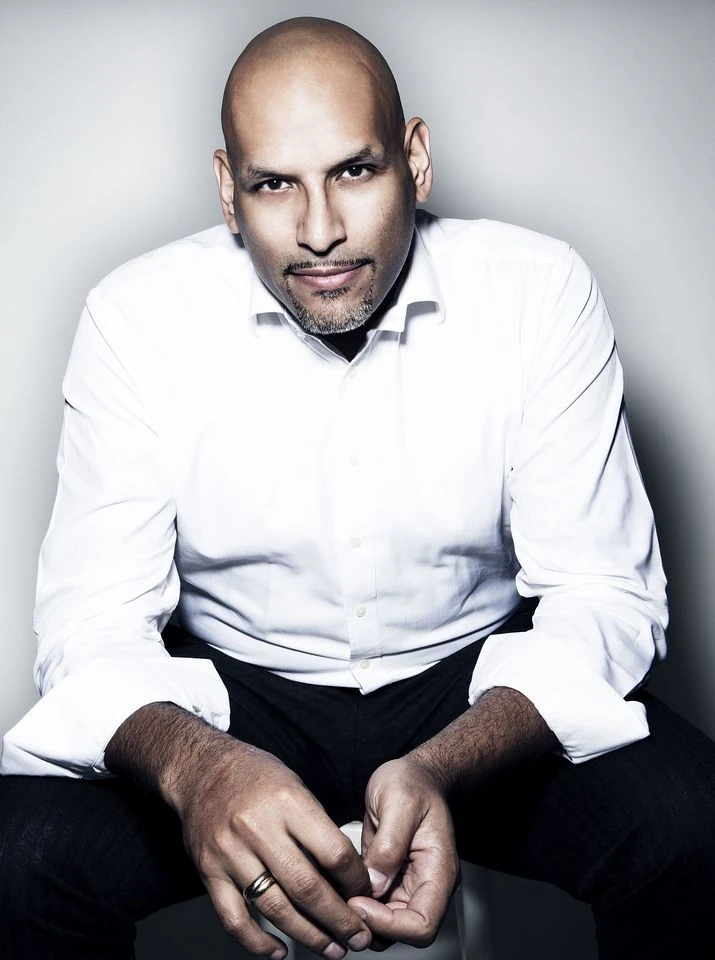
John Amaechi’s route from Stockport to the NBA began unusually late: he first played basketball at 17. Undrafted in 1995, he nonetheless established a professional career across several countries, won the British Basketball League’s Most Valuable Player award and played in the NBA for the Cleveland Cavaliers, Orlando Magic and Utah Jazz. Basketball was only one part of his public life. He later represented England, worked in British broadcasting and built a career as a psychologist and organisational consultant. In 2007, he became the first former NBA player to publicly come out as gay, bringing questions about sexuality and belonging in elite sport into wider view.
Growing up in Stockport, finding basketball
Amaechi was born in Boston, Massachusetts, on 26 November 1970, to an English mother and a Nigerian Igbo father. He and his two younger sisters were raised by their mother in Heaton Moor, Stockport. He attended Tithe Barn Primary School and Stockport Grammar School. Those early years in Greater Manchester are central to his British story: the child educated in Stockport would go on to play for England and become a prominent voice in British sport and professional life.
Basketball was not a childhood specialism for Amaechi. He began playing at 17, coached by Joe Forber, whom he later described as a father figure. He joined Manchester United’s basketball team, later known as the Manchester Eagles. His performances there helped lead to a move to the United States, where he played high-school basketball at St John’s Jesuit High School in Toledo, Ohio.
He went on to study and play at Vanderbilt University before transferring to Penn State. There, he was twice selected as a First Team Academic All-American. The combination of competitive sport and academic achievement would remain a feature of his career. His path was not simply a progression through increasingly prominent teams: it also involved sustained study, which helped prepare him for the work in psychology and organisational behaviour that followed basketball.
A professional career across leagues and countries
Amaechi went undrafted in 1995, but signed with the Cleveland Cavaliers. He became the first undrafted player to start his first NBA game, stepping into the starting-centre role when Michael Cage was unavailable through injury. Amaechi played 28 games for Cleveland in the 1995–96 season. His NBA opportunity came without the standing of a high draft pick, and he went on to build his professional career through appearances in several different basketball systems.
After Cleveland, his playing career took him to France, Greece, Italy and the United Kingdom as well as the United States. His European teams included Cholet, Panathinaikos, Virtus Bologna and CSP Limoges. With Panathinaikos, he won the FIBA Intercontinental Cup in 1996; he and teammate Fragiskos Alvertis were the team’s joint highest scorers in the tournament. Amaechi returned to Britain with the Sheffield Sharks, receiving the British Basketball League’s MVP award in 1998 and an All-Star selection that year.
In 1999, Amaechi signed for the Orlando Magic. During the 1999–2000 season he averaged 10.5 points in 21.1 minutes per game. He played for Orlando through the 2000–01 season, then joined the Utah Jazz, where he remained until 2003. His NBA career amounted to 294 regular-season games, with a career average of 6.2 points per game. The figures put his achievement in context: he was not merely present in the league, but a working professional who earned playing time and contributed across several seasons.
Amaechi’s career after Utah included a trade to the Houston Rockets before the 2003–04 season, although he did not play a game for them. The Rockets later traded him to the New York Knicks, who bought him out of his contract. He retired from playing in 2003. His career had begun in Manchester, crossed the Atlantic and Europe, and eventually returned to the British game in a different role.
Coming out and changing the conversation
In February 2007, Amaechi publicly came out as gay in connection with his memoir, Man in the Middle, and an appearance on ESPN’s Outside the Lines. He was the first former NBA player to speak publicly about being gay. The memoir drew on his experience as a closeted professional athlete, making visible a part of elite sport that had rarely been discussed openly.
The announcement drew a range of responses from people in basketball. Some players offered support; others made hostile or dismissive remarks. The episode exposed the barriers faced by gay athletes in a sport where assumptions about masculinity and team culture could make openness seem risky. Amaechi’s action did not, by itself, resolve those problems. It did make it harder for the league and its audiences to treat sexuality as irrelevant to the lives of players or to ignore the consequences of a culture that expected silence.
His memoir also helped extend the discussion beyond basketball. Amaechi spoke from direct experience of professional sport, but the questions his decision raised were broader: who feels able to be open in a workplace, what leaders do when colleagues are excluded, and whether belonging is compatible with high standards. His public profile gave those questions a particular force, while his subsequent work gave him another way to address them.
Psychology, organisations and communication
After retiring from basketball, Amaechi returned to education and worked as a psychologist and consultant. He established Amaechi Performance Systems, a consultancy that works with companies on leadership, communication and organisational diversity. The business brought together his interest in psychology and his experience of teams: how people work together, how leaders set expectations and how the culture of an organisation affects its members.
His work has also connected him with professional psychology in both the United States and Britain. He is listed as a member of the American Psychological Association and of the British Psychological Society, including its Division of Organisational Psychology and Psychological Testing Centre. He became a senior fellow at the Centre for Emotional Literacy and Personal Development at the University of Central Lancashire. These roles place his post-sport work in a professional context rather than treating it as a general interest in motivation or a simple continuation of his public profile as an athlete.
Amaechi has also used broadcasting to explain sport to wider audiences. He has commented on basketball for British television and the BBC during Olympic Games, and was a judge on the BBC series The Speaker in 2009. His media work has included BBC Radio Manchester’s business programme. Those appearances put his experience of competition and organisational life into a public conversation, extending his reach beyond basketball supporters and corporate clients.
Representing England and investing in Manchester
In 2006, Amaechi came out of retirement to represent England at the Commonwealth Games in Melbourne. The team won bronze, and Amaechi appeared in 18 games for England. The medal added a distinct British chapter to a career that had been built in international leagues and the NBA. It also brought him back to the court as a representative of the country where he had grown up.
His involvement in basketball in Greater Manchester has included work with the ABC Foundation, which encourages children to take part in sport and their communities through the development of youth sports centres. The first facility, the Amaechi Basketball Centre, was built in Manchester, not far from his childhood home in Stockport. It became a home for Manchester Magic and Manchester Mystics, teams that Amaechi owns. A centre, teams and opportunities for young players give his connection to the local game a practical form: basketball can be played and developed in the region that first introduced him to the sport.
Recognition has reflected both his sporting and community work. Manchester Metropolitan University awarded him an honorary Doctor of Science in 2007, citing his achievements as an athlete and broadcaster and his charitable work. He later received an honorary Doctorate of Arts from the University of East London. In the 2011 Birthday Honours he was appointed an Officer of the Order of the British Empire for services to sport and the voluntary sector.
Why John Amaechi deserves a place in British Legacy
John Amaechi deserves a place in British Legacy because his achievements connect British beginnings with an international sporting career and a sustained contribution to public life at home. Raised and educated in Stockport, he started basketball at 17, joined Manchester United’s team and went on to play in the NBA and across Europe. He returned to represent England, winning a Commonwealth Games bronze, and helped establish a lasting base for basketball in Manchester through the ABC Foundation and the Amaechi Basketball Centre. These are specific links between his own progress and opportunities for other people: the centre and its teams give young players a place to develop in the area close to where he grew up.
His legacy is also evident in the breadth of work he undertook after playing. Through psychology and organisational consultancy, he has applied his professional experience to questions of leadership, communication and workplace culture. Through broadcasting, he has helped bring basketball to British audiences. And by coming out publicly in 2007, he challenged the expectation that gay athletes should remain silent, prompting an unusually visible discussion of sexuality and acceptance in men’s professional sport. These contributions are different in form, but joined by a practical concern with how people are treated in teams and institutions. Amaechi’s British significance lies not only in reaching the NBA, but in bringing the authority of that achievement back into sport, organisations and communities in Britain.
Sources
John Amaechi — Wikipedia revision 1372744078
Adapted in part from John Amaechi by Wikipedia contributors, under CC BY-SA 4.0. Text has been edited and combined with the existing article; this adapted text is shared under the same licence. Contributor history.