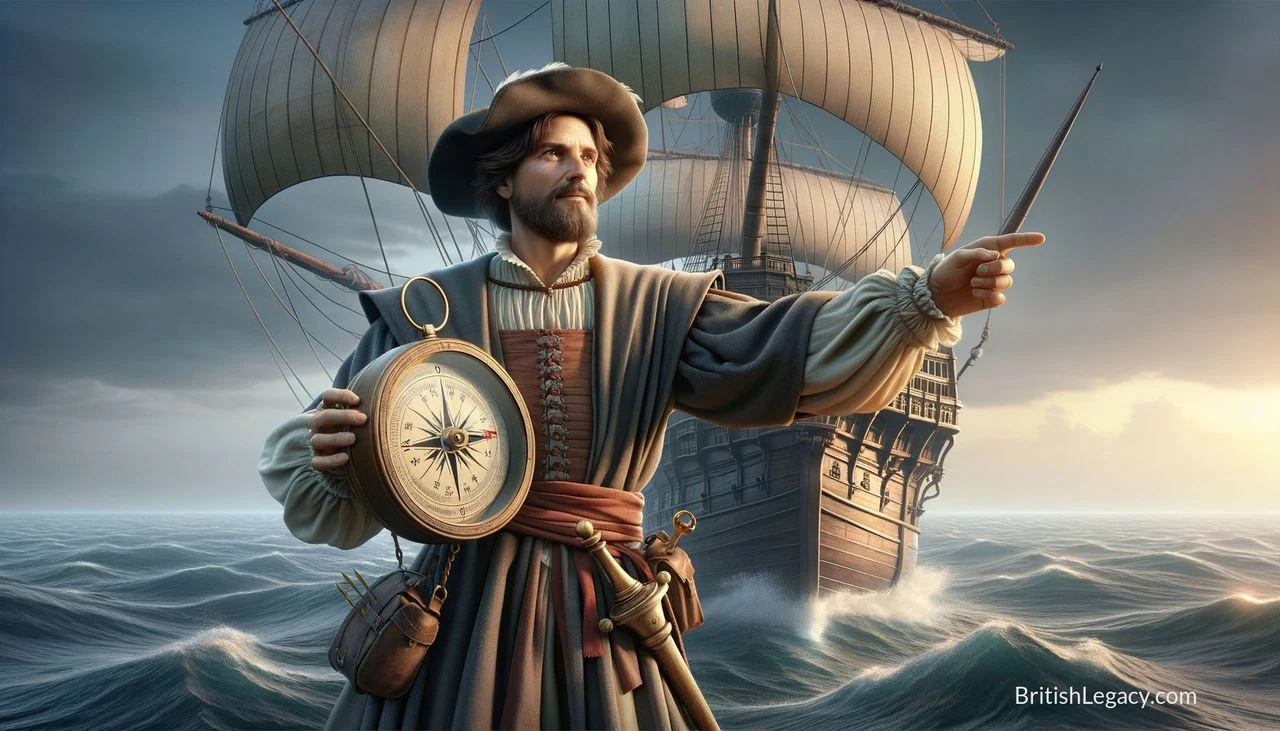
In 1497, John Cabot crossed the North Atlantic in the service of Henry VII of England. The voyage brought an English-backed expedition to the coast of North America and became an early marker of England’s later engagement with the continent. Cabot was born Giovanni Caboto in Genoa, but his expedition was organised from Bristol and undertaken under royal commission. Its precise landfall remains uncertain; its place in the history of English exploration rests on the voyage and the claims and ambitions attached to it, not on a settled identification of the shore.
From Italian ports to Bristol
Cabot was born in Genoa around 1450. The existing account places his early life in the maritime cities of Genoa and Venice, before he moved to England and reached Bristol around 1494. It offers little detail about his early years or how he acquired his navigational knowledge, so the path from his Italian origins to his English expedition is not fully documented here. What is clear from the account is that Bristol became the base from which he pursued a westward voyage across the Atlantic.
In 1496, Cabot sought backing from Henry VII for an expedition. The project belonged to an era of European interest in reaching lands and resources across the Atlantic, and the account associates Cabot’s proposal with the example of Christopher Columbus and reports of riches and new territories. The English king granted him a commission to seek lands on England’s behalf. That royal backing gave the voyage an English political purpose, although Cabot himself was Italian-born and the expedition was not evidence of an established English presence in North America.
The voyage of 1497
Cabot sailed from Bristol aboard the Matthew on 2 May 1497. The account describes the ship as Venetian-built and gives the crew’s number as 18. On 24 June, the expedition reached the North American coast. The precise location is disputed in the account, which identifies Newfoundland and Cape Breton Island as possible landfalls. It is therefore more accurate to describe the voyage as reaching the coast of North America than to present either location as certain.
The expedition’s significance lay in its English commission and the information and claims associated with its arrival. The original account presents it as the first European expedition since the Vikings to reach the continent, but its wording about setting foot ashore and the planting of an English flag goes beyond the detail it establishes. Cabot’s return to Bristol in August 1497 is also reported there. The voyage drew attention to the possibility of further English expeditions across the Atlantic, though it did not by itself create the later settlements or political arrangements that followed.
After the return
Cabot’s 1497 expedition was followed by further voyages, but their course and outcome are described only as uncertain and troubled. The account says his son Sebastian became an explorer and navigator, continuing the family’s association with exploration. It does not provide enough detail to establish the scope of John Cabot’s later journeys, so the record is clearest around the 1497 voyage and its return to Bristol.
The importance later attached to Cabot’s expedition must be distinguished from what it immediately achieved. It provided England with an early basis for asserting an interest in lands across the Atlantic, but the subsequent colonisation of North America unfolded over centuries and involved many people and expeditions. Cabot’s voyage can be understood as part of that longer history, not as its sole cause or as the moment when a British presence across the continent was secured.
Why John Cabot deserves a place in British Legacy
John Cabot’s place in British Legacy rests on a specific connection: an Italian-born navigator undertook a transatlantic expedition under the authority of the English crown. His 1497 voyage from Bristol linked a port in England, a royal commission from Henry VII and an arrival on the North American coast. The expedition’s uncertain landfall should remain part of its story, but that uncertainty does not erase its significance as an early English-backed Atlantic venture.
Cabot also offers a useful perspective on how the history of exploration became connected to later political claims. His voyage did not alone bring about the colonisation of North America, and it should not be credited with creating a lasting British presence by itself. Its value is more precise: it formed an early episode in England’s attempts to extend its reach across the Atlantic and helped establish a precedent for subsequent expeditions. Remembering Cabot in that measured way recognises the voyage’s place in English history while keeping its consequences in proportion.