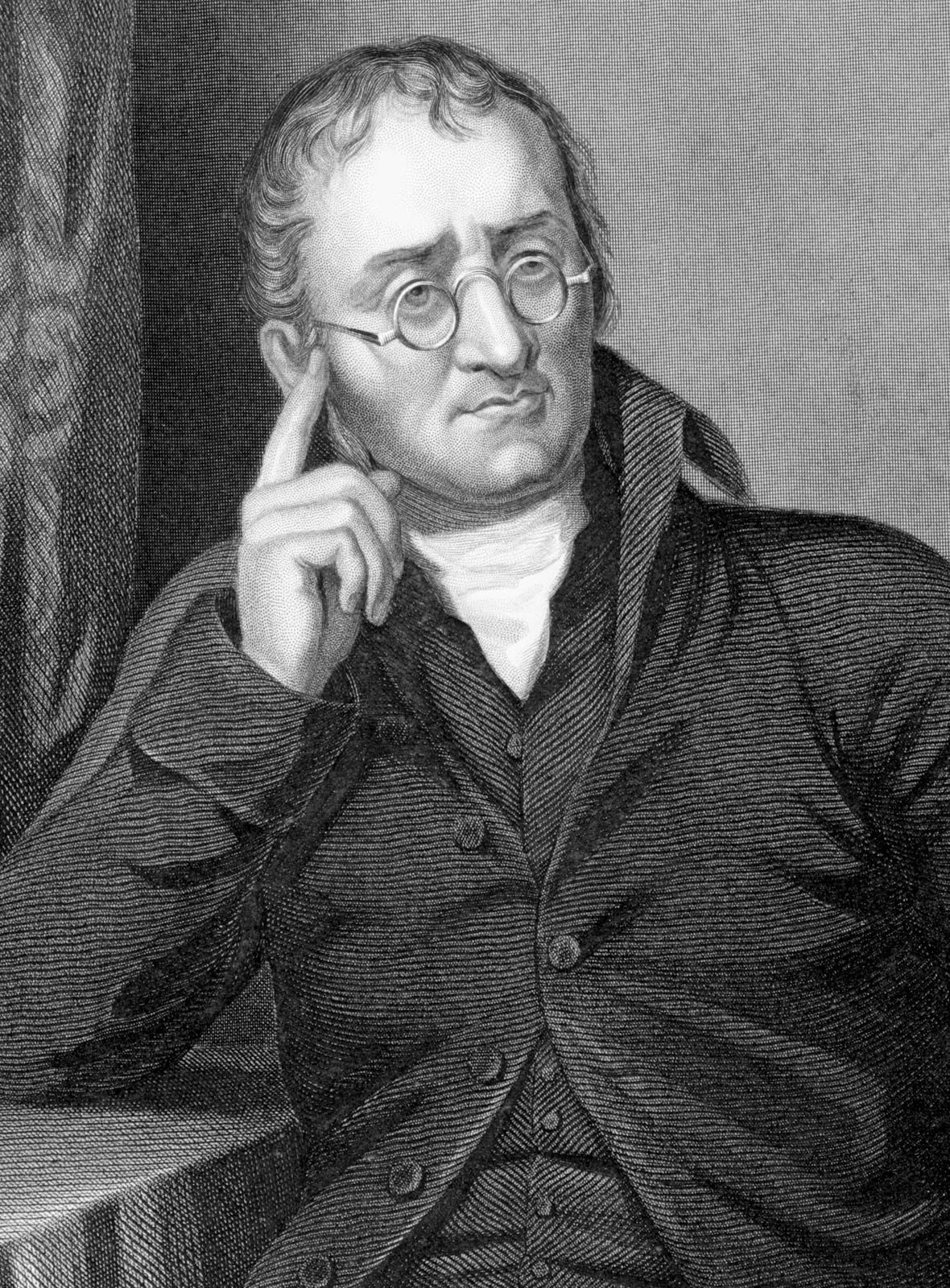
John Dalton did not originate the idea that matter might be made of atoms. His achievement was to give that idea a working role in chemistry. By relating elements to atoms of characteristic relative weights, and compounds to combinations in simple whole-number ratios, he offered chemists a way to connect what they could measure with an account of matter too small to see. Chemistry could be calculated as well as described.
Dalton developed this approach in Manchester, where teachers, investigators and learned societies sustained a lively culture of inquiry. His scientific work ranged from atomic theory to gases, weather and colour vision. Its common thread was a commitment to observation and measurement. Some of his proposed formulas and explanations were wrong; the framework he helped establish nevertheless gave later chemists a system they could test, revise and extend.
A Quaker education and a career in Manchester
Dalton was born into a Quaker family in Eaglesfield, Cumberland, on 5 or 6 September 1766. The supplied accounts differ over the day, so the discrepancy cannot be settled here. His father was a weaver, and the family had little money. Dalton received early instruction from his father and from John Fletcher, a Quaker schoolmaster. At ten, he began earning his living in the service of local Quaker Elihu Robinson, whose interests in mathematics and meteorology helped encourage the boy’s own studies.
Dalton taught from an early age and pursued learning within dissenting communities beyond England’s traditional universities. In 1793 he went to Manchester, where teaching and tutoring provided a living alongside his scientific investigations. Manchester offered him a setting in which industry, commerce and intellectual curiosity met. In 1794 he joined the Manchester Literary and Philosophical Society. He later became its secretary and then its president, and published many papers in its memoirs.
The society was more than a badge of membership. It gave Dalton a place to present observations, discuss explanations and exchange ideas with others engaged in natural philosophy. His career shows how scientific work could develop beyond the older university centres. A teacher working through a Manchester learned society became one of the central figures in the history of chemistry, supported by an institution rooted in the civic life of the city.
Dalton’s interests extended well beyond chemistry. In 1801 he published Elements of English Grammar, reflecting his work as a teacher as well as his scientific activity. He also contributed to the society’s extensive programme of publications: the supplied account reports that he contributed 117 memoirs between 1817 and his death in 1844. The quantity of this work gives a sense of his sustained participation in Manchester’s intellectual life, although his scientific reputation rests chiefly on his work on atoms, gases and meteorology.
Weather records and the study of gases
Dalton’s interest in weather began early and continued throughout his life. In 1787, aged 21, he began a meteorological diary. He kept it for 57 years, recording more than 200,000 observations and continuing until the day before his death. Repeated measurements allowed him to compare changing conditions over time rather than rely on isolated impressions. That discipline of recording and comparison also shaped his work in chemistry: he sought regularities beneath apparently varied phenomena.
He published Meteorological Observations and Essays in 1793. The book brought together observations and arguments on atmospheric subjects, and his wider writing included rain, dew, springs, heat and the behaviour of light. His annual visits to the Lake District also involved studying meteorology. In the absence of weather balloons and aeroplanes, measuring temperature and humidity at altitude required climbing; Dalton used a barometer to estimate heights. His observations of the region’s mountains were among the sources used for comparison by the local surveyor Jonathan Otley.
Dalton’s investigations of air led to a series of lectures in Manchester in 1801 on mixed gases, vapour pressure, evaporation and the expansion of gases. In the following years he published work on related questions. His studies of gas mixtures produced the law of partial pressures: the total pressure of a mixture is the sum of the pressures each gas would exert separately. The law remains associated with his name. It is one example of how he approached a complex whole by examining its parts and describing their relations quantitatively.
His work on gases helped direct his attention towards the particles that might account for matter’s behaviour. The supplied account of the development of his atomic theory cautions that its precise origins remain debated. It may have grown from his investigations of gases and their physical properties, as well as from attempts to reconcile chemical analyses. The secure point is not a single moment of inspiration but the method he ultimately brought to chemistry: use measured properties and combining quantities to make an atomic explanation answerable to evidence.
Atoms, ratios and a new chemical language
Dalton’s theory did not simply assert that atoms existed. It proposed that each chemical element consisted of atoms with a characteristic relative weight, and that atoms of different elements combined in fixed, simple ratios to form compounds. Chemical reactions, in this account, rearranged atoms. The theory connected experimental chemistry to an unseen structure and offered a way to reason from measured quantities towards the composition of substances.
In 1808 the first volume of A New System of Chemical Philosophy set out his ideas at length. Dalton published a table of relative atomic weights for six elements, taking hydrogen as the reference weight. He also devised circular symbols to represent elements and compounds. Chemists later adopted the more flexible notation associated with Jöns Jacob Berzelius, rather than Dalton’s system. The symbols changed, but the ambition behind them endured: chemistry needed a compact way to represent composition so that it could be compared, taught and debated.
Dalton’s atomic account helped make sense of what became known as the law of multiple proportions. When two elements form more than one compound, the quantities of one that combine with a fixed quantity of the other stand in ratios of small whole numbers. Carbon and oxygen, for example, form carbon monoxide and carbon dioxide in different proportions. Dalton’s theory gave chemists a way to connect such differences in measured composition with different numbers of atoms.
Relative atomic weights and combining ratios helped chemistry develop a quantitative architecture. The branch now called stoichiometry deals with exact numerical relationships in chemical reactions; Dalton’s work belongs near its beginnings because it linked analytical results to formulas and countable units. He did not create quantitative chemistry single-handedly, nor was every aspect of his theory settled. His contribution was to provide a coherent scheme in which chemical measurements could be interpreted through atomic weights and proportions.
That scheme had clear limits. Dalton’s “rule of greatest simplicity” required assumptions about how many atoms combined in compounds, even when the available evidence could not establish a formula. He represented water as HO rather than H2O, and some of his other proposed formulas were also incorrect. His account of atoms belongs to an early nineteenth-century model, not modern physics. Its historical importance lies not in the survival of every claim but in making atomic ideas part of an experimental and quantitative science, where they could be challenged and improved.
Dalton’s research also intersected with earlier work by other chemists, and the history of how he arrived at the theory is not entirely straightforward. The supplied Wikipedia account describes claims of influence and dispute, but also distinguishes the central novelty of Dalton’s work: a method for calculating relative atomic weights and relating them to chemical formulas. Rather than present him as the sole source of atomism, it is more accurate to recognise how he gave earlier particle ideas a distinctive quantitative application.
Colour vision: turning experience into inquiry
In 1794 Dalton presented a paper on what he called “the vision of colours”. He and his brother shared an unusual perception of colour, prompting him to investigate colour vision as a scientific subject. Dalton thought the condition arose from a discoloured fluid in the eye. That explanation was wrong, but he recognised that the shared condition might be hereditary and brought his own experience into a systematic discussion of perception.
Examination of Dalton’s preserved eye tissue in 1995 established that he had deuteranopia, a form of congenital red-green colour blindness. This later finding clarified the biological nature of his condition; it did not make his original explanation correct. His paper remains significant as an early scientific investigation of colour vision deficiency, and his name became associated with colour blindness in several languages.
Colour vision, meteorology and chemistry may appear to be distinct subjects, but Dalton approached each through observation, comparison and attempts to identify regularities. His scientific life was not confined to atomic theory. He wrote on atmospheric phenomena and light, investigated gases and considered how perception differed between individuals. Some interpretations proved mistaken, as his account of colour vision did, but his willingness to turn observation into a question for investigation was consistent across these fields.
Honours, independence and Manchester’s remembrance
Dalton’s scientific reputation grew during his lifetime. He was elected a Fellow of the Royal Society in 1822 and received its Royal Medal in 1826 for his work on atomic theory. He was also elected to the French Académie des Sciences. Recognition did not mean that he readily adopted every new convention. He continued to prefer his circular symbols after Berzelius’s notation gained ground, and the supplied account describes him as resistant to some conclusions reached by other chemists. Independence could become inflexibility, but it was also part of the character behind his own attempt to reorganise chemical thought.
Dalton suffered strokes in the final years of his life, including one in 1838 that left him with a speech impairment, although he continued to perform experiments. On 26 July 1844, with his hand trembling, he made his last meteorological observation. He died in Manchester the following day, aged 77. The diary that had begun in 1787 thus continued almost to the end of his life.
Manchester gave Dalton a civic funeral. His body lay in state at the Town Hall for four days, and more than 40,000 people filed past his coffin. The response went beyond the recognition of a specialist scientific community: it showed the public standing he had acquired in the city where he had spent much of his career. His memory remains present in Manchester in the name of John Dalton Street, a plaque marking the site of his laboratory, and university buildings and awards associated with him. The Dalton Medal is also awarded by the Manchester Literary and Philosophical Society.
His name has travelled beyond civic commemoration. Dalton’s law of partial pressures and the term “Daltonism” preserve different parts of his scientific story. Chemists and biochemists also use the dalton as a unit of mass. The Royal Society of Chemistry’s Dalton Division and its journal Dalton Transactions are further examples of how his name remains part of scientific institutions and practice. These honours and names do not all carry the same meaning, but together they point to the range of his influence.
Why John Dalton deserves a place in British Legacy
John Dalton deserves a place in British Legacy because he made an abstract idea useful to working science. He did not invent atomism; he developed a way to connect atoms with measured chemical combinations, relative weights and formulas. His model contained errors, including his formula for water, and later science revised its assumptions. Yet Dalton provided a framework in which proposals could be tested against chemical evidence. That contribution helped turn chemistry towards exact quantitative relationships and made later correction possible. His lasting importance is therefore not a claim that every answer he gave was right, but that he gave chemists a more powerful way to ask and investigate questions about composition.
His career also demonstrates the reach of British scientific life beyond its traditional university centres. Born in Cumberland and formed by Quaker teaching and learning, Dalton made his scientific career in Manchester. The city’s Literary and Philosophical Society offered a place to present work, exchange ideas and build a sustained scientific practice. His decades of weather observations, his research on gases and his investigation of colour vision show the breadth of that practice, while his atomic theory gave chemistry a quantitative structure with consequences far beyond the city. Manchester’s civic response to his death, and the continuing institutions and scientific terms that carry his name, record both local recognition and wider impact. His legacy joins patient observation and provincial intellectual life to a method of understanding matter that remains central to the study of chemistry.
Sources
John Dalton — Wikipedia, revision 1374984610
Adapted in part from John Dalton by Wikipedia contributors, under CC BY-SA 4.0. Text has been edited and combined with the existing article; this adapted text is shared under the same licence. Contributor history.