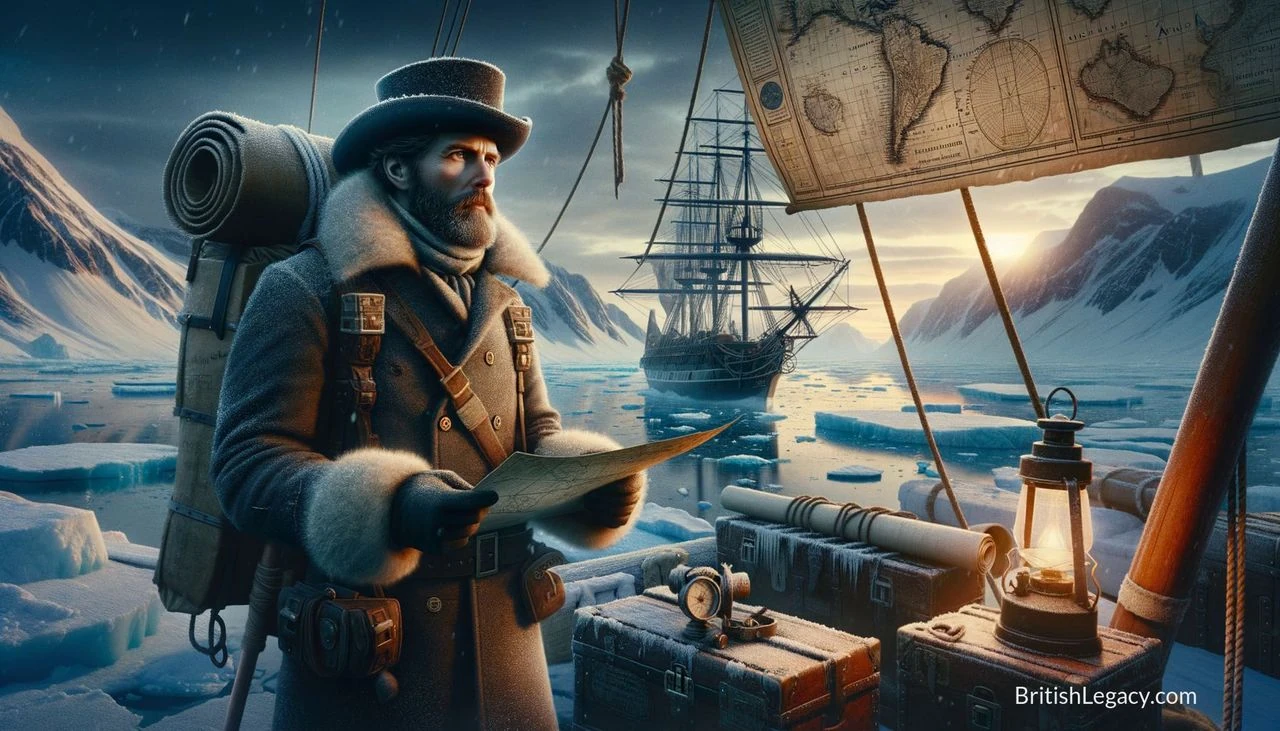
John Ross’s Arctic career was shaped by two expeditions in search of the Northwest Passage, the imagined sea route linking the Atlantic and Pacific through the Arctic. His first voyage ended in controversy when he turned back after interpreting a mirage as a mountain barrier. A decade later, he returned to the region in a privately funded expedition aboard the steamship Victory. That voyage reached the Boothia Peninsula and included the identification of the Magnetic North Pole by his nephew James Clark Ross.
From naval service to Arctic command
Born in Scotland on 24 June 1777, Ross joined the Royal Navy in 1786. His early naval service gave him experience at sea and in navigation before he became associated with the search for the Northwest Passage. In the early nineteenth century, that search drew attention because a route through the Arctic might connect the Atlantic and Pacific and offer new possibilities for trade. It was also a matter of national prestige and geographical inquiry.
In 1818, Ross was commissioned to lead an expedition seeking the passage. He sailed in HMS Isabella, accompanied by HMS Alexander, commanded by William Edward Parry. The voyage did not achieve its main objective. It nevertheless produced observations and surveys that contributed to geographical and scientific knowledge of the region. The expedition’s records would be part of the information available to later navigators and explorers.
A disputed decision, then a second voyage
The 1818 expedition became controversial because Ross turned back after seeing what he believed to be an impassable range of mountains. The feature was a mirage. Officers including Parry criticised the decision, and Parry went on to achieve success in subsequent Arctic exploration. The disagreement became a defining episode in accounts of Ross’s career: the voyage gathered information, but its early conclusion left his judgement open to challenge.
In 1829, Ross set out on a second Arctic expedition, this time privately funded. He commanded the steamship Victory and travelled towards the Boothia Peninsula. The expedition lasted until 1833. During it, James Clark Ross, John’s nephew and second-in-command, identified and named the Magnetic North Pole in 1831. The discovery was an important contribution to geomagnetism, the study of Earth’s magnetic field, and a notable result of the voyage.
John Ross later published an account of the expedition under the title Narrative of a Second Voyage in Search of a North-West Passage. His records and surveys, alongside the work of those who sailed with him, formed part of the geographical material gathered during the search for a route through the Arctic. Ross was knighted in 1834.
Surveying the Arctic and recording its voyages
Ross’s expeditions belonged to a wider effort to chart northern waters that were difficult to navigate and little known to European mariners. The search for a passage did not deliver the straightforward route its sponsors hoped to find. Yet voyages that failed in that primary aim could still yield observations, maps and records useful to subsequent explorers. Ross’s first expedition and his return to the Arctic therefore had different outcomes: the first was marked by a disputed retreat, while the second reached the Boothia Peninsula and produced the reported magnetic discovery.
His published narrative gave readers an account of the second voyage, while the surveys and observations associated with his expeditions added to the information available about the Arctic. The expedition’s achievement at the Magnetic North Pole belonged specifically to James Clark Ross, not John. Distinguishing the uncle’s command from his nephew’s discovery keeps the credit clear without diminishing the wider work of the crew.
Why John Ross deserves a place in British Legacy
John Ross’s place in British Legacy rests on a particular contribution to the history of British exploration: he commanded two expeditions into the Arctic during the search for the Northwest Passage. The first became controversial when he turned back after mistaking a mirage for a mountain barrier. That decision is part of the record, as is the criticism it drew from officers including Parry. Remembering both the dispute and the expedition’s observations presents a more useful account than a simple tale of triumph.
His second voyage, undertaken privately aboard the Victory, brought Ross to the Boothia Peninsula and included James Clark Ross’s identification of the Magnetic North Pole in 1831. John Ross’s published narrative and the surveys associated with his voyages helped preserve accounts of Arctic exploration and its findings. These achievements connect his story to Britain’s naval and geographical history, while keeping individual credit precise: command and expedition belonged to John Ross; the magnetic discovery was made by James Clark Ross. Together, the voyages show how exploration could produce lasting records even when the passage itself remained elusive.