
On 2 April 1739, John Wesley preached outdoors near Bristol, overcoming his scruples about taking a sermon beyond a church. The decision helped him reach people who rarely attended parish services and set the pattern for a ministry that would carry him across Great Britain and Ireland. Wesley did more than preach: he organised local societies, trained and appointed preachers, wrote prolifically and argued that religious commitment should change how people lived. The Methodist movement that grew from this work began within the Church of England, but developed structures and a following of its own.
A disciplined education, and a name first used in derision
Born in Epworth, Lincolnshire, on 28 June 1703, Wesley was the fifteenth child of Samuel and Susanna Wesley. His father was rector of Epworth; his mother took a close part in her children’s education. At 11, John went to Charterhouse School in London. In 1720 he entered Christ Church, Oxford, and after graduating stayed on for further study. He was ordained a deacon in 1725, elected a fellow of Lincoln College in 1726 and ordained an Anglican priest in 1728. He also taught and lectured at Oxford before returning to parish work.
On his return to Oxford in 1729, Wesley took the lead in a small religious society formed by his younger brother Charles and other students. Its members met for prayer and scriptural study, received Communion regularly and visited prisoners. Their scheduled, methodical habits prompted other students to call them the “Holy Club” and, derisively, “Methodists”. Wesley later helped turn that label into the name of a movement.
In 1735, John and Charles sailed to Georgia in the American colonies. John served as a parish priest in Savannah, but the mission ended badly: conflict over his treatment of a parishioner led to legal proceedings, and he returned to England in 1737. The voyage had brought him into contact with Moravian Christians, whose confidence in their faith made a lasting impression. Back in London, he joined a Moravian meeting in Aldersgate Street. On 24 May 1738, while listening to a reading of Martin Luther’s preface to the Epistle to the Romans, he wrote that he felt his “heart strangely warmed”. The experience became a defining point in his account of faith, though his preaching and theological development did not rest on a single moment alone.
Taking the sermon outside
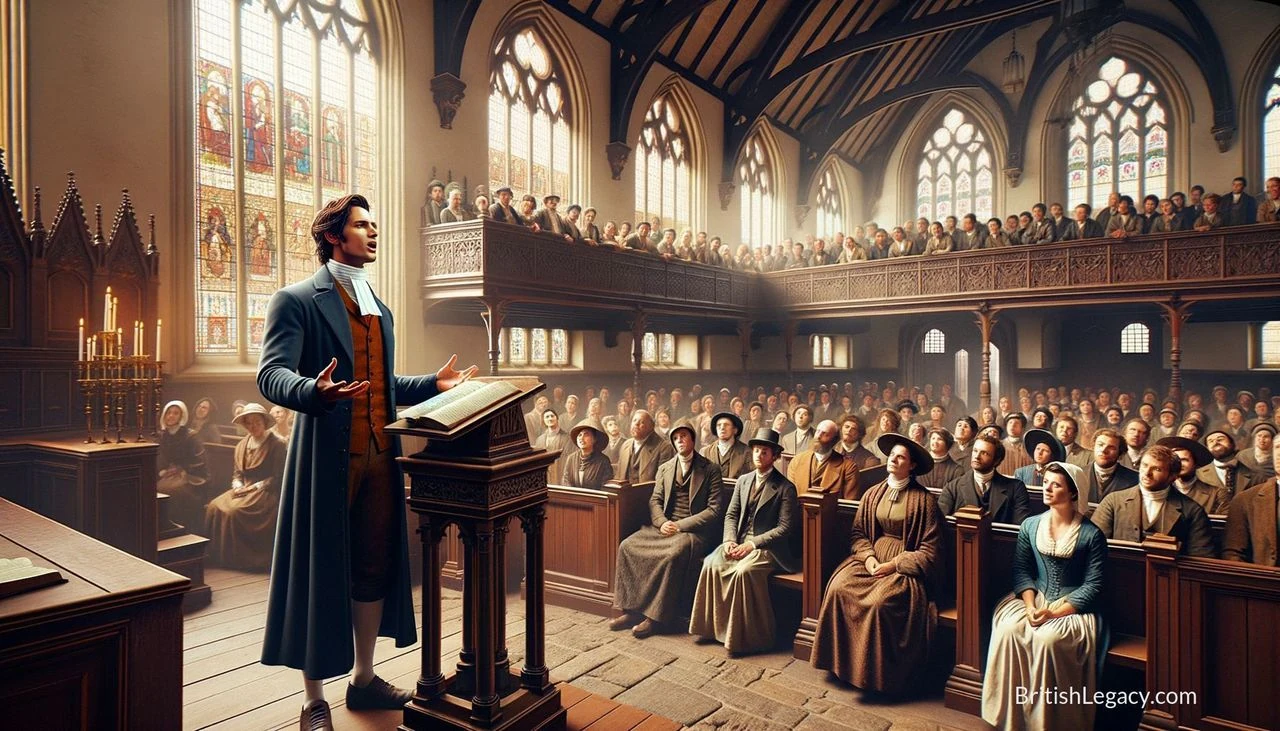
Wesley’s friend George Whitefield had begun preaching to crowds in the open air near Bristol. Wesley was initially reluctant to follow, having been trained to regard church worship and order as essential. He changed his mind and preached outdoors for the first time at Whitefield’s invitation on 2 April 1739. He went on to speak in fields, halls, cottages and chapels, as well as churches when invited. The approach brought his message to people who were unlikely to enter a parish church and became one of the defining methods of the revival.
As the audiences and societies grew, Wesley built an organisation to support them. He helped establish chapels, including the New Room in Bristol and, later, a chapel on City Road in London. Local groups met for fellowship and religious instruction; class meetings provided regular contact and mutual support. Societies were organised into circuits served by travelling preachers, and an annual conference helped co-ordinate the movement. Wesley drew up general rules for the United Societies and appointed lay preachers when the available clergy could not meet the demand. These preachers were not ordained by the Anglican Church, a practice that widened the reach of the movement and also sharpened its tensions with church authorities.
Wesley continued to identify with the Church of England and did not set out to found a separate church. Yet the societies acquired their own chapels, routines and leadership. In 1784, unable to secure Anglican ministers for Methodists in the newly independent United States, he ordained Thomas Coke and two other men for service there. The step helped establish an independent Methodist church in America. Wesley urged his English followers to remain within the established church, even as the movement’s separate organisation became more substantial.
Faith expressed in teaching and action
Wesley travelled extensively, usually on horseback, preaching frequently and organising the communities he visited. His work extended to Ireland as well as England, Scotland and Wales. He did not confine his energies to sermons: he wrote, edited or abridged hundreds of publications, including sermons, journals, hymns and theological works. His Forty-Four Sermons and Explanatory Notes Upon the New Testament became Methodist doctrinal standards. His writing also addressed practical subjects, among them medicine, music and the use of money.
His theology placed personal faith at the centre of Christian life and insisted that faith should be expressed in conduct. Wesley argued against Calvinist doctrines of predestination and emphasised the availability of grace to all. He taught that Christians should seek holiness and love of God and neighbour, ideas that shaped the character of the societies he organised. In his view, religious life involved more than private conviction: it called for disciplined practice, instruction and mutual responsibility.
Wesley also spoke and wrote against slavery. His 1774 tract Thoughts Upon Slavery condemned the trade and defended liberty as a right belonging to every human being. He supported the work of women in early Methodism as well. After Sarah Crosby began preaching while leading a large class, Wesley allowed her to continue, with guidance. In 1771, following an argument for women’s preaching made by Mary Bosanquet, he formally permitted women to preach in the movement. These measures were part of the practical development of Methodism, although Wesley’s permission was bounded by his own rules and expectations.
Writing, travel and a growing movement
Wesley’s ministry demanded constant movement between societies and preaching appointments. He visited Manchester repeatedly, travelled to Ireland from 1747 onwards and kept preaching into old age. His organisation gave local groups a structure that could continue beyond a single meeting or visiting sermon. The annual conference, travelling preachers, classes and circuits linked congregations while allowing the movement to expand into new towns and regions.
At the same time, Wesley remained a prolific writer and editor. His journals recorded the course of his work, while his sermons set out doctrine in a form intended for preaching and instruction. He compiled and published hymn books, including work with his brother Charles, whose hymns became closely associated with Methodism. Wesley’s publications were not limited to theology: he wrote on medicine and electricity, and produced a practical guide to remedies. His output reflected an effort to make religious teaching and useful knowledge available beyond the university or the pulpit.
In 1751 Wesley married Mary Vazeille, a widow with four children. The marriage was unhappy, and the couple separated in 1758. He died in London on 2 March 1791, aged 87, and was buried at his chapel on City Road. At his death, the Methodist movement had 135,000 members and 541 itinerant preachers, according to the account of his final years in the biographical record. The small Oxford circle whose discipline had attracted a mocking nickname had become an organised movement with a far wider reach.
Why John Wesley deserves a place in British Legacy
Wesley’s British legacy lies not simply in the size of the Methodist movement but in the practical means by which he built it. Field preaching took religious teaching to audiences beyond parish churches; classes, societies and travelling circuits gave those audiences ways to learn, meet and sustain a shared life. Lay preachers helped carry the work into places where clergy were scarce. Wesley’s system turned an itinerant ministry into an organisation capable of continuing across regions and, eventually, across generations. The development was not a clean break from the Church of England: Wesley sought to remain within it while making choices that gave Methodism increasing independence. That tension is part of the history, not an obstacle to understanding it.
His record also connects preaching to public questions. Wesley’s writing against slavery gave a clear religious argument against the trade, while his support for women preachers widened who could speak and lead within the movement. His publications, from sermons and theological notes to journals and hymn collections, helped carry its teaching beyond the places he could visit in person. Together, these achievements show how one eighteenth-century English cleric helped shape religious practice, organised community life and reforming debate in Britain. His importance rests on those specific, lasting contributions: a movement with local roots, a model of active religious organisation, and a body of teaching that joined personal faith to duties towards others.
Sources
Adapted in part from John Wesley by Wikipedia contributors, under CC BY-SA 4.0. Text has been edited and combined with the existing article; this adapted text is shared under the same licence. Contributor history.
.jpg)