Jonathan Anderson’s work moves between fashion, accessories and costume, often unsettling the familiar distinctions between menswear and womenswear. He founded JW Anderson in 2008, developed it from a menswear label into an internationally recognised fashion house, and went on to lead design at Spanish luxury house Loewe and French house Dior. His career links a Northern Irish upbringing with London training and the institutions, collaborations and fashion stages that shape the British industry.
From Magherafelt to London
Jonathan William Anderson was born on 17 September 1984 in Magherafelt, Northern Ireland. His father, Willie Anderson, played international rugby for Ireland; his mother, Heather Buckley, worked as a secondary-school English teacher. His grandfather was a textile designer. Anderson grew up in Northern Ireland during the Troubles and also spent considerable time in Ibiza, where his parents owned a house. He has described the contrast between those settings as formative.
At 18, Anderson moved to the United States intending to become an actor. He was based in New York at the Juilliard School, but became more interested in costume design than performance. After moving to Dublin, he got his first fashion-related job at the department store Brown Thomas. He later moved to London and graduated from the London College of Fashion in 2005.
Before establishing his own label, Anderson worked as a visual merchandiser for Prada, working with Manuela Pavesi. Those early steps placed him in different parts of the fashion business: retail presentation, a department-store environment, formal study and the visual world of an established luxury brand. In 2008, he launched JW Anderson with a menswear collection. The label’s beginnings in menswear became the starting point for a career that would repeatedly cross categories.
Building JW Anderson
Anderson’s first JW Anderson collection attracted critical attention. In 2010, the British Fashion Council’s NewGen initiative sponsored him, and he presented his first catwalk collection at London Fashion Week. A second NewGen sponsorship followed as the label developed. These stages connected a young designer and an independent label with one of Britain’s main platforms for presenting emerging fashion talent.
A collaboration with Topshop followed in 2012. Its limited-edition range combined clothing and accessories with items including stationery, phone cases and Rubik’s cubes. The collection sold out within hours of its launch, and another collaboration was scheduled for the following year. The partnership brought Anderson’s designs into a high-street retail setting as well as the fashion-show circuit.
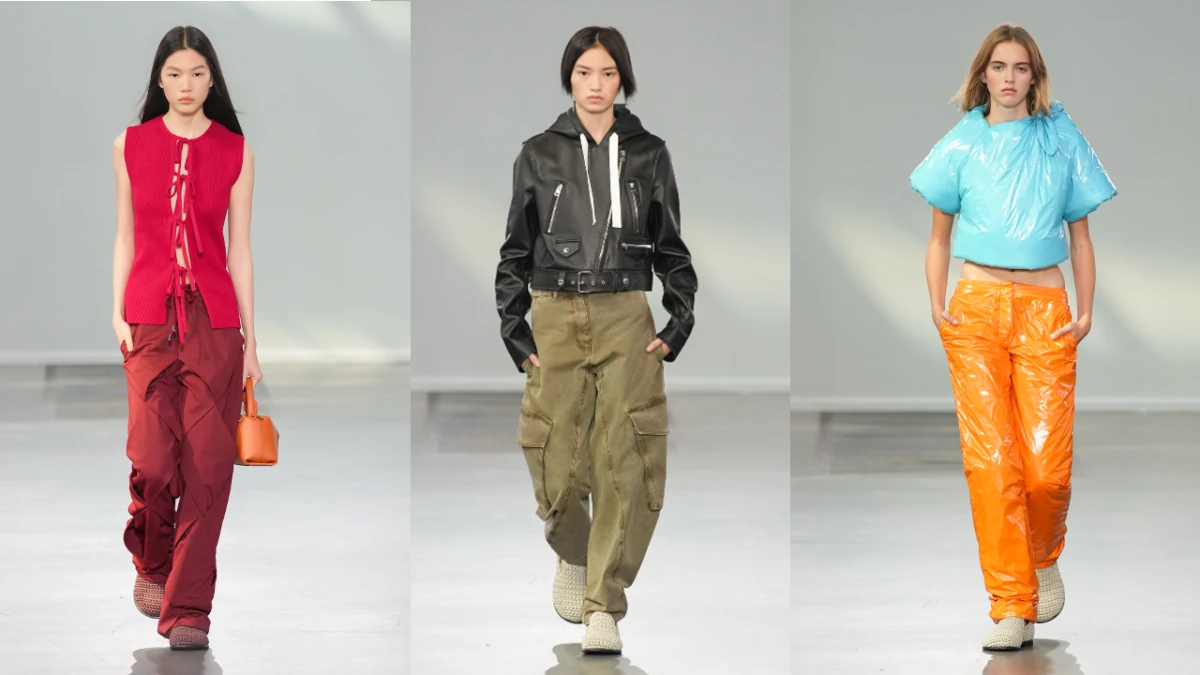
JW Anderson became known for bringing together elements conventionally associated with menswear and womenswear. Rather than treating those categories as fixed boundaries, Anderson used them as material to rearrange. Unusual silhouettes, varied fabrics and detailed finishes became part of the label’s visual language. This approach makes the work experimental without reducing it to a single slogan: the collections and objects show how familiar forms can be altered, combined or given a different use.
The Pierce bag is one recognisable example. Its circular, barbell-like closure turns a familiar accessory detail into a conspicuous feature. The design illustrates Anderson’s interest in shifting the character of an everyday object through a focused change in shape and hardware. It also demonstrates how accessories became an important part of the label’s public identity alongside clothing.
London fashion and international houses
In 2013, luxury group LVMH took a minority stake in JW Anderson and appointed Anderson creative director of Loewe, the Spanish luxury house. He led Loewe for 11 years before stepping down in March 2025. The role extended his work beyond his own label, placing him in charge of a separate house with its own history and craft traditions. It also made his career an example of how a designer working from a British fashion base can shape an international luxury brand.
Anderson’s workload across JW Anderson, Loewe and collaborations was substantial. By 2019, he was creating 18 collections a year: six for JW Anderson, ten for Loewe and two for ongoing Uniqlo collaborations. The Uniqlo work brought his design ideas into a different retail context from the luxury houses. Together, these commitments show the range of settings in which he worked, though they should not be mistaken for a simple measure of a collection’s reach or reception.
His work has also crossed into film and performance. In 2022, he worked with director Luca Guadagnino on the film Challengers, and in 2023 he served as costume designer for Guadagnino’s Queer. In February 2023, he designed the red outfit Rihanna wore to announce her second pregnancy during her Super Bowl half-time performance. These projects took his design practice beyond the seasonal fashion collection and into specific visual moments made for screen or a live audience.
Museum work and recognition
Anderson became a member of the Victoria and Albert Museum’s board of trustees in 2019. That appointment is a concrete connection to a British cultural institution and to the museum’s governance. It is distinct from claims that he curated exhibitions there: the available source records his trusteeship, not that curatorial role.
His awards include several British Fashion Awards. JW Anderson received the Emerging Talent Award for ready-to-wear in 2012 and New Establishment Designer of the Year in 2013. Anderson won Menswear Designer of the Year for JW Anderson in 2014 and 2015; in 2015, the label also received the Womenswear Designer of the Year award. In 2017, he was named British Designer of the Year in womenswear for JW Anderson and Accessories Designer of the Year for Loewe. Later recognition included the 2023 and 2024 Designer of the Year awards for work across JW Anderson and Loewe, and the CFDA International Designer of the Year award in 2023.
These honours span his own label and his work at Loewe, reflecting a career that did not remain within one house or one category. They also place Anderson’s achievements within an established British fashion-award framework, while the international roles and awards show that his work has been assessed and presented well beyond the UK.
Dior and a new phase
After leaving Loewe in March 2025, Anderson took on a new set of responsibilities at Dior. He was appointed artistic director of Dior menswear in April 2025, succeeding Kim Jones, and was named creative director of the house’s womenswear and couture collections in June that year. The appointments brought menswear, womenswear and couture under his direction at a major French fashion house.
In June 2025, Dior unveiled a reimagined Lady Dior handbag made in collaboration with textile artist Sheila Hicks. The bag debuted with Anderson’s Spring/Summer 2026 collection, his first for Dior. The project connects an established house accessory with a new design collaboration, while marking the beginning of his work across Dior’s collections. Anderson’s move to Dior is a new chapter rather than the conclusion of his career: the supplied account records his appointments and debut, not a settled final legacy.
Why Jonathan Anderson deserves a place in British Legacy
Anderson’s place in British Legacy rests on a specific combination of British fashion training, institutional support and achievements that travelled internationally. After graduating from the London College of Fashion, he built JW Anderson into a label that received British Fashion Council NewGen sponsorship and presented at London Fashion Week. Its Topshop collaboration took his designs into high-street retail; later Uniqlo collaborations offered another point of connection between his work and a broader retail audience. These are concrete links to the networks through which British fashion talent is developed, presented and circulated.
His contribution is also visible in the range of design settings he has entered. He led Loewe for 11 years, worked on film costumes and designed a high-profile performance outfit, while his appointment to the V&A’s board of trustees connected him to a major British museum. His awards recognise work across menswear, womenswear and accessories, rather than a single defining collection. Anderson is Northern Irish, London-trained and internationally active; that combination is more meaningful than a loose claim that any successful designer represents Britain. His career shows how a designer rooted in the UK’s fashion institutions can build an independent label, collaborate across retail and culture, and take on creative leadership at major houses abroad.
Sources
Jonathan Anderson (fashion designer), revision 1378375400
Adapted in part from Jonathan Anderson (fashion designer) by Wikipedia contributors, under CC BY-SA 4.0. Text has been edited and combined with the existing article; this adapted text is shared under the same licence. Contributor history.