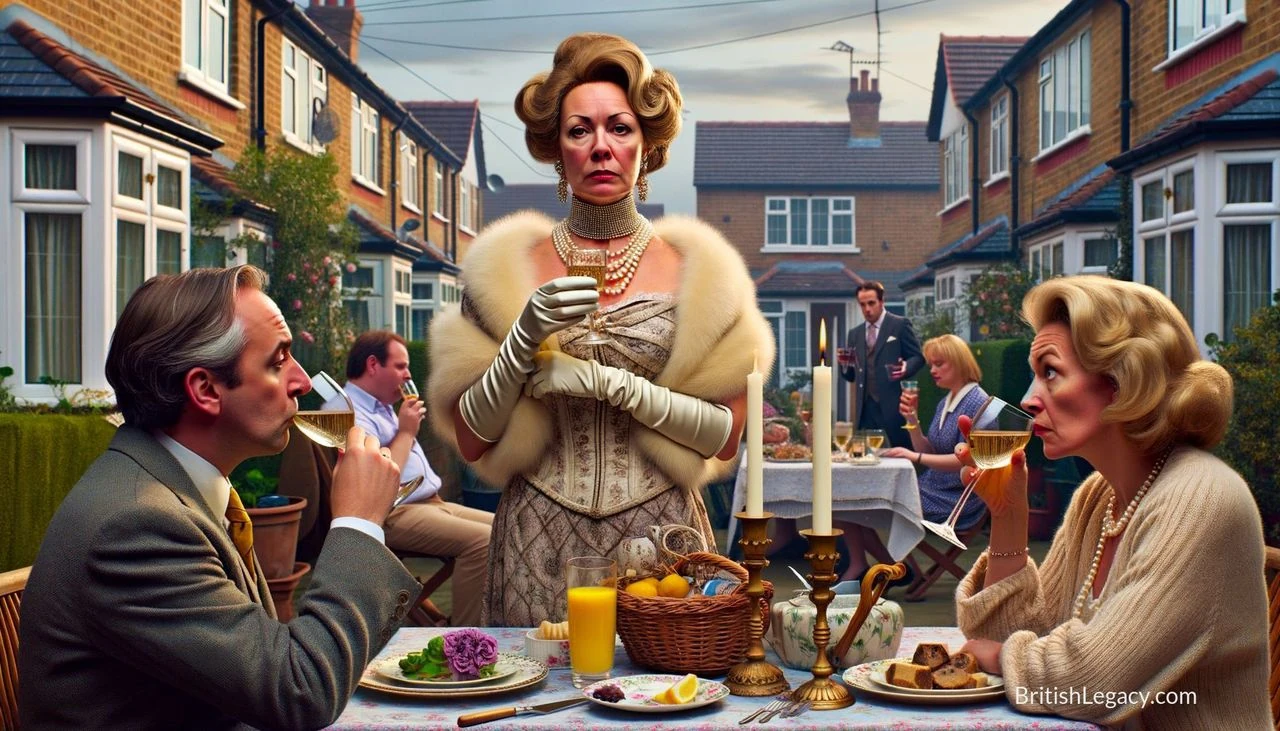
Hyacinth Bucket is determined to be admired as a woman of refinement. The difficulty is that she lives among the relatives she would rather keep out of sight, and that her neighbours and acquaintances rarely share her view of her social standing. In Keeping Up Appearances, her insistence that “Bucket” should be pronounced “Bouquet” captures the whole comic project: a change of emphasis meant to disguise a reality that keeps coming back into view.
Created and written by Roy Clarke, the sitcom ran on BBC1 from 1990 to 1995. Patricia Routledge played Hyacinth, with Clive Swift as her long-suffering husband, Richard. Across five series and 44 episodes, the programme built its comedy around the collision between Hyacinth’s carefully managed image and the people, habits and mishaps that unsettle it.
A name, a performance and a social ambition
Hyacinth’s surname is a running joke and a declaration of intent. She insists on “Bouquet”, presents herself as a model of good manners and takes conspicuous pride in her possessions. Her telephone greeting—“The Bouquet residence, the lady of the house speaking”—turns an ordinary call into a performance. A misdialled call from a Chinese takeaway, or a relative arriving at the wrong moment, can quickly undo the impression she is trying to create.
Her ambition is not simply to behave well. Hyacinth wants other people to recognise her supposed superiority. She visits stately homes in the hope of meeting their owners and hosts candlelight suppers she describes as executive-style. Neighbours and acquaintances are invited into a world of carefully displayed china and social rules. They may be reluctant guests, but their presence gives Hyacinth an audience for the status she is trying to project.
The joke depends on the difference between her public presentation and the background she fears will be exposed. Her working-class sisters Daisy and Rose, Daisy’s husband Onslow and their father repeatedly bring that background to her door. Hyacinth tries to distance herself from them, while they make little effort to conform to the image she wants to maintain. The family is not just an obstacle in her schemes; its presence shows how much effort those schemes require.
Richard, the neighbours and the people around her
Richard, played by Clive Swift, bears much of the strain of Hyacinth’s plans. He works in local government, and his wife describes his position in more grand terms than the programme’s account of his job warrants. At the start of the third series, he reluctantly accepts early retirement. His quiet exasperation provides a counterpoint to Hyacinth’s confident declarations, while his affection for her keeps their marriage from becoming only a contest of wills.
The wider cast supplies different reactions to Hyacinth’s self-invention. Daisy, played by Judy Cornwell, and Onslow, played by Geoffrey Hughes, live at an unhurried remove from the appearances Hyacinth prizes. Rose was played by Shirley Stelfox in the first series and by Mary Millar in series two to five. Their differing attitudes and circumstances repeatedly unsettle the social distinctions Hyacinth tries to draw.
Hyacinth’s neighbour Elizabeth Warden, known as Liz and played by Josephine Tewson, is often invited round for coffee. Although normally calm, she becomes so nervous in Hyacinth’s home that she spills coffee or breaks china. Liz’s brother Emmet, played by David Griffin, moves in with her in the second series. A musician, he finds himself the target of Hyacinth’s enthusiastic, out-of-tune singing whenever she hopes to be cast in one of his productions.
Other recurring characters widen the circle of people who have to manage Hyacinth. Jeremy Gittins plays Michael, the local vicar; George Webb plays her father; and Anna Dawson appears as her sister Violet in the fifth series. Hyacinth is proud of Violet’s apparent wealth, but even the family members she considers socially useful bring complications of their own. The comedy comes from the interactions among these characters, not just from Hyacinth’s attempts to impress them.
Five series, and a deliberate ending
The programme’s original BBC1 run began on 29 October 1990 and ended on 25 December 1995. Its five series were accompanied by four Christmas specials and a short Children in Need sketch. The final episode, “The Pageant”, marked the end of the sitcom after Routledge decided to pursue other television and theatre work. She later explained that she preferred to leave while audiences still wanted more rather than continue until they had tired of the character.
Clarke’s central comic device was the contrast between “Bucket” and “Bouquet”. He said he had been partly inspired by people with the surname Bottom who insisted on pronouncing it “Bo-tome”. In the series, Hyacinth’s preferred pronunciation makes social aspiration audible: she tries to alter how others hear her even as the programme shows the limits of that effort.
The programme also travelled beyond its original British audience. It was sold to overseas broadcasters and attracted audiences in countries including the United States, Canada, Australia, Ireland and New Zealand. By February 2016, it had reportedly been sold nearly a thousand times to overseas broadcasters, making it BBC Worldwide’s most exported television programme at that point. In Britain, episodes were later syndicated on channels including Gold and Drama; the full series was made available on BBC iPlayer in 2022.
After the original series
The characters returned in several related broadcasts. In 1995, a six-minute Children in Need sketch, “Daddy’s Dead”, placed Hyacinth in a dream about her father’s funeral. A later compilation, The Memoirs of Hyacinth Bucket, used clips from the series in a frame story featuring Daisy and Onslow; it was first broadcast in the United States in 1997. In 2004, the documentary series Comedy Connections devoted an episode to the programme, bringing together members of its cast and production team to discuss its making.
Clarke also proposed a spin-off centred on Onslow, Daisy and Rose living on the grounds of a manor house, but the idea was not commissioned. The programme instead acquired a prequel: Young Hyacinth, written by Clarke, followed the character as a young woman in the post-war period. Kerry Howard played Hyacinth, and the special was broadcast on BBC One in September 2016.
The series found a life in other formats, too. Its episodes were issued on VHS and DVD, and the BBC released three episodes on audio cassette in 1998, with Swift narrating as Richard. A stage adaptation toured UK theatres in 2010, with Rachel Bell as Hyacinth. It later received an American production in New York in 2015. These later versions took the same central character and comic tensions into new settings without changing the original television run.
Why Keeping Up Appearances deserves a place in British Legacy
Keeping Up Appearances deserves a place in British Legacy because it made social aspiration the engine of a sustained television comedy. Hyacinth’s performance of gentility is specific and memorable: the carefully pronounced surname, the formal telephone greeting, the china and the candlelight suppers are all attempts to turn social status into something visible. Yet the programme does not leave the idea at the level of a joke about manners. Her family and neighbours expose the difference between the image she promotes and the relationships she actually has to live with.
The series also owes its shape to the interplay of its ensemble. Routledge’s forceful Hyacinth needs Richard’s restraint, Liz’s anxious politeness and the less impressed responses of Daisy, Rose and Onslow. That balance lets the comedy examine class and self-presentation while keeping its focus on particular people and domestic encounters. Its original BBC1 run, overseas sales, later broadcasts and continuing availability on television and in home releases show how far this distinctly British story travelled. The prequel and stage adaptation carried its characters into new forms, while the original episodes remained the source of their appeal. The result is a comedy whose central contradiction still reads clearly: a person can work hard to command respect, but cannot entirely control how others see her.
Sources
Keeping Up Appearances (revision 1379702433)
Adapted in part from Keeping Up Appearances by Wikipedia contributors, under CC BY-SA 4.0. Text has been edited and combined with the existing article; this adapted text is shared under the same licence. Contributor history.