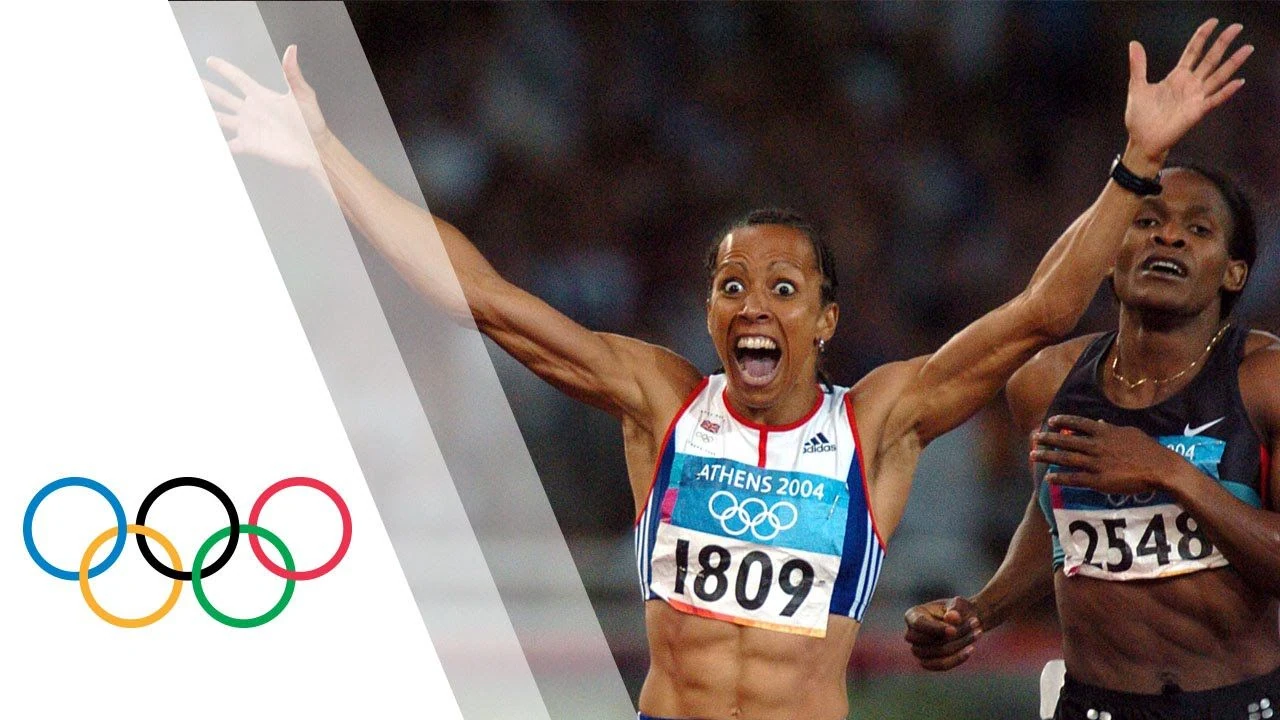
Dame Kelly Holmes reached the summit of middle-distance running at the Athens Olympics in 2004, winning gold in both the 800 metres and 1500 metres. The double capped a career built over many years: she had competed internationally while serving in the British Army, won medals at major championships and taken Olympic bronze before her triumph in Greece. Her story is not simply one of a breakthrough at Athens, but of an athlete returning to the track, negotiating injuries and steadily establishing herself among Britain’s leading runners.
Early running and Army service
Holmes was born in Pembury, Kent, on 19 April 1970. She grew up in Hildenborough and attended Hildenborough Church of England Primary School, followed by Hugh Christie Comprehensive School in Tonbridge. She began athletics training at 12, joining Tonbridge Athletics Club. Coached by David Arnold, she won the English Schools 1500 metres in her second season, in 1983. The performances of British middle-distance runner Steve Ovett, particularly his Olympic success in 1980, had inspired her.
Holmes joined the Army shortly before turning 18. She first worked as a heavy goods vehicle driver in the Women’s Royal Army Corps, then trained as a physical training instructor. She passed the Army’s new physical training syllabus in 1990 and later qualified as a Class 1 instructor. When the Women’s Royal Army Corps was disbanded in 1992, she remained in the Adjutant General’s Corps. Her Army service continued until 1997, during which she advanced to sergeant.
She did not leave athletics behind when she enlisted. Holmes competed at Army events and won the British Army judo championship. She also demonstrated her range on the track and field: at one athletics event, she won the 800 metres, 3000 metres and a relay in a single day, and she won a heptathlon. In 1992, watching the Olympic Games on television prompted her to return to athletics more seriously. For several years she combined training and competition with Army work; increased funding eventually enabled her to become a full-time athlete in 1997.
Building an international career
Holmes turned to the professional athletics circuit in 1993. The following year, she won the 1500 metres at the Commonwealth Games in Victoria and took silver over the same distance at the European Championships in Helsinki. At the 1995 World Championships in Gothenburg she won silver in the 1500 metres and bronze in the 800. Those results established her as a contender across both events, although progress was interrupted by injuries.
At her first Olympics, in Atlanta in 1996, Holmes competed in the 800 and 1500 metres while carrying a stress fracture. She finished fourth in the 800 and 11th in the 1500, without a medal. The following years brought further ups and downs: she won silver in the 1500 metres at the 1998 Commonwealth Games in Kuala Lumpur, then claimed bronze in the 800 at the Sydney Olympics in 2000. It was her first Olympic medal.
Her results continued to accumulate in the seasons before Athens. In 2002 she won the Commonwealth 1500 metres in Manchester and took bronze in the 800 at the European Championships in Munich. In 2003 she was runner-up in the 800 at the World Championships in Paris and the 1500 at the World Indoor Championships in Birmingham. These finishes formed part of a career that included medals at Olympic, world, European and Commonwealth level, and 12 national titles.
Athens: two Olympic titles
The run-up to Athens was difficult. During training in France in 2003, Holmes suffered leg injuries and became depressed. She later spoke publicly about self-harm and the pressure she experienced as an elite athlete, explaining that she wanted others to understand how demanding professional sport could be. By the time the 2004 Olympics began, she was competing without the injury worries that had affected much of her career.
Holmes had initially planned to run only the 1500 metres, but a victory over Jolanda Čeplak before the Games helped persuade her to enter the 800 as well. She did not announce that decision until five days before the event’s final. In the 800 metres, she resisted the fast early pace of several rivals and moved ahead of Maria de Lurdes Mutola on the final bend. Holmes took gold, finishing ahead of Hasna Benhassi and Čeplak, with Mutola fourth. It was Britain’s second women’s Olympic gold in the event, after Ann Packer’s win in 1964.
Five days later, Holmes won the 1500 metres in 3 minutes 57.90 seconds. The victories made her Olympic champion over both distances at the same Games. She also won the 1500 metres at the World Athletics Final in Monte Carlo later that year. Her performances in Athens were the defining results of a career that had included Olympic bronze, world and European medals, and years of competing while still in Army service.
Retirement, recognition and work beyond the track
Holmes announced her retirement from athletics in December 2005. Her final season had been affected by a recurring Achilles tendon injury, and she cited a loss of motivation as well as the death of a friend in explaining her decision. That year she received the Laureus World Sports Award for Sportswoman of the Year and was appointed Dame Commander of the Order of the British Empire for services to athletics. She had previously received an MBE for services to the British Army.
Her post-athletics work has included public speaking, television and efforts to support young people. Since 2004 she has taken part in athletics camps for junior athletes. In 2008 she founded the Dame Kelly Holmes Trust, a charity supporting young athletes and young people facing disadvantage across the UK. She has also taken part in fundraising events for the charity. Her work has included television presenting and appearances, including presenting an episode of the BBC series Women at War: 100 Years of Service in 2017. She has spoken publicly about mental health and menopause, and has promoted participation in parkrun.
Holmes has received further recognition for her contribution to sport. Loughborough University awarded her an honorary doctorate in 2007, and she was inducted into the England Athletics Hall of Fame in 2010. From 2018 until November 2024, she served as honorary colonel of the Royal Armoured Corps Training Regiment. Her Army experience has remained part of her public story alongside her sporting career.
Why Dame Kelly Holmes deserves a place in British Legacy
Holmes’s place in British sporting history rests first on a rare achievement: winning Olympic gold in both the 800 metres and 1500 metres at Athens in 2004. Those events demand different combinations of speed, endurance and race judgement, and Holmes secured both titles within the same Games. The achievement followed a long record of international competition, including medals at the World Championships, European Championships and Commonwealth Games, as well as an Olympic bronze in Sydney. Her career shows the breadth of British athletics success across distances and competitions, rather than reducing her to a single celebrated night.
Her contribution also reaches beyond the medals. Holmes competed while serving in the British Army, later became a full-time athlete and used her public profile to speak about the pressures and mental health difficulties she experienced. The Dame Kelly Holmes Trust extends that legacy into practical support for young athletes and young people facing disadvantage across the UK. Together, her sporting record, Army service and charitable work give her British connection a clear substance: she represented Great Britain at the highest level, earned recognition for services to athletics and the Army, and established an organisation intended to help others. Remembering Holmes means recognising both an exceptional Olympic double and the wider work she has undertaken since retiring from competition.
Sources
Kelly Holmes (revision 1379677124) · Kelly Holmes
Adapted in part from Kelly Holmes by Wikipedia contributors, under CC BY-SA 4.0. Text has been edited and combined with the existing article; this adapted text is shared under the same licence. Contributor history.