
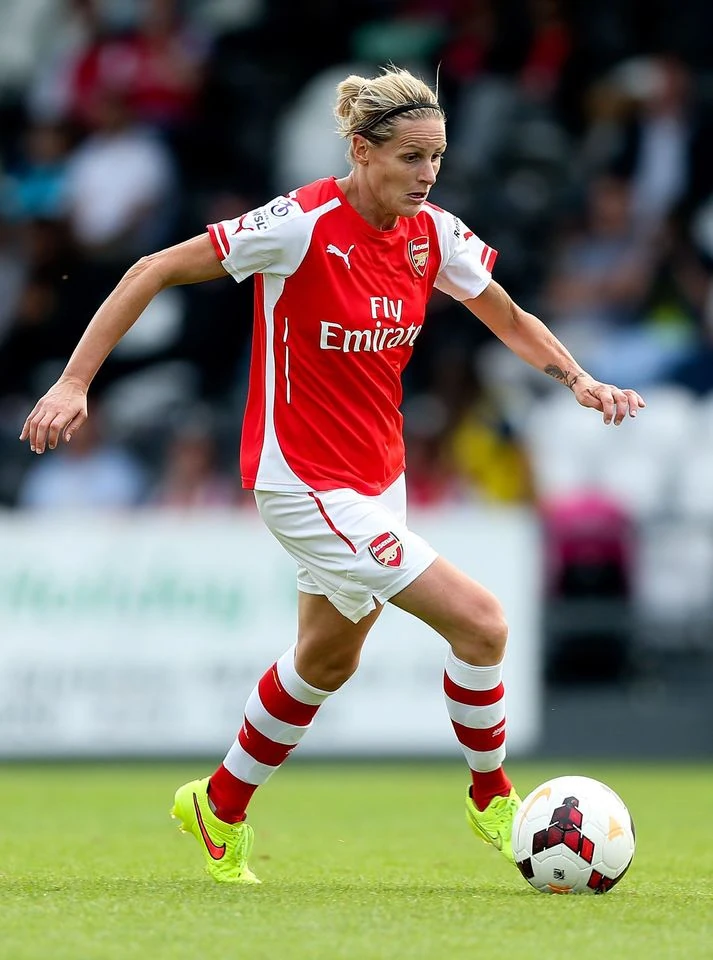
Kelly Smith’s career crossed two continents and several generations of women’s football. She emerged from Watford, became a record-setting university player in the United States, returned to win major honours with Arsenal and finished her England career with 117 caps and 46 goals. Injuries repeatedly interrupted that progress, but they did not diminish the range of her achievement: Smith competed at European Championships, World Cups and the London Olympics, and later returned to Arsenal in a coaching role.
A young player from Watford
Kelly Jayne Smith was born in Watford, Hertfordshire, on 29 October 1978. Growing up in the Garston area, she played for boys’ teams. At seven, despite being the team’s leading goalscorer, she was made to leave Garston Boys Club after parents of boys playing against her complained. Her father formed Pinner Girls, where she continued to play.
Smith joined Wembley Ladies and made her senior debut in the 1994–95 season. She attended Francis Combe School and Community College and spent time at West Herts College. In August 1995, shortly before her 17th birthday, she received an early public endorsement: a newspaper profile described her as an outstanding prospect in the women’s game.
She joined Arsenal during the 1996–97 season and helped secure the league title, scoring twice and assisting a third goal in a 3–0 win over Liverpool. The following year, she moved to the United States to study and play for Seton Hall University in New Jersey. There, Smith established herself as one of college football’s most productive players. In her first season she became the first athlete in any sport to win the Big East Conference’s Offensive Player of the Year and Newcomer of the Year awards in the same season. She led the Big East in scoring in each of her next two seasons and was also the leading scorer across NCAA Division I.
In three years, Smith scored 76 goals and recorded 174 points in 51 appearances for Seton Hall. The university retired her number six shirt; she was its first athlete outside basketball to receive that honour. The college years were not simply a detour before professional football: they made her a standout in a different football system and helped establish an international career.
Professional football on both sides of the Atlantic
After graduating, Smith remained in the United States. She played for the New Jersey Lady Stallions before being selected by Philadelphia Charge in the Women’s United Soccer Association’s 2001 foreign allocation draft. She played all three seasons with the club and was named to the league’s Global 11 All-Star Team in 2001. A torn anterior cruciate ligament in her right knee curtailed much of the next two seasons, and the league ceased operations after 2003.
Smith continued with the New Jersey Wildcats in 2004, scoring eight goals in eight appearances, but broke her leg. She returned to Arsenal later that year and rejoined the club officially in 2005. A stress fracture in her foot delayed her return to action. At the end of the 2004–05 season, she scored from 30 metres against Charlton Athletic to clinch the league title for Arsenal.
Her second Arsenal spell brought a remarkable run of team and individual success. In 2006–07, she scored 30 goals in 34 matches across four competitions during the club’s quadruple-winning season. She was suspended for both legs of the UEFA Women’s Cup final after being sent off in the semi-final, but Arsenal went on to win the European competition. In the league, she scored 73 goals in 66 appearances for Arsenal between 2005 and 2009. She won the FA Women’s Players’ Player of the Year award in 2006 and 2007.
Smith moved back to the United States in 2009 to play for Boston Breakers in the newly formed Women’s Professional Soccer league. She scored six goals in her first season and led the team with 11 goals in 2010. Further injury affected her 2011 campaign. When the league went on hiatus ahead of the next season, she returned to Arsenal for a third spell, turning down offers from Sweden and Germany. Another stress fracture—sustained before her return and aggravated during a promotional shoot—was an unwelcome start. Her final competitive Arsenal appearance brought a hat-trick in a 5–0 win over Doncaster Belles in the Premier League Cup final.
England, tournaments and an Olympic shirt
Smith made her England debut against Italy on 1 November 1995, three days after turning 17. She scored her first international goal in her second appearance, against Croatia. In a career spanning 1995 to 2014, she collected 117 caps and scored 46 goals, making her England’s second-highest goalscorer according to the career account. She became the team’s leading scorer at the time when she netted her 41st international goal, against Switzerland in September 2010.
Her tournament record included three UEFA Women’s Championships—in 2001, 2005 and 2009—and two FIFA Women’s World Cups, in 2007 and 2011. England finished runners-up at the 2009 European Championship. At the 2007 China Cup, Smith was named player of the tournament. She scored in England’s 2011 World Cup quarter-final against France, but England lost the shoot-out. Smith later spoke candidly about being dissatisfied with her own performance at that tournament, where an Achilles injury had affected her.
Smith also represented Great Britain at the 2012 London Olympics. Named in the squad for the home Games, she sustained a minor injury during the 1–0 group-stage win over Brazil at Wembley and was unable to take part in the quarter-final defeat by Canada. She announced her retirement from international football in February 2015. When the Football Association introduced legacy numbers to mark the 50th anniversary of England’s first women’s international, Smith was allotted number 108.
Recognition and a return to Arsenal
Smith was appointed a Member of the Order of the British Empire in the 2008 Birthday Honours. Her career brought distinction in England and in the United States: at Seton Hall, records and a retired shirt; at Arsenal, domestic and European trophies; and for England, a long international record spanning nearly two decades. The Women’s Super League Hall of Fame named her among its members in 2021.
Her later work has included broadcasting. She made her television debut on Fox Sports in December 2014 and provided commentary for the 2018 FIFA World Cup. In March 2023, Arsenal announced that she would return to coach at the women’s academy while working towards her UEFA A Licence. The following month, she joined the first-team coaching set-up until the end of the 2022–23 season. This return placed her back at the club where several of her most successful playing years had unfolded.
Why Kelly Smith deserves a place in British Legacy
Smith’s place in British sporting history rests on a body of work, not a single headline achievement. For England, 117 appearances and 46 goals represent exceptional longevity and output. She played at major European and world tournaments and represented Great Britain at the London Olympics. At club level, she helped Arsenal win league and cup honours, including the 2006–07 UEFA Women’s Cup, while her 30 goals in the club’s quadruple-winning season show the scale of her contribution. Her career also included success beyond Britain: Seton Hall records and a retired shirt, and professional seasons with Philadelphia Charge and Boston Breakers.
That transatlantic route matters to her British legacy. Smith developed in English grassroots football, went abroad to compete and study, then brought her experience back to Arsenal and the England team. Her career records the growth of women’s football through different environments, from a girl pushed out of a boys’ club despite leading its scoring to an established international whose performances drew recognition on both sides of the Atlantic. Her return to Arsenal as a coach extends that connection beyond her playing days. The honours, goals and trophies are specific measures of achievement; her continued involvement with the club also makes her experience part of the game’s present, not only its record books.
Sources
Adapted in part from Kelly Smith by Wikipedia contributors, under CC BY-SA 4.0. Text has been edited and combined with the existing article; this adapted text is shared under the same licence. Contributor history.
_(cropped).jpg)