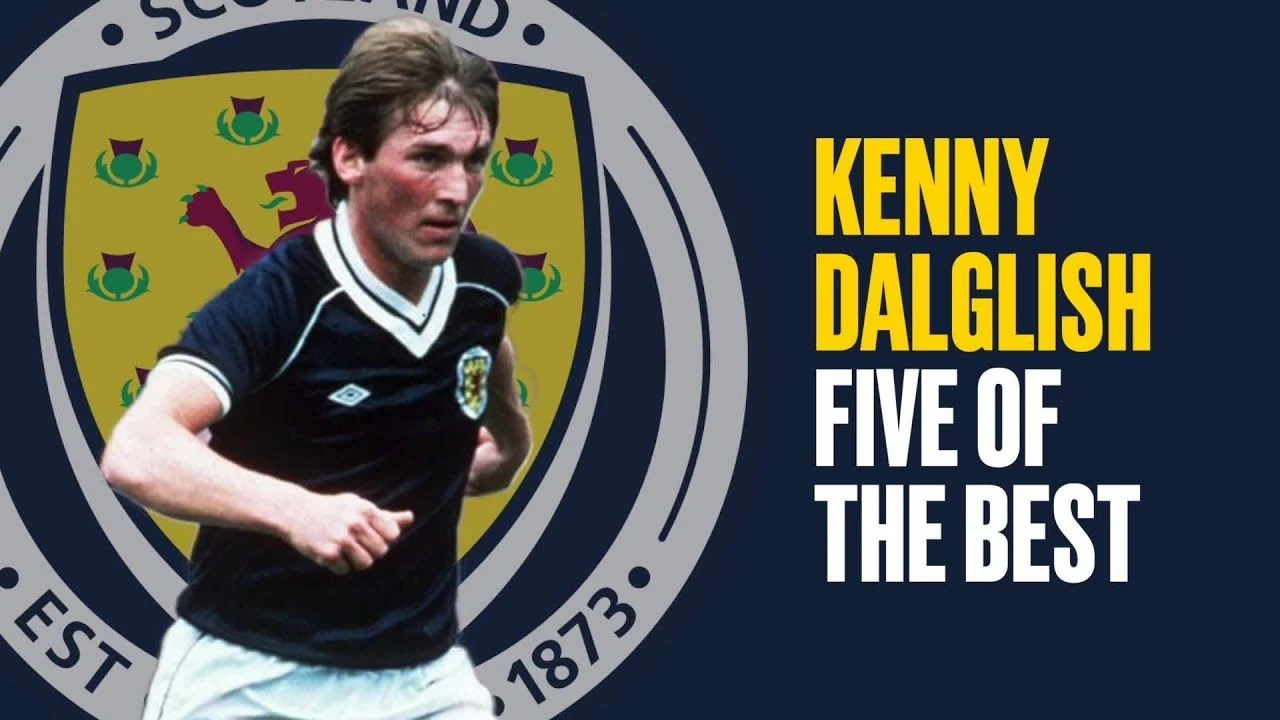
Kenny Dalglish made a career of connecting the pieces of a football team. A forward with the vision to create chances as well as score them, he became a central figure in successful sides at Celtic and Liverpool. He later took charge of Liverpool and Blackburn Rovers, winning league titles with both. His story links Scottish football with the English game, and includes a lasting contribution to Liverpool both on the pitch and beyond it.
From Glasgow to Celtic’s first team
Kenneth Mathieson Dalglish was born in Glasgow on 4 March 1951. He grew up in Milton in the north of the city, after his family moved from Dalmarnock. He attended Miltonbank Primary School and High Possil Senior Secondary School, played for Glasgow school teams and began as a goalkeeper. At 14, after another family move, he lived in Ibrox, near Rangers’ ground; he had grown up supporting the club.
Celtic signed him as a professional in 1967. He spent an initial season on loan at Cumbernauld United, scoring 37 goals, and worked as an apprentice joiner. At Celtic he developed through the reserves before establishing himself in the first team. His breakthrough came in 1971–72: he scored 29 goals in 53 games as Celtic won the league, then added the Scottish Cup. He went on to win four Scottish league championships and four Scottish Cups with the club, as well as a League Cup.
Dalglish became Celtic captain in 1975–76. The club won no trophies that season, but returned to a league and cup double in 1976–77. Dalglish scored 27 goals in all competitions. On 10 August 1977, Liverpool manager Bob Paisley signed him for £440,000, then a British transfer record. Dalglish left Celtic having made 320 appearances and scored 167 goals, according to the career account in the cited biography.
A defining Liverpool partnership
Dalglish joined Liverpool as a replacement for Kevin Keegan and made an immediate impression. He scored on his league debut against Middlesbrough, and again on his first appearance at Anfield, against Newcastle United. In his first season he scored 31 goals in 62 appearances, including the winning goal in the 1978 European Cup final against Club Brugge. He won six league championships as a Liverpool player, three European Cups and four League Cups, alongside other domestic and European honours.
His partnership with Ian Rush became one of the defining features of Liverpool’s attack. Dalglish could play as a second striker or a withdrawn forward, dropping deeper to link midfield and attack before moving into scoring positions. His close control, passing and sense of space let him supply Rush as well as finish chances himself. He was named Football Writers’ Association Footballer of the Year in 1979 and 1983, and the Professional Footballers’ Association Players’ Player of the Year in 1983.
Dalglish’s playing role changed as his Liverpool career progressed. He remained a regular even when he scored less frequently, then gave younger players greater priority after becoming player-manager. His final league appearance came in May 1990, when he was 39. By then, he had made 515 appearances for Liverpool in all competitions and scored 172 goals.
Player-manager, and the years beyond Liverpool
Dalglish became Liverpool’s player-manager in 1985, after Joe Fagan resigned in the aftermath of the Heysel Stadium disaster. In his first season, Liverpool won the league and FA Cup double. Dalglish scored the goal that secured the league title, a 1–0 win away to Chelsea on the final day, and also played in the FA Cup final victory over Everton. His Liverpool teams won further league titles in 1988 and 1990, and the FA Cup in 1989.
As manager, he was in charge of Liverpool at the time of the Hillsborough disaster in April 1989. He attended many victims’ funerals. The disaster’s aftermath and the demands of the job formed part of the circumstances surrounding his resignation in February 1991. His time at Liverpool’s helm combined competitive achievement with the responsibility of leading a club through profound loss.
Dalglish returned to management at Blackburn Rovers in 1991. He guided the club from the Second Division into the new Premier League and, in 1994–95, to the league title. That made him one of the small number of managers to win the English top-flight championship with two different clubs. He later managed Newcastle United, taking them to second place in the Premier League in 1996–97, and had a brief spell in charge of Celtic in 2000, winning the Scottish League Cup.
He returned to Liverpool in January 2011, initially as caretaker manager and then in the permanent role. His side won the League Cup in 2012 and reached that year’s FA Cup final, where they lost to Chelsea. Liverpool finished eighth in the league, and Dalglish left the managerial post in May. He returned to the club as a non-executive director in 2013.
Scotland, recognition and charitable work
Dalglish made his Scotland debut in 1971 and went on to win a record 102 caps, scoring 30 goals, a total shared with Denis Law. He represented Scotland at the World Cups of 1974, 1978 and 1982, starting in all three tournaments. He was selected for the 1986 squad but withdrew because of injury. His international career stretched from 1971 to 1986, making him a lasting presence in the national side as well as a leading figure at club level.
His honours include an MBE, awarded in 1985 for services to football, and a knighthood in 2018 for services to football, charity and the City of Liverpool. He has been inducted into the English and Scottish Football Halls of Fame. Liverpool named its Centenary Stand after him in 2017, recognising his contribution to the club. In 2023 he received the BBC Sports Personality of the Year Lifetime Achievement Award.
Dalglish and his wife, Marina, founded the Marina Dalglish Appeal in 2005 to raise money for cancer care. The appeal helped fund an oncology centre at Aintree University Hospital, which opened in 2007 after the charity had raised £1.5 million. In 2012, the foundation donated £2 million to the Walton Centre to help purchase an MRI scanner. Their work gave Dalglish’s public profile a purpose beyond football and supported treatment facilities in the Liverpool area.
Why Kenny Dalglish deserves a place in British Legacy
Dalglish’s place in British Legacy rests first on the range and substance of his football achievements. He was a major figure in Celtic’s success before moving between Scottish and English football as a player, then becoming one of Liverpool’s most influential forwards. His 102 appearances for Scotland and record 30 goals connect those club careers to a sustained contribution to the national team. At Liverpool, his partnership with Ian Rush exemplified a forward’s ability to shape a match through both finishing and creative play.
His managerial record adds another dimension. Dalglish led Liverpool to league and FA Cup doubles, won further league titles there, and took Blackburn Rovers from the Second Division to the Premier League title. Those achievements belong to different clubs and stages of English football, while his Celtic and Scotland careers root his story in the game north of the border. His role at Liverpool during the Hillsborough disaster is also part of his public legacy: he stood with bereaved families at a time of immense grief. Alongside this, the Marina Dalglish Appeal raised substantial funds for cancer care and equipment at Liverpool hospitals. Together, his playing, management and charitable work show a career whose impact reached beyond trophies and into the communities connected to the game.
Sources
Kenny Dalglish — Wikipedia revision
Adapted in part from Kenny Dalglish by Wikipedia contributors, under CC BY-SA 4.0. Text has been edited and combined with the existing article; this adapted text is shared under the same licence. Contributor history.