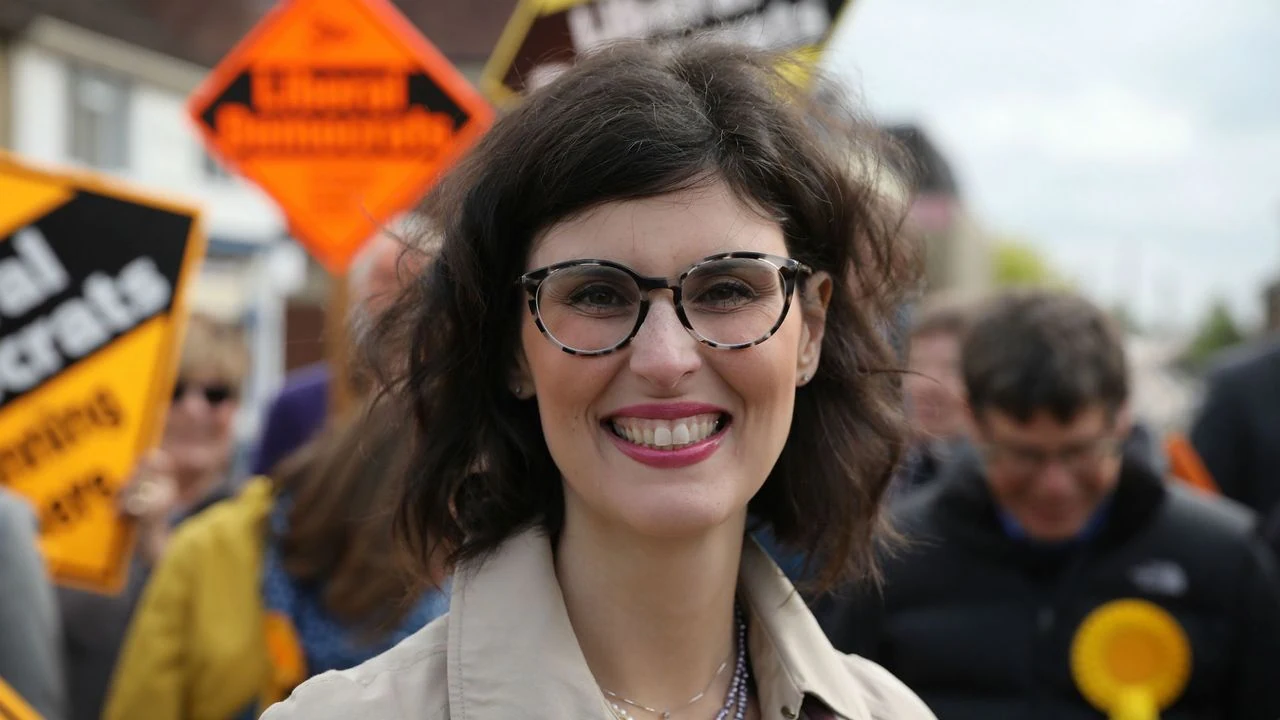
Layla Moran’s route to Westminster ran through science classrooms, not a party headquarters. A maths and physics teacher before entering politics, she came to Parliament with experience of the daily work behind education policy. Since her election in 2017 as Liberal Democrat MP for Oxford West and Abingdon, she has taken on roles covering education, foreign affairs and public spending; in September 2024, she became chair of the Health and Social Care Committee.
Classrooms before the Commons
Moran was born in Hammersmith in 1982, the daughter of diplomat James Moran and Randa Moran, a Palestinian Christian from Jerusalem. Her father’s work took the family to several countries, including Belgium, Greece, Ethiopia, Jamaica and Jordan. She attended schools in Brussels and Kingston before going to Roedean School in Brighton. Her upbringing crossed borders, but her political career would be built in British constituencies and Parliament.
She studied physics at Imperial College London from 2000 to 2003, then completed a teacher-training qualification at Brunel University London. From 2007 to 2008, she studied comparative education at the Institute of Education. The sequence matters: science degree, classroom training and further study of education gave her both subject knowledge and a grounding in how educational systems are organised.
From 2003 to 2012, Moran taught maths and physics at the International School of Brussels and at two London schools, Queensmead School and Southbank International School. She also tutored for Oxford Study Courses, which supports International Baccalaureate teachers and students, before becoming its full-time academic manager in 2013. This work preceded her parliamentary arguments about school funding and curriculum. It did not make her immune to political disagreement, but it gave those arguments a practical point of reference.
A route built through repeated candidacies
Moran’s first campaigns did not produce an immediate Commons seat. She stood for the Liberal Democrats in Battersea at the 2010 general election, finishing third, and contested the West Central constituency in the 2012 London Assembly election. In 2015 she fought Oxford West and Abingdon, finishing second to Conservative MP Nicola Blackwood.
Selected again for the constituency at the 2017 general election, Moran won with 43.7 per cent of the vote and a majority of 816. She defeated Blackwood and became the first MP of Palestinian descent and the first female Liberal Democrat MP from an ethnic-minority background. The result was a personal breakthrough after earlier defeats, as well as a change in who was represented in the Commons.
Her first parliamentary responsibilities came quickly. In June 2017, she became the Liberal Democrat spokesperson for education, science and young people. She used her maiden speech to call for fairer school funding and spoke that summer against the closure of Sure Start children’s centres in Oxfordshire. She also challenged the government over the funding of its 30-hours-free-childcare scheme. These interventions put education at the centre of her early parliamentary work, while showing that the detail of spending and provision would be as important to her as broad declarations of principle.
Education: funding, access and what is taught
In her first weeks as an MP, Moran argued that children should have equal access to education and linked that aim to fairer funding. The connection between the principle and the budget was characteristic of her approach: opportunity depends not only on what politicians promise, but on whether schools have the resources to deliver it. Her own experience of teaching maths and physics gave her a direct professional background in the system she was asking Parliament to scrutinise.
Her education brief also extended beyond school finances. Moran called for a review of the GCSE history curriculum, arguing that students should learn about Britain’s colonial past and the injustices associated with it. In 2020, after a petition calling for colonial history to be compulsory in the curriculum attracted more than 250,000 signatures, she and 30 other MPs pressed the government for significant changes. This was an argument about what education should include and how a country explains its past to the next generation, not simply about the organisation of schools.
After the 2019 election, Moran was re-elected with an increased vote share and majority. She continued as education spokesperson until 2020, having served in the role under three party leaders. The work connected her professional experience to a national political responsibility: representing concerns about resources and teaching in a forum where those decisions could be challenged publicly.
From public accounts to health and social care
Moran’s parliamentary work has also involved oversight of government. In September 2017, she joined the Public Accounts Committee, which examines public expenditure. Committee scrutiny can be less visible than a ministerial announcement, but it is one of the ways Parliament examines how public money is used and whether government decisions stand up to examination.
During the Covid-19 pandemic, Moran was one of three MPs who took legal action against the Department of Health and Social Care over the publication of details about contracts. The High Court found that the department had failed to comply with its transparency policy and had repeatedly breached the legal duty to publish contract award notices within 30 days. The case concerned the public record of decisions made during an emergency and the rules governing disclosure. It was one part of Moran’s wider record of pressing for accountability, rather than a substitute for the political work of setting policy.
Her roles within the Liberal Democrats broadened over time. She served as spokesperson for digital, culture, media and sport from 2019 to 2020, and from 2020 held foreign-affairs and international-development responsibilities. After the 2019 general election, she was re-elected for Oxford West and Abingdon. In 2020 she stood for the Liberal Democrat leadership, finishing second to Ed Davey. The contest was a party role, not an election to government, but it marked her emergence as a senior figure within the Liberal Democrats.
In September 2024, Moran was elected chair of the Health and Social Care Committee. The position moved her scrutiny work into a field that touches people directly through treatment, care and access to services. The committee’s remit includes examining the health and social care system; the chair’s task is to lead that parliamentary examination, not to run the services under review. The appointment brought together two strands of her career: experience in a public-facing profession and a record of asking how institutions perform and account for their decisions.
Representation and public life
Moran has described herself as British-Palestinian. Her family background is part of her biography, not a complete explanation of her politics. Her election nevertheless had a clear representational significance: she became the first MP of Palestinian descent. A Parliament that includes members with different family histories can bring a wider range of experiences into public debate, while the responsibility to argue and answer for political positions remains the same for every member.
In January 2020, Moran spoke publicly about being pansexual. She was reported as the first UK parliamentarian to come out as pansexual. The significance of that disclosure lies in its public example rather than any claim that a politician’s private life should define their work. Visibility can affect what people regard as possible in public life; it does not replace the policy record by which elected representatives are also judged.
Her political positions have included opposition to Brexit and support for a second referendum on EU membership. She later criticised her party’s policy of cancelling Brexit without a second referendum. On foreign affairs, she opposed the 2003 invasion of Iraq, criticised the Saudi-led intervention in Yemen and called for the release of Nazanin Zaghari-Ratcliffe, who was imprisoned in Iran. She has also supported recognition of Palestine. These positions reflect a career that has ranged beyond her original education brief, while the parliamentary roles she has held provide the formal settings in which she has pursued them.
There have been other areas of disagreement and constituency politics. Moran supported action on climate change and backed the Climate and Ecological Emergency Bill in 2021, while opposing proposed solar farms in her constituency in 2023. She also opposed a proposal for 11,000 new homes in Oxford by 2036. These examples resist a simplified portrait of a politician whose positions can be described by one label: decisions about environmental policy and development can involve competing priorities, and her public record includes taking positions on both.
Why Layla Moran deserves a place in British Legacy
Layla Moran deserves a place in British Legacy because her career connects professional experience with parliamentary work in a particularly clear way. Before asking questions about school funding and curriculum, she had taught maths and physics and worked with International Baccalaureate teachers and pupils. In Parliament, she argued for fairer funding and equal access, and called for a fuller account of Britain’s colonial past in the GCSE history curriculum. Those are specific contributions to a national debate about what schools can provide and what they should teach. Her significance does not depend on claiming that she alone changed education policy; it lies in bringing classroom experience into scrutiny of decisions affecting pupils, teachers and families.
Her record also illustrates less visible but essential forms of democratic work. Service on the Public Accounts Committee and involvement in the legal challenge over Covid-contract transparency show Parliament’s role in examining how government acts and spends. As chair of the Health and Social Care Committee, she leads further scrutiny of services on which people rely at vulnerable moments in their lives. Her election as the first MP of Palestinian descent, and her public disclosure that she is pansexual, have also widened the range of biographies visible in the Commons. Together, these achievements make her a subject for British Legacy not as a finished political story, but as an example of how representation, professional knowledge and accountability can contribute to British public life.
Sources
Layla Moran — Wikipedia revision 1372432288
Adapted in part from Layla Moran by Wikipedia contributors, under CC BY-SA 4.0. Text has been edited and combined with the existing article; this adapted text is shared under the same licence. Contributor history.