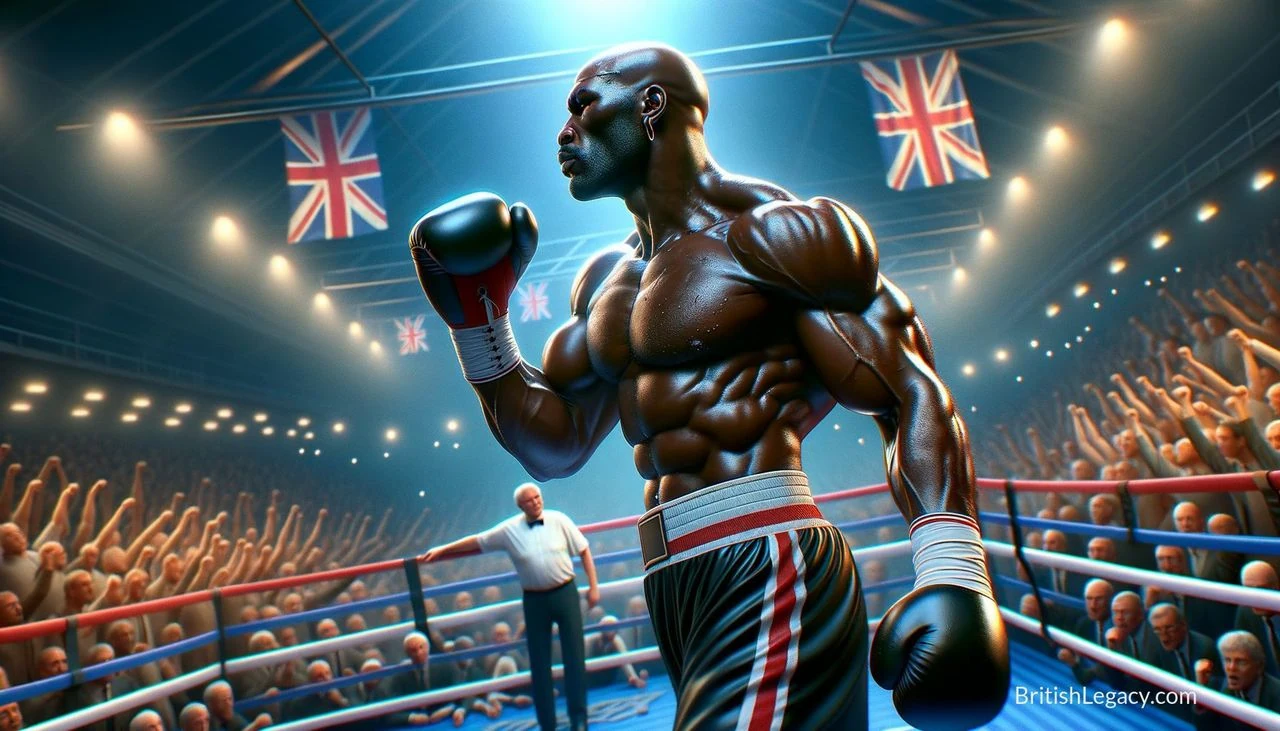
Lennox Lewis’s boxing career joined two countries and two kinds of achievement. Born in London, raised in Ontario and an Olympic gold medallist for Canada, he returned to England after the 1988 Games and began his professional career there. He won British, Commonwealth and European titles, became world heavyweight champion and, after two bouts with Evander Holyfield, unified the WBC, WBA and IBF belts. His last fight, against Vitali Klitschko in 2003, ended with Lewis victorious and still a world champion.
From London to the Olympic podium
Lewis was born in West Ham, London, on 2 September 1965. His parents were Jamaican immigrants. In 1977, when he was 12, he moved with his mother to Kitchener, Ontario. At Cameron Heights Collegiate Institute he played Canadian football, soccer and basketball, and helped the school’s basketball team win an Ontario provincial championship. He took up boxing around 1978, and in 1983 won gold at the Junior World Championships.
At the 1984 Los Angeles Olympics, Lewis represented Canada in the super-heavyweight division. He won his first bout but lost to American Tyrell Biggs in the quarter-finals; Biggs went on to win the gold medal. Lewis continued as an amateur rather than turning professional immediately. He won the super-heavyweight title at the 1986 Commonwealth Games in Edinburgh and competed at the 1987 Pan American Games. There he lost a close final to Cuba’s Jorge Luis González, then beat him eight days later to take the North American amateur title.
At the Seoul Olympics in 1988, Lewis reached the goal he had set himself. He defeated Riddick Bowe in the final by a second-round referee-stopped contest. Lewis carried Canada’s flag at the closing ceremony and became the first Canadian boxer to win Olympic gold in 56 years. The medal was a Canadian achievement; his professional story would be made chiefly in Britain.
Building a professional career in Britain
After the Olympics, Lewis declared himself a professional and moved back to England. He later explained that he had gone to the United Kingdom to pursue his career because Canada then lacked the infrastructure to develop boxers. His professional debut came in June 1989. He fought in both Britain and North America as he moved up the heavyweight rankings, and won a series of regional championships.
Lewis took the European heavyweight title in 1990, the British title in 1991 and the Commonwealth title in 1992. His victory over British champion Gary Mason helped establish him as a leading contender. He also beat former WBA champion Mike Weaver and Olympic gold medallist Tyrell Biggs. On 31 October 1992, Lewis stopped Donovan “Razor” Ruddock in two rounds, earning the number-one position in the WBC rankings and becoming mandatory challenger to champion Riddick Bowe.
Bowe relinquished the WBC belt rather than defend it against Lewis. The WBC declared Lewis its champion on 14 December 1992, making him the first world heavyweight titleholder from Britain in the 20th century. He defended the title three times, beating Tony Tucker, Frank Bruno and Phil Jackson by knockout. His 1993 fight with Bruno in Cardiff was the first modern-era world heavyweight title bout between two British-born boxers.
Lewis’s first reign ended at Wembley Arena in September 1994, when Oliver McCall knocked him down and the referee stopped the fight in the second round. Lewis and others in his camp argued that the stoppage was premature. After the defeat, he changed trainer, joining Emanuel Steward. Steward worked on his stance and technique, including the use of his jab. Their partnership lasted until Lewis retired.
Setbacks, rematches and undisputed champion
The route back to the title was not straightforward. Lewis won a series of comeback bouts, but the WBC passed him over for an immediate title opportunity. He regained the vacant WBC belt in a rematch with McCall in February 1997. McCall had lost the first three rounds and refused to box in the fourth and fifth; after he began crying in the ring, the referee stopped the contest and awarded Lewis the victory. Lewis then defended the title against Henry Akinwande, Andrew Golota, Shannon Briggs and Željko Mavrović.
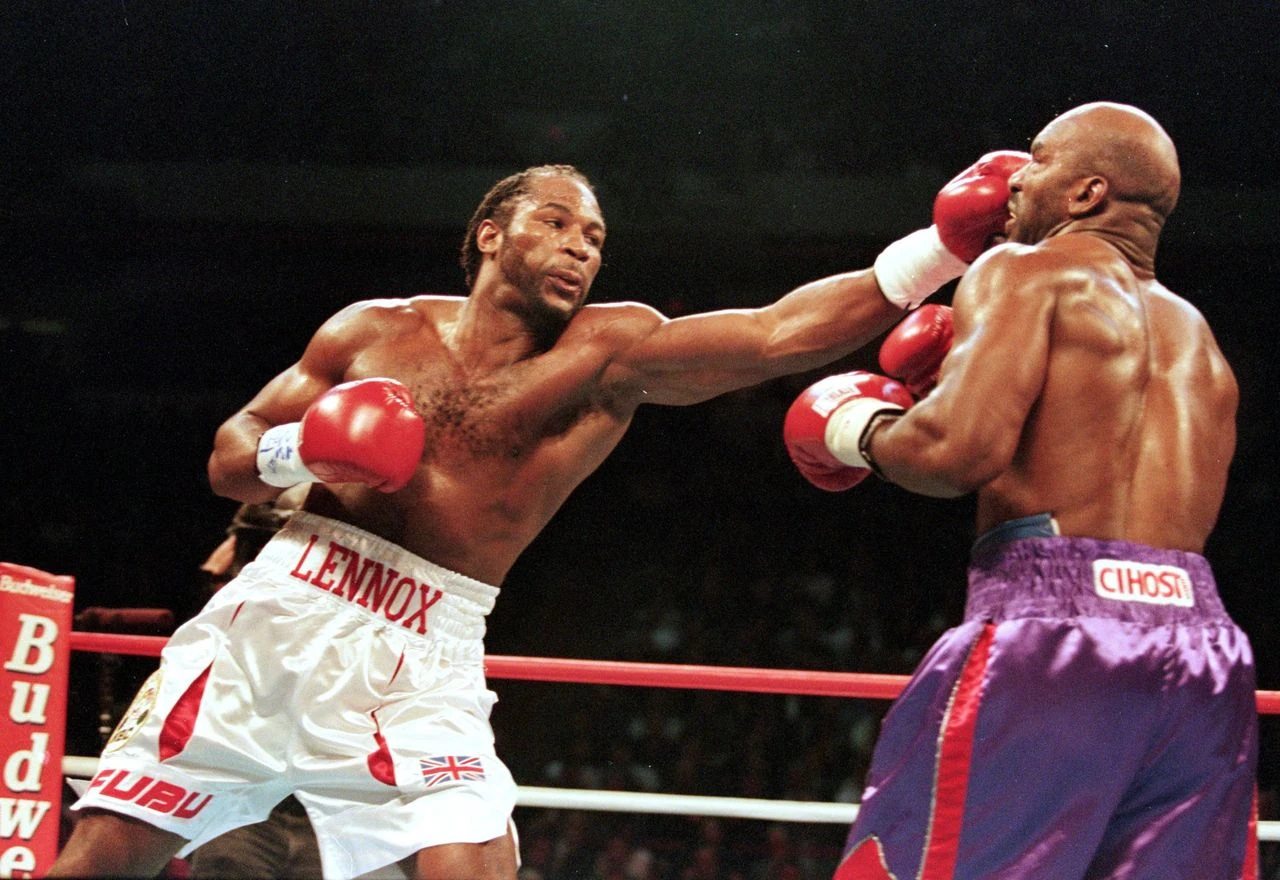
In March 1999, Lewis met WBA and IBF champion Evander Holyfield in a unification bout. Lewis fought behind his jab and landed more punches, but the judges declared a draw, a decision that drew widespread criticism. The two met again eight months later. This time Lewis won by unanimous decision, and became undisputed heavyweight champion by unifying his WBC title with Holyfield’s WBA and IBF belts. The distinction between the two bouts matters: their first contest did not make Lewis undisputed champion.
In April 2001, Lewis was knocked out by Hasim Rahman in South Africa. He pursued a rematch and regained the WBC and IBF titles in November, stopping Rahman in the fourth round. The following year, Lewis defeated Mike Tyson by an eighth-round knockout in Memphis. It was among the most anticipated contests of his career, but not his last: that came against Vitali Klitschko.
A final title fight, then retirement
Lewis had been scheduled to fight Kirk Johnson in June 2003, but Johnson withdrew with an injury. Lewis instead faced Klitschko, the WBC’s leading contender, in Los Angeles. Klitschko had the better of the early rounds and Lewis was hurt; Lewis later opened a cut above Klitschko’s eye and improved as the contest went on. The ringside doctor advised that the fight be stopped because of the cut, and Lewis won by technical knockout. Klitschko was ahead on all three judges’ scorecards when the bout ended.
Talk of a rematch followed, but Lewis announced his retirement in February 2004 and vacated his remaining titles. His professional record was 41 wins, two losses and one draw, with 32 victories by knockout. He had avenged both defeats, against McCall and Rahman. His final bout had been a world-title fight, and he left the sport as champion.
After boxing, Lewis worked as an analyst for HBO’s Boxing After Dark from 2006 to 2010. His other activities included film and television appearances and playing in the World Series of Poker. He established the Lennox Lewis Foundation, which helps disadvantaged children in Canada, Jamaica, the United Kingdom and the United States. Those later pursuits extended his public life, while the central record of his sporting career remained his work in the ring.
Why Lennox Lewis deserves a place in British Legacy
Lewis deserves a place in British Legacy because his achievements connect British boxing to a wider sporting history without simplifying his identity. He was born in London, moved to Canada as a child and represented Canada at two Olympic Games, winning gold in Seoul. He then returned to England to pursue professional boxing. There he won the British and European heavyweight championships, followed by the Commonwealth title, before becoming WBC world champion. His career was not exclusively British, and recognising its Canadian chapters makes the British part more—not less—distinctive.
The professional record gives that connection lasting substance. Lewis became the first world heavyweight titleholder from Britain in the 20th century, then unified the WBC, WBA and IBF championships after his rematch with Holyfield. He defended his position against leading opponents, including Tyson and Klitschko, and recovered from defeats by McCall and Rahman. His career also included a disputed stoppage and a controversial draw, reminders that championship histories are not always straightforward. Lewis’s British professional titles, world championship and final victory as a titleholder form a specific contribution to the country’s boxing story. Set beside his Canadian Olympic success, they make him a figure whose sporting legacy crosses national boundaries while remaining firmly part of British boxing history.
Sources
Adapted in part from Lennox Lewis by Wikipedia contributors, under CC BY-SA 4.0. Text has been edited and combined with the existing article; this adapted text is shared under the same licence. Contributor history.