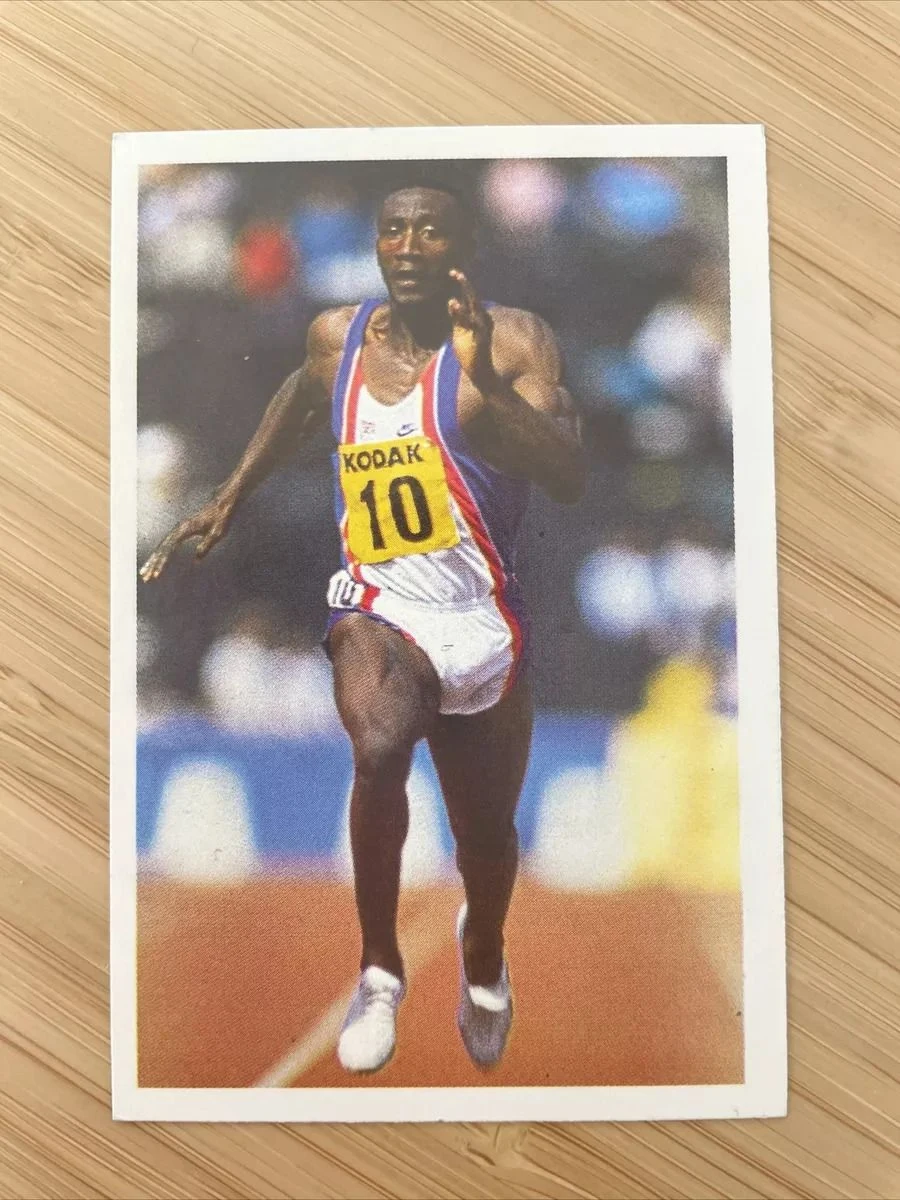
Linford Christie was 32 when he won the Olympic 100 metres in Barcelona, running 9.96 seconds to become the oldest male Olympic champion in the event. It was the defining moment of a career that also brought him world, European and Commonwealth titles, and a British record that lasted nearly 30 years. His path to sprinting’s biggest stages was not straightforward: he did not take athletics seriously until he was 18, missed selection for the 1984 Olympics and worked for years to improve his technique.
From Jamaica to west London
Christie was born in Saint Andrew, Jamaica, on 2 April 1960. He was brought up by his maternal grandmother before joining his parents in London at the age of seven. They had emigrated to England five years earlier and settled in Acton. Christie attended Henry Compton Secondary School in Fulham, where he excelled in physical education, and competed for Hammersmith and Fulham in the first London Youth Games in 1977. The following year, he joined the Air Training Corps.
Athletics was not an early certainty. Christie’s first years on the track were unpromising, and he was a comparatively slow starter. He began working seriously on his running technique in 1979 under coach Ron Roddan. His progress took time: Christie was not selected for the British team at the 1984 Summer Olympics, including for the sprint relay. Four years later, he would leave Seoul with an Olympic silver medal.
Building a championship career
Christie’s breakthrough came in 1986, when he won the 100 metres at the European Championships in Stuttgart. At the Commonwealth Games in Edinburgh that year, he finished second to Canada’s Ben Johnson. The next season brought fourth place in the 100 metres at the World Championships in Rome. He was subsequently awarded the bronze after Johnson was disqualified following his admission of steroid use.
At the 1988 Seoul Olympics, Christie won silver in the 100 metres. He ran 9.97 seconds, a European record, finishing behind Johnson, whose world-record performance was later disqualified after a positive drug test. Christie also reached the 200-metre final and ran in the 4 × 100 metres relay. His sprinting record in Seoul was accompanied by a separate controversy: after competing in the 200-metre heats, he tested positive for pseudoephedrine. The Olympic disciplinary committee gave him the benefit of the doubt, and he received no sanction. Christie said the substance had been taken inadvertently in ginseng tea.
He added European 100-metre titles in 1990 and 1994 to his 1986 victory, and won the event at the 1990 Commonwealth Games in Auckland. In 1992, he reached the Olympic 100-metre final in Barcelona. With his great rival Carl Lewis absent, Christie beat Frankie Fredericks of Namibia in 9.96 seconds. At 32 years and 121 days, he became the oldest man to win Olympic gold in the event, a record he still holds according to the article’s account. He was the third British athlete to take the Olympic 100-metre title, after Harold Abrahams and Allan Wells.
The peak: four major titles and a British record
Christie’s most exceptional season came in 1993. At the World Championships in Stuttgart, he won the 100 metres in 9.87 seconds, the fastest time of his career and a British record. The victory made him the first man to hold the Olympic, World, European and Commonwealth 100-metre titles at the same time. He also helped Britain win the 4 × 100 metres relay, with the team setting a European record of 37.77 seconds. Christie was voted BBC Sports Personality of the Year by the British public.
The 9.87-second mark remained the British record until 2023, close to 30 years after Christie set it. He was also the first European to break the ten-second barrier in the 100 metres, and did so nine times. In 1994 he defended his Commonwealth title in Victoria, Canada, running 9.91 seconds. His wider championship record included three Commonwealth 100-metre golds, three European outdoor 100-metre titles and medals in Olympic, world and indoor competition. Across his track career, he won 24 medals, more than any other British male athlete, according to the article’s account.
Christie’s achievements were not confined to the 100 metres. He set a European record of 6.47 seconds for 60 metres in 1995, and broke the world indoor 200-metre record with a time of 20.25 seconds that year. In the 1996 Olympic 100-metre final in Atlanta, he was disqualified after two false starts. He retired from representative international competition in 1997, though he continued to appear at invitation meetings.
Coaching, public life and scrutiny
After his competitive career, Christie worked as a coach and athletics mentor. Among the athletes he coached were Darren Campbell and Katharine Merry, both of whom went on to win Olympic and world medals. He also worked in broadcasting, presenting programmes including Record Breakers and Garden Invaders, and appeared in television drama and entertainment programmes. In 1993 he formed the sports management and promotions company Nuff Respect with sprinter and hurdler Colin Jackson.
His career also included difficult questions about drugs in athletics. The 1988 pseudoephedrine case ended without a sanction, but in 1999 a test at an indoor meeting in Dortmund found nandrolone. A British Athletic Federation hearing found him not guilty; the International Association of Athletics Federations overturned that decision and imposed a two-year ban. Christie, who had effectively retired from representative competition, denied wrongdoing. The IAAF rejected the explanations offered for the test result. The distinction between the two cases matters: the earlier Seoul test resulted in no penalty, while the later nandrolone finding led to a suspension.
Christie’s honours included appointment as an MBE in 1990 and an OBE in 1998. In 1993, the West London Stadium where he trained was renamed the Linford Christie Stadium. He was inducted into the London Youth Games Hall of Fame in 2009 and the England Athletics Hall of Fame in 2010. His career has therefore been remembered not only through medals and records, but also through the naming of a training venue and recognition by organisations connected with athletics and youth sport.
Why Linford Christie deserves a place in British Legacy
Christie’s place in British sporting history rests first on the scale and range of his achievements. He won the Olympic 100 metres in Barcelona, then became the first man to hold the Olympic, World, European and Commonwealth titles in the event at once. His 9.87-second British record stood from 1993 until 2023, giving that performance a significance beyond a single championship. His European record in the 60 metres, indoor world record in the 200 metres and European relay record in 1993 show that his career was not built around one race alone. For British athletics, those results established a sustained presence at the highest level of international sprinting.
His story also offers a more particular legacy than uncomplicated triumph. Christie did not make the 1984 Olympic team; under Ron Roddan’s coaching he developed his technique, returned to major competition and won Olympic silver in 1988 before taking gold four years later. The later nandrolone suspension belongs in that account too, alongside his denial of wrongdoing, rather than being erased or treated as the whole story. After competing, he coached athletes including Campbell and Merry, whose own Olympic and world medals connect his work to a subsequent generation. The Linford Christie Stadium and his place in the halls of fame of the London Youth Games and England Athletics make that influence visible in the sporting institutions that recognised him. His British legacy is therefore both a record of exceptional results and a continuing connection to the athletes, venues and competitions through which the sport develops.
Sources
Linford Christie — revision 1377031839 · Linford Christie
Adapted in part from Linford Christie by Wikipedia contributors, under CC BY-SA 4.0. Text has been edited and combined with the existing article; this adapted text is shared under the same licence. Contributor history.