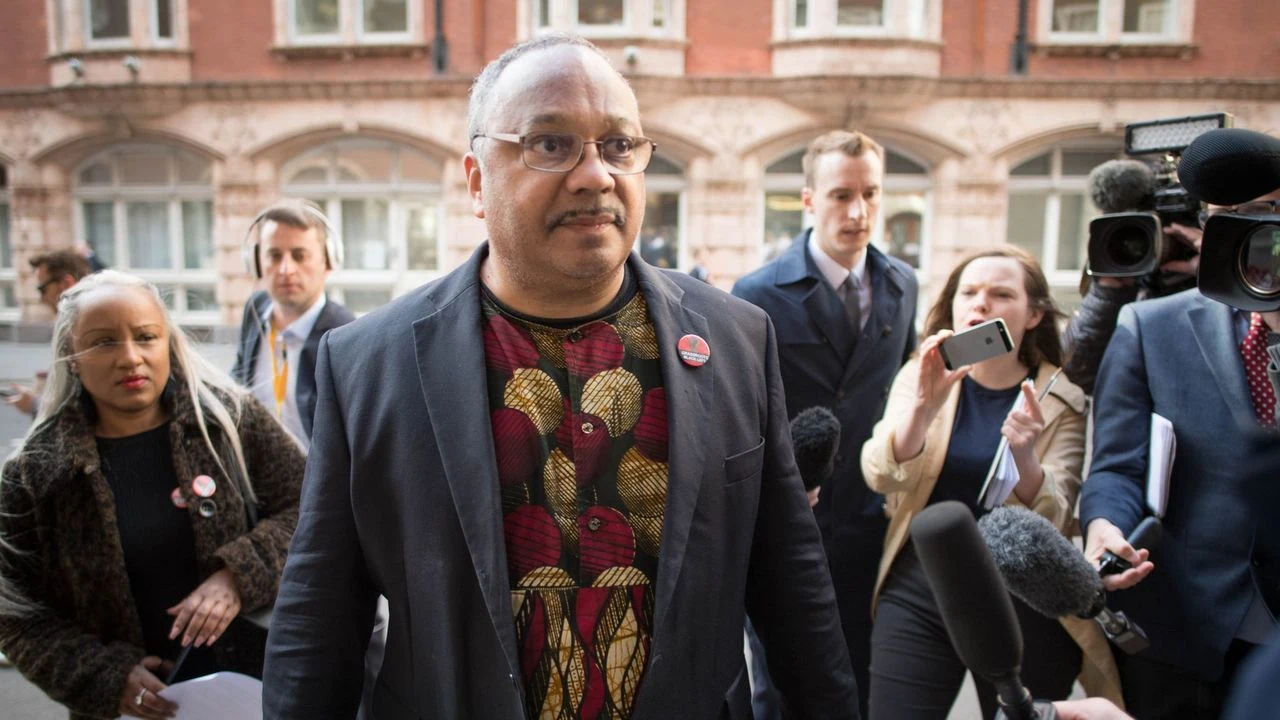
Marc Wadsworth’s career has moved between journalism, political organising and historical recovery. He campaigned for greater Black representation in Labour, founded the Anti-Racist Alliance, helped establish the justice campaign after Stephen Lawrence’s murder, and used newspapers, broadcasting and independent media to bring overlooked stories before the public. His record also includes a contentious dispute at the 2016 launch of the Chakrabarti Inquiry report, followed by his expulsion from the Labour Party. These different parts of his public life belong in the same account: they show a campaigner working within, and challenging, institutions that shape British politics, media and memory.
A Birmingham childhood and a family shaped by migration
Wadsworth was born in Birmingham. His father, George “Busha” Rowe, travelled from Jamaica to Britain in 1944 to serve as ground crew in the Royal Air Force during the Second World War. Rowe returned to Jamaica in 1946, then came back to Britain on the Empire Windrush in 1948. He and other Jamaican passengers settled in Birmingham, where they found accommodation and factory work. Rowe described the city as having a “colour bar” and being “unfriendly”. Wadsworth’s mother was Finnish. A hairdresser in Finland, she came to England at the age of 20 and worked as an au pair.
Wadsworth spent his first six years in a children’s home at Hagley, where his mother worked as a domestic helper, then a further year in foster care in Balsall Heath, Birmingham. He later attended Ottershaw School, a boys’ boarding school in Surrey. He recalled being the only Black pupil and being bullied. Inspired by Muhammad Ali, he took up amateur boxing at 13; he later described Ali’s politics in terms of Black Pride and Black Power. These experiences help place his later concerns in context, but they do not offer a simple explanation for a career that took shape through work, organising and political choices.
Journalism became both a profession and a route into public campaigns. Wadsworth worked across print and broadcasting, taught the subject and developed media projects of his own. He was not only a commentator on institutions: he also served within a professional union and sought to make space for forms of journalism beyond established news organisations. Across these roles, a recurring issue was who could speak, whose accounts were heard and how people might challenge the institutions reporting on their lives.
Organising for representation and legal change
In the early 1980s, Wadsworth helped secure the establishment of Black Sections, or caucuses, within the Labour Party. The proposal was first tabled in 1983 and sought greater political representation for African, Caribbean and Asian people. It made inclusion an organised question within a major political party: access to candidate selection and decision-making affects who can enter public life and speak from positions of authority. The supplied biographical account notes that all four of Britain’s first modern minority African, Caribbean and Asian MPs were members of Black Sections.
That work was collective, not a solitary achievement. Black Sections aimed to give members a means of pressing for representation inside a party whose structures could otherwise leave advancement dependent on established networks. Wadsworth’s contribution lay in helping make the demand more organised and harder to treat as peripheral.
In 1991, Wadsworth founded the Anti-Racist Alliance (ARA). Its campaigning connected public mobilisation with calls for legal reform. The organisation secured work from human-rights lawyer Geoffrey Bindman on proposals to make racial harassment and racial violence specific criminal offences; the supplied Wikipedia account says the proposals later became law. Wadsworth lost his position as ARA leader in 1994 following disputes involving Socialist Action and Ken Livingstone. That rupture is part of the organisation’s history, and a reminder that movements sharing a goal may still disagree over leadership and direction.
The Stephen Lawrence campaign
Stephen Lawrence, a Black teenager, was murdered in a racist attack in Eltham in April 1993. Wadsworth and the ARA helped set up and support the campaign for justice. He introduced Lawrence’s parents, Neville and Doreen, to Nelson Mandela and Archbishop Desmond Tutu, connecting their demand for accountability with a wider anti-racist movement. The campaign helped keep the case in public view and challenge the authorities’ handling of it.
The consequences of the Lawrence campaign are often discussed through the Macpherson Report and its finding of institutional racism. Wadsworth did not act alone, and the history cannot be reduced to one organiser. Public scrutiny does not arise by itself: campaigners help create the conditions in which institutions must answer questions they might otherwise leave unresolved. His work belongs to that broader effort to ensure that the case, and the failures surrounding it, remained part of the national conversation.
Journalism, unions and an early online platform
Wadsworth’s media work spanned print, radio and television. A 1990 appearance on The Black and White Media Show placed him among Black broadcasting figures addressing how television served a society marked by prejudice and discrimination. He later wrote for national newspapers, reported and presented for BBC radio and television, and worked for ITV’s Thames News. He also interviewed Margaret Thatcher, who, he recalled, walked out when he asked about the vote by her colleagues that effectively removed her from power.
His involvement in journalism included professional representation and teaching. He served twice on the National Executive Council of the National Union of Journalists (NUJ) and chaired its Black Members’ Council. From 2001 to 2012, he lectured in journalism at City University London and also took part in community journalism training. In March 2023, the NUJ awarded him its Gold Badge for his “exceptional contribution” to the union over many years. These roles connected his experience as a reporter to questions about who could enter the profession, take part in its institutions and develop the skills to report their own communities.
In January 2006, Wadsworth became founding editor of The-Latest.com, described in the supplied Wikipedia account as Britain’s first dedicated citizen-journalism news portal. In 2008, an interview he published there brought the website into a national political controversy. James McGrath, political strategist to newly elected London mayor Boris Johnson, said he would be content if many elderly British African-Caribbean Londoners left the country because of Johnson’s policies. McGrath resigned after publication and the controversy that followed.
The episode showed how reporting on an independent platform could enter a larger political dispute. It also fits Wadsworth’s longer interest in who receives a platform and whose experience is taken seriously. His work on history reached readers through other forms too: he wrote newspaper obituaries for Caribbean Second World War veterans Sam King and Allan Wilmot, both of whom featured in his film work.
A contentious dispute within Labour
Wadsworth resigned from Labour in 2003 in protest against the Iraq War and rejoined in May 2016. A month later, at the launch of the Chakrabarti Inquiry report into allegations of antisemitism and other forms of racism in the party, a dispute arose involving Wadsworth, Labour MP Ruth Smeeth and a press release he was distributing. Wadsworth said he saw Daily Telegraph journalist Kate McCann pass his press release to Smeeth and accused them of “working hand in hand”. Smeeth said he had verbally attacked her with an antisemitic slur. Wadsworth said he did not know she was Jewish and regretted that she felt offended.
The supplied account records competing descriptions of the incident and its aftermath. In April 2018, Labour’s National Constitutional Committee found two charges of prejudicial and detrimental conduct proven and decided that Wadsworth should be expelled from the party. The Wikipedia text also records that Wadsworth challenged some media accounts of the incident. This episode is a significant part of his public history, but it should not be presented as an uncontested account or used to erase his other work. Equally, that work does not settle the dispute.
Putting neglected lives into the national story
Historical research and broadcasting became another strand of Wadsworth’s journalism. His book Comrade Sak, published in 1998 and reissued in a new edition in 2020, is a political biography of Shapurji Saklatvala (1874–1936), the British Indian Labour and Communist MP for Battersea. Saklatvala’s life linked parliamentary politics with class and anti-imperialism. By giving him a book-length account, Wadsworth brought attention to a figure whose place in British political history can be overlooked.
Wadsworth studied contemporary British history at King’s College London, receiving an MA with distinction in 2012. His documentary Divided by Race, United in War and Peace focused on his late father’s fellow Caribbean veterans of the Second World War and the racism and colour prejudice they faced. The men had volunteered to serve Britain, yet encountered discrimination after the war. The project joined a family connection to a broader history of military service and post-war life without treating those histories as interchangeable.
The BBC remade the film with Wadsworth as a producer under the title Fighting for King and Empire: Britain’s Caribbean Heroes, broadcast in May 2015. It was shown again, including during Remembrance Sunday week in 2016. In May 2022, BBC Radio 4 broadcast The Amazing Life of Olaudah Equiano, a docudrama made by Wadsworth’s independent production company and produced by Wadsworth and Deborah Hobson. Equiano, a freed African, became a prominent abolitionist in eighteenth-century Britain. The programme continued Wadsworth’s work of bringing Black lives and contributions into accounts of the country’s history.
Why Marc Wadsworth deserves a place in British Legacy
Marc Wadsworth deserves a place in British Legacy because his work addresses several connected parts of British public life: political representation, racial justice, journalism and the stories the country tells about itself. Through Labour’s Black Sections, he helped organise a campaign for greater representation within a national political party. Through the Anti-Racist Alliance, he connected public campaigning with proposals for legal change. After Stephen Lawrence’s murder, he helped establish and support a justice campaign that kept the case in view and connected the Lawrence family with international anti-racist figures. These efforts show how change can depend on sustained organisation as well as decisions made inside formal institutions.
His work in journalism added practical ways to question who could report and be heard. The-Latest.com demonstrated how citizen journalism could bring a story into a wider political dispute; his reporting, broadcasting, union service and teaching kept questions of access and representation close to the profession itself. In Comrade Sak, his film about Caribbean veterans and the radio programme on Olaudah Equiano, he also addressed gaps in historical memory. Each project brings specific people and contributions into view: a British Indian parliamentarian, Caribbean servicemen and an eighteenth-century abolitionist.
Wadsworth’s public record includes disputes as well as campaigning and professional recognition. A balanced account need not turn those tensions into a single verdict on his whole career. His British legacy lies in the sustained effort to widen who can organise, report and be remembered, and in the journalism and historical projects through which he put that effort into practice.
Sources
Marc Wadsworth — Wikipedia revision 1373303635
Adapted in part from Marc Wadsworth by Wikipedia contributors, under CC BY-SA 4.0. Text has been edited and combined with the existing article; this adapted text is shared under the same licence. Contributor history.