Margaret Howell’s career began with handmade beads and shirts, not a grand plan for a fashion empire. After studying art and design at Goldsmiths College, she sold beaded accessories and, in 1972, began making and selling shirts from a flat in Blackheath. More than five decades later, her work in men’s and women’s clothing remains rooted in an interest she has described as understated quality and updated modern classics.
From Goldsmiths to a first commission
Howell was born in Tadworth, Surrey, on 5 September 1946. At Goldsmiths College in London, she took a four-year diploma course in art and design, graduating in 1969. She has described making her own clothes and learning to choose fabric and adapt patterns as part of her training. The course, she said, developed her understanding of colour, proportion and design.
After graduating, Howell made accessories while looking for work. In 1970, Vogue took up her handmade beads. A display of the beads in the window of Browns brought them to the attention of costume designer Beatrice Dawson, who commissioned a beaded vest for Elizabeth Taylor, then filming Zee and Co in London. The commission gave Howell an early introduction to the connection between a considered design and the practical demands of making clothes for a particular wearer.
Two years later, she began designing, making and selling shirts from her Blackheath flat in south-east London. Orders came from Joseph in London and American retailers including Tommy Perse, Alan Bilzerian and Howard Partman. With Joseph’s support, a Margaret Howell franchise shop opened on South Molton Street in 1976.
Growing a label, and starting again
In 1980, Howell and her then husband, Paul Renshaw, opened her first independent shop at St Christopher’s Place in London. The label expanded quickly. A New York shop opened in Manhattan in 1982, the same year that Vogue editor Grace Coddington selected one of Howell’s pieces as Dress of the Year. The first standalone Margaret Howell shop in Tokyo followed in 1983.
That rapid growth brought business and personal difficulties. Howell and Renshaw divorced in 1987, and he left the company. In 1990, the business was restructured with the help of Sam Sugure, who was responsible for Japanese licensing, and Richard Craig, who remained as managing director. The new management was followed by steady growth.
The company’s development included investment in its own production: it established a shirt factory in Edmonton, north London, in 2000. Two years later, it opened its Wigmore Street flagship, designed in collaboration with Will Russell of Pentagram. The shop also housed a design studio and provided space for exhibitions and events. Its retail range included selected products by makers and designers such as Poole Pottery, Ercol, Anglepoise, Robert Welch and David Mellor.
Clothes designed to work
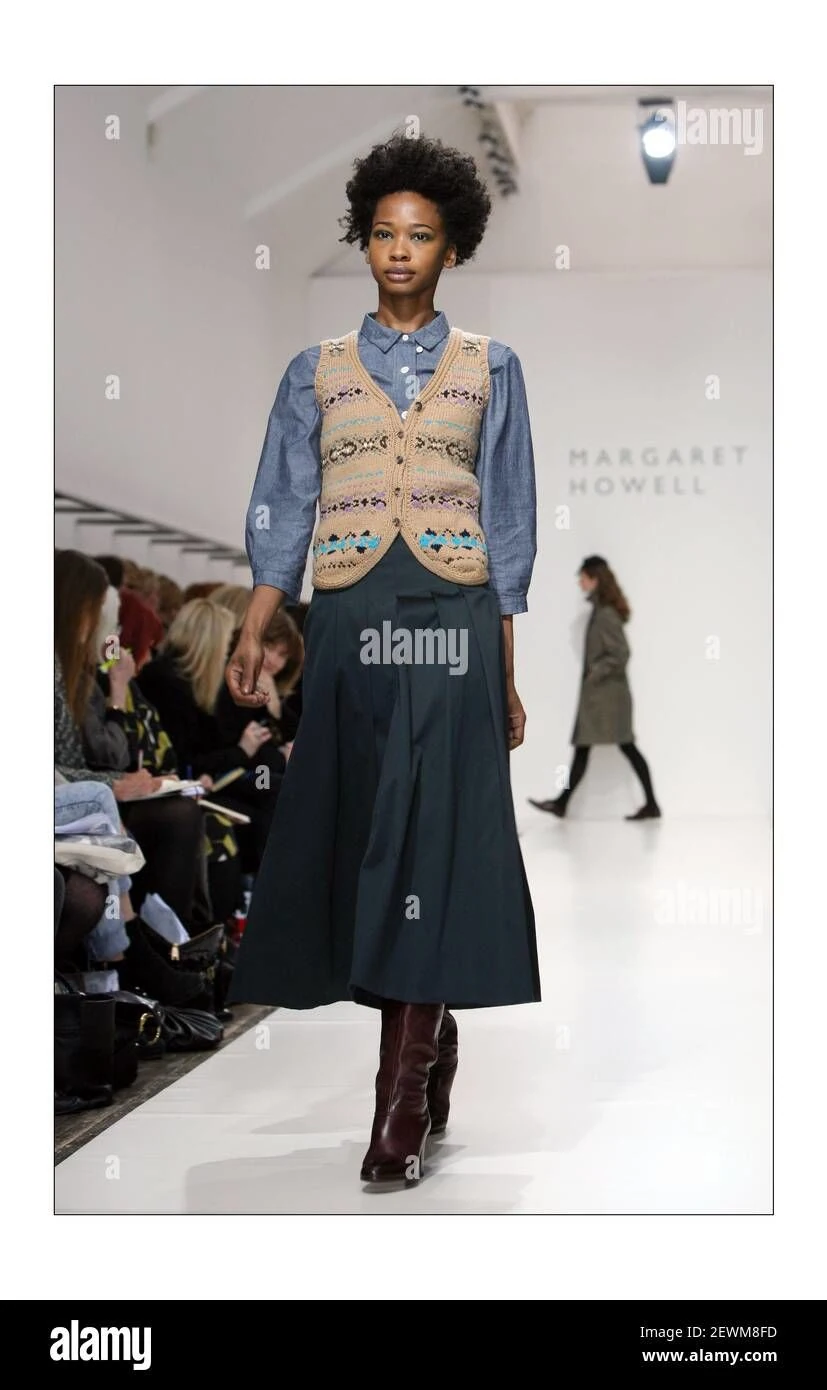
Howell’s design vocabulary has returned to familiar garments: the well-tailored shirt, the gymslip, lace-up shoes, the duffel coat and the trench coat. Rather than treating clothing as an image alone, she has emphasised that it needs to work for the people who wear it. Her stated interest in how things are made, alongside influences including architecture, fine art, modern design, photography and traditional crafts of the British Isles, helps explain the balance of utility and considered form in her work.
Her clothes have been described as bringing traditional styles together with modern appeal. Howell has called her own approach “understated quality, updated modern classics”. That phrase fits a career built through the development of recognisable pieces rather than a succession of abrupt changes in direction. Her calendars, produced from 1995, have also reflected her interests in swimming, swimming pools and coastal landscapes, as well as design and craft.
The company added the MHL clothing line in 2004. A later series of shirt collaborations, Margaret Howell Plus, began in 2010 with designer Kenneth Grange and was followed by projects with Sam Hecht, Dan Pearson and Georgina von Etzdorf. The business grew beyond its London origins: the supplied account records around 500 employees and more than 80 locations, including in Paris, Florence and Tokyo.
Recognition and continuing influence
Howell’s work attracted attention from fashion and culture beyond her own shops. A 1977 profile in French Elle described her precise working methods as closer to those of a craftsperson than an industrialist. Actor Jack Nicholson was a fan and wore his own Margaret Howell corduroy jacket in The Shining; director Stanley Kubrick subsequently ordered 12 duplicates.
Her public recognition has included appointment as a Commander of the Order of the British Empire in 2007 for services to the retail industry and selection as a Royal Designer for Industry by the Royal Society of Arts that year. She received an honorary doctorate from the University of the Arts London in 2010, became an honorary professor of the University for the Creative Arts in 2013 and received an honorary fellowship from Goldsmiths College in 2015. Howell continues to live in south-east London.
Why Margaret Howell deserves a place in British Legacy
Margaret Howell’s place in British fashion is grounded in a career that links design to the work of making and selling clothes. She began with handmade accessories, moved into shirts from a flat in Blackheath and built a business through shops, manufacturing and international expansion. The creation of a shirt factory in north London is a concrete part of that story: the label’s growth was not only a matter of retail visibility, but also involved establishing production of its own. Her work has drawn on traditional crafts of the British Isles while bringing familiar garments into a modern wardrobe.
Her approach also offers a particular account of design’s value. Howell has argued that good design must work and that clothes should serve their wearers, a principle reflected in her recurring attention to shirts, coats and other enduring forms. The business’s evolution—from its early London shops to a network of more than 80 locations—and its collaborations with designers show how a distinct visual language can travel without abandoning its origins. Her honours recognise contributions to retail and design; her longer legacy lies in making British craft, practical clothing and a measured idea of modernity part of a continuing, internationally visible enterprise.
Sources
Adapted in part from Margaret Howell by Wikipedia contributors, under CC BY-SA 4.0. Text has been edited and combined with the existing article; this adapted text is shared under the same licence. Contributor history.