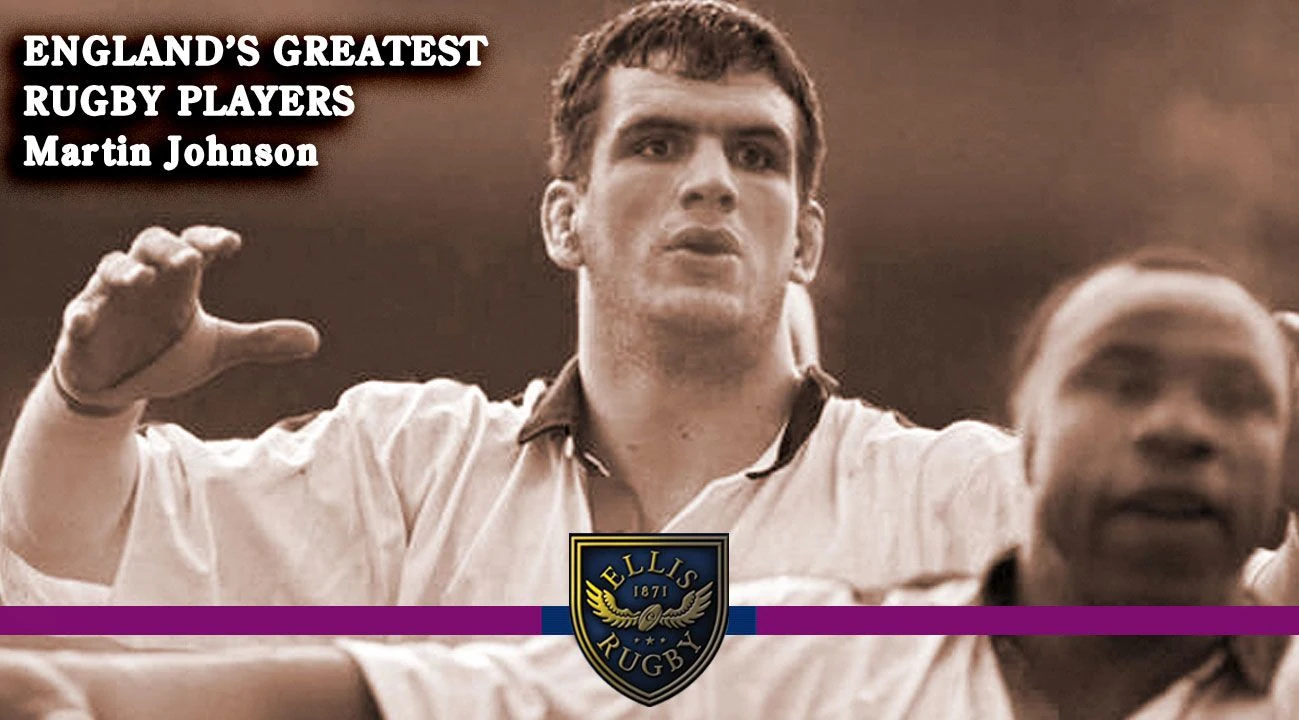
Martin Johnson’s defining achievement as a rugby player came in Sydney in 2003, when he captained England to victory in the Rugby World Cup final. The lock had already led Leicester Tigers to domestic and European honours and captained the British and Irish Lions. England’s win made him the first captain of a northern-hemisphere side to lift the tournament; his later spell as England team manager brought another Six Nations title.
From Solihull to Leicester
Martin Osborne Johnson was born in Solihull, Warwickshire, on 9 March 1970. When he was seven, his family moved to Market Harborough in Leicestershire. He attended Ridgeway Primary School, Welland Park School and Robert Smyth School. Before concentrating on rugby, he briefly played American football for the Leicester Panthers.
In 1989, former All Black Colin Meads invited Johnson to try out for King Country in New Zealand. Johnson played two seasons there and was selected for the New Zealand under-21 side. He made his Leicester debut in February 1989, then established himself in the first team after returning from New Zealand. Leicester became his only senior club in England: across his career there, he made 362 appearances.
Johnson’s early seasons brought setbacks as well as progress. A recurring shoulder injury limited his appearances in 1990–91, but he went on to establish a long-running second-row partnership with Matt Poole. Leicester reached the 1993 Pilkington Cup final, where Johnson scored a try in the 23–16 win over Harlequins. That January he had made his England debut against France, summoned at short notice to replace the injured Wade Dooley. Later that year, he joined the British Lions tour of New Zealand.
Club success and Lions captaincy
Johnson won his first league title with Leicester in 1995, the year he was also an ever-present in England’s Grand Slam-winning Five Nations side and Rugby World Cup campaign. After the game turned professional, he signed a five-year contract with Leicester in 1996 and left his job with Midland Bank. In 1997 he captained Leicester to the Pilkington Cup, then took charge of the British Lions tour of South Africa.
The Lions won the test series 2–1, a landmark in Johnson’s international career. He captained the side again on its 2001 tour of Australia, becoming the first player to lead the Lions on two tours. At Leicester, meanwhile, he was appointed club captain in 1997. The team won the Premiership in 1998–99 and retained the title the following season. In 1999, Johnson was named the league’s Player of the Season.
Leicester’s strongest run followed. The club won the Premiership in 2000–01 and 2001–02, taking its run of consecutive titles to four. It also won the Heineken Cup in both seasons, becoming the first club to retain the European title. Johnson captained the team to its first European Cup in 2001; the victory, alongside the league and play-off successes, completed a treble. The 2002 final brought a second European title, secured with a 15–9 win over Munster.
England’s World Cup captain
Johnson became England captain in 1999. He led the side at that year’s Rugby World Cup, where England reached the quarter-finals. In 2003, England won the Six Nations Grand Slam before building towards the tournament in Australia. On tour in New Zealand that year, England secured its first victory over the All Blacks in New Zealand since 1973. The side also beat Australia in the same tour.
England carried that form into the World Cup, beating South Africa, Wales and France on the way to the final against the hosts. The match went to extra time, and Jonny Wilkinson’s drop goal secured a 20–17 victory. The final was Johnson’s 84th and last international appearance. England became the first northern-hemisphere team to win the Rugby World Cup.
Johnson’s individual recognition followed. He received a CBE in the 2004 New Year Honours for services to rugby and finished second to Wilkinson in the BBC Sports Personality of the Year award. He was inducted into the International Rugby Board Hall of Fame in 2011 alongside other World Cup-winning captains and head coaches. His Leicester playing career ended in 2004–05. In June 2005, a testimonial match at Twickenham also marked the return to rugby of Jonah Lomu after a kidney transplant.
Managing England
On 1 July 2008, Johnson became England team manager. The role brought a different challenge from captaining a team on the field: England’s results during his tenure included defeats as well as significant wins. The side finished second in the 2009 Six Nations, won the Calcutta Cup in 2009, 2010 and 2011, and took the Cook Cup in 2010.
England won the 2011 Six Nations under Johnson, its first championship since 2003. A final-weekend defeat by Ireland denied the team the Grand Slam. Later that year, England reached the quarter-finals of the Rugby World Cup in New Zealand, where it lost to France. Johnson resigned in November 2011 after the tournament. During and after his time in rugby, he also appeared as a studio analyst for television coverage, including the 2018 Six Nations.
Why Martin Johnson deserves a place in British Legacy
Johnson’s place in British sporting history rests on more than one celebrated final. As captain, he led teams representing England, Leicester and the British and Irish Lions. The 2003 World Cup win was an exceptional result for English rugby: England became the first side from the northern hemisphere to win the tournament. The triumph followed a Grand Slam and an unbeaten tour of New Zealand and Australia. It was built on achievements across a long playing career, including five Premiership titles and two Heineken Cups with Leicester, and a Lions series victory in South Africa.
His significance also lies in the different responsibilities he took on. Johnson captained the Lions in 1997 and 2001, then managed England from 2008 to 2011. Under his management, England won the 2011 Six Nations, while his record also includes disappointing campaigns and a World Cup quarter-final defeat. Keeping both the success and the setbacks in view makes his legacy more than a story of a single trophy. His career gives British Legacy a concrete account of leadership across club, national and international rugby, and of the work and results that made the 2003 victory possible.
Sources
Martin Johnson (rugby union), revision 1339996594
Adapted in part from Martin Johnson (rugby union) by Wikipedia contributors, under CC BY-SA 4.0. Text has been edited and combined with the existing article; this adapted text is shared under the same licence. Contributor history.