
Radio waves could reveal objects beyond the reach of ordinary sight, but early radio astronomers faced a problem: their instruments often could not show precisely where a signal came from or what its source looked like. Martin Ryle helped change that. At Cambridge, he developed ways for separated aerials to work together, turning measurements gathered over time into detailed radio images. Instead of trying to build one impossibly large telescope, he made distance, timing and mathematics part of the instrument.
Ryle’s contribution was at once practical and conceptual. He helped establish interferometry and aperture synthesis as powerful tools for astronomy, built a research group and observatory capable of using them, and applied the resulting observations to questions about the universe. His career also took a striking turn: in later life, he devoted much of his attention to nuclear danger, energy and the responsibilities that accompany scientific knowledge.
From Brighton to wartime radar
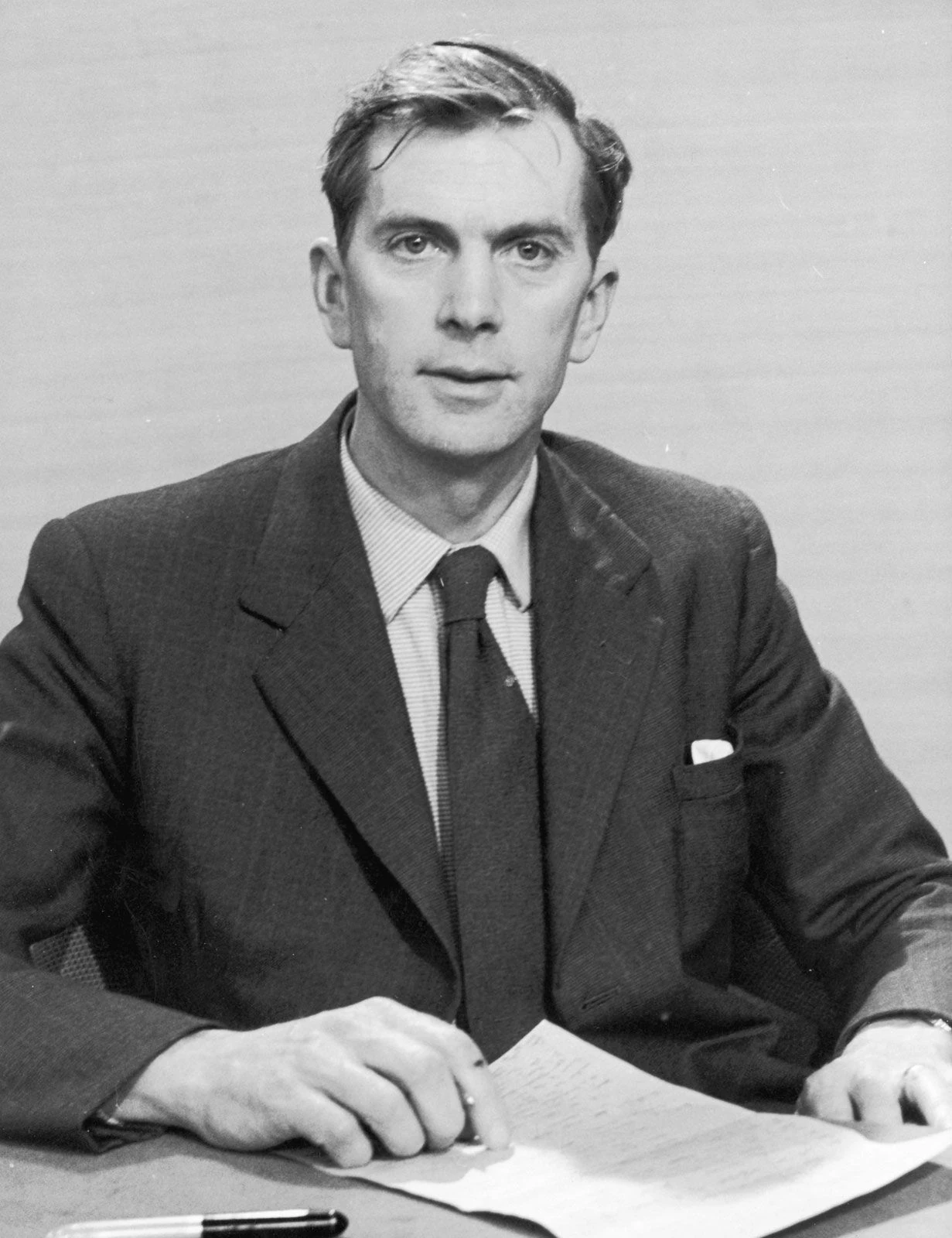
Martin Ryle was born in Brighton on 27 September 1918, the son of John Alfred Ryle and Miriam Ryle. He was educated first at home and then at Bradfield College. At Christ Church, Oxford, he studied physics. He was already interested in radio: while still at school he built a transmitter and obtained a licence to operate as an amateur radio operator.
In 1939, the outbreak of war redirected that technical interest towards military work. Ryle joined the Telecommunications Research Establishment, where he worked on antennas for airborne radar and on radar countermeasures. The experience gave him practical knowledge of radio equipment: how it could be designed, tested and improved, and how its limitations shaped what it could detect.
When the war ended, Ryle returned to Cambridge, taking up a fellowship at the Cavendish Laboratory. His early research there concerned radio waves from the Sun. He soon became interested in a broader problem facing radio astronomy. Radio waves have long wavelengths, making fine detail difficult to resolve. A single dish large enough to achieve the desired sharpness would be impractical. Ryle looked for another way to obtain the necessary information.
Making an instrument from several aerials
Ryle’s answer was to treat several receiving elements as parts of one measuring system. In 1946, he and Derek Vonberg published interferometric astronomical measurements at radio wavelengths. That year Ryle also built the first multi-element astronomical radio interferometer. The underlying principle was simple to state but demanding to put into practice: compare the signals received at separated aerials and use their relationship to recover information about the radio source.
Aperture synthesis developed this idea further. An array of aerials can gather measurements corresponding to different parts of a source’s radio structure. As the Earth turns, the arrangement of the aerials in relation to the source changes, adding more measurements. Mathematical analysis can then combine those observations into an image. The effective sharpness depends on the separation between the elements, rather than on the diameter of a single dish.
This approach made a large effective aperture possible without requiring a single structure of comparable size. It also called for more than an ingenious design: the measurements had to be carefully taken and interpreted, and the equipment had to work reliably. Ryle’s contribution joined the theory of how the elements could be combined to the engineering and observation needed to make the method useful.
Ryle became the driving force behind the development and improvement of astronomical interferometry and aperture synthesis at Cambridge. The techniques improved the quality of radio astronomical observations and opened the way to more precise location and imaging of faint radio sources. They were not a replacement for every other method of observation, but they made radio astronomy a more capable means of examining the sky.
Mapping the radio sky
Improved instruments gave the Cambridge radio astronomy group the means to compile catalogues of radio sources. The Third Cambridge Catalogue of Radio Sources, usually called the 3C catalogue, appeared in 1959. It provided astronomers with a systematic record of detected sources and helped them compare radio observations with objects visible in the sky. Sources in the Cambridge catalogues contributed to the identification of the first quasi-stellar object, or quasar.
Cataloguing was not simply a matter of listing discoveries. Radio surveys also produced evidence that could be used to test ideas about the universe. Counts of radio sources suggested that faint sources were more numerous than expected in a static, unchanging universe. The early Cambridge surveys were disputed, including because of difficulties distinguishing closely spaced sources. Later observations with improved equipment offered stronger evidence that the population of radio sources had changed over cosmic time.
That evidence mattered to a major debate in cosmology. Fred Hoyle’s steady-state model proposed an unchanging universe on large scales. The evolving pattern suggested by the improved radio-source counts helped challenge that picture. Ryle’s work therefore had consequences beyond the construction of better aerials: the methods helped produce observations that could bear on competing accounts of the universe.
Radio astronomy became a significant route to studying objects not adequately described by visible-light observations alone. Ryle and his colleagues helped make it possible to locate and image weak sources with greater precision. The resulting catalogues gave astronomers a foundation for investigating radio galaxies, quasars and other distant objects, while the techniques developed at Cambridge contributed to a broader change in how radio observations could be made.
Building a Cambridge centre for radio astronomy
Ryle’s influence extended from methods and results to the organisation of research. He became director of the Mullard Radio Astronomy Observatory in 1957 and, in 1959, the University of Cambridge’s first Professor of Radio Astronomy. He guided the Cambridge radio astronomy group as it developed successive instruments and catalogues.
The observatory at Lord’s Bridge provided room for arrays with longer separations. Its One-Mile and Five-Kilometre telescopes used the principle that distance between elements could create a much greater effective aperture. The work at Lord’s Bridge turned interferometry from a promising idea into a sustained programme of instrument-building and observation. Cambridge became a leading centre for radio astronomy, with equipment and researchers able to test and refine the techniques in practice.
Ryle’s institutional work was closely connected to his scientific approach. The method depended on many coordinated parts: aerials, measurements, analysis and a research group able to keep improving the system. The observatory provided a setting in which those components could be developed together. It helped establish radio astronomy at Cambridge as a major scientific activity, rather than a peripheral extension of work in other fields.
His honours reflected the growing standing of the subject and his role within it. Ryle was elected a Fellow of the Royal Society in 1952 and was knighted in 1966. He shared the 1974 Nobel Prize in Physics with Antony Hewish. The prize was the first Nobel awarded in recognition of astronomical research. Ryle served as Astronomer Royal from 1972 to 1982, and in 1965 he co-delivered the Royal Institution Christmas Lecture on the exploration of the universe.
Practical skills and other interests
Ryle’s scientific work was supported by an interest in making and building. As a child, he and his elder brother received lessons in carpentry and manual skills. He later built boats to his own design, and practical engineering remained part of his approach to research. His wartime radar work, the construction of radio telescopes and his later investigations into wind energy all involved working with physical systems, not just abstract ideas.
He also maintained a lifelong interest in sailing. As a young man he became an amateur radio operator, building his own transmitter while at school and later belonging to the Oxford University Wireless Society. These interests sit alongside his academic appointments as evidence of a career that crossed boundaries between scientific research, engineering and hands-on experimentation.
Ryle’s personality could be forceful. Accounts describe him as quick-thinking and impatient, and he could be difficult to work with. He was concerned that Cambridge might lose ground to better-funded radio astronomy groups elsewhere, and the Wikipedia account notes that he sometimes encouraged secrecy around the group’s aperture-synthesis methods to preserve its advantage. His disagreements with Fred Hoyle over the steady-state universe also contributed to strained relations between the Cambridge radio group and the Institute of Astronomy during the 1960s.
These tensions are part of the record of how research was conducted, not a reason to overlook what the group achieved. They show that Ryle’s drive to build Cambridge’s position could have costs for collaboration. His career involved both institution-building and sharp disagreement, alongside the discoveries and methods for which he is best known.
Science, peace and energy
In the 1970s, Ryle shifted much of his attention from astronomy to social and political questions that he regarded as urgent. His experience of wartime technology formed part of the background to his concern about how scientific knowledge could be used. He wrote and campaigned against nuclear armaments, including in the pamphlet Towards the Nuclear Holocaust, and criticised nuclear power.
His interest in energy was not confined to opposition. Ryle investigated and promoted alternative energy, energy efficiency and the problems of storing energy. His publications included work on short-term storage and wind-power availability. The shift was substantial, but it continued a practical habit of mind: examine how a system works, consider its consequences and ask whether scientific effort might be directed towards different needs.
Ryle argued for responsible uses of science and technology, and for redirecting resources devoted to destruction towards problems facing people around the world. In 1983, responding to a request from the president of the Pontifical Academy of Sciences for ideas for a meeting on science and peace, he set out his views in a letter later published after his death. His interventions made public responsibility part of his scientific legacy, rather than a separate matter from it.
Family, final years and remembrance
Ryle married Rowena Palmer in 1947. They had three children and lived in Cambridge. He died there on 14 October 1984, aged 66. His death brought to a close a career that had moved from wartime radar to radio astronomy and, in its later years, to questions about energy, peace and the direction of technological change.
His name also remains attached to the work he helped establish: the Ryle Telescope at the Mullard Radio Astronomy Observatory is named after him. In 2009, he was included on a first-class stamp in an Eminent Britons set. These memorials point to different aspects of his place in public memory: the Cambridge research centre, the instruments and methods, and his standing among British scientists.
Why Martin Ryle deserves a place in British Legacy
Martin Ryle deserves a place in British Legacy because his work changed what astronomers could do with radio waves. Rather than accepting the poor resolution of a single dish or relying on an impractically large one, he helped turn separated aerials into a coordinated instrument. Interferometry and aperture synthesis made it possible to assemble useful images from carefully combined measurements. The Cambridge catalogues and the observations made with improved equipment helped identify radio sources and contributed evidence to debates about the changing universe. These were not isolated technical refinements: they established methods that gave radio astronomy a more precise and productive way to investigate the cosmos.
His British connection is grounded in a clear institutional story. Born in Brighton and educated at Bradfield and Oxford, Ryle did his defining work at Cambridge, where he became the first Professor of Radio Astronomy and director of the Mullard Radio Astronomy Observatory. Lord’s Bridge gave his group space to develop instruments whose reach depended on separation, not simply on the size of a dish. His Nobel Prize and service as Astronomer Royal marked the rise of astronomy that had once depended on specialised radio techniques into a recognised part of modern science.
Ryle’s later campaigns add a further reason to remember him. Having worked on wartime radar, he spent his later years warning about nuclear weapons and arguing for responsible uses of science, while investigating alternative energy and storage. His example links technical achievement with questions about who benefits from knowledge and what purposes it serves. That combination—practical invention, institution-building and public concern—makes his contribution to British science both specific and enduring.
Sources
Martin Ryle — Wikipedia, revision 1371971627
Adapted in part from Martin Ryle by Wikipedia contributors, under CC BY-SA 4.0. Text has been edited and combined with the existing article; this adapted text is shared under the same licence. Contributor history.

.jpg)