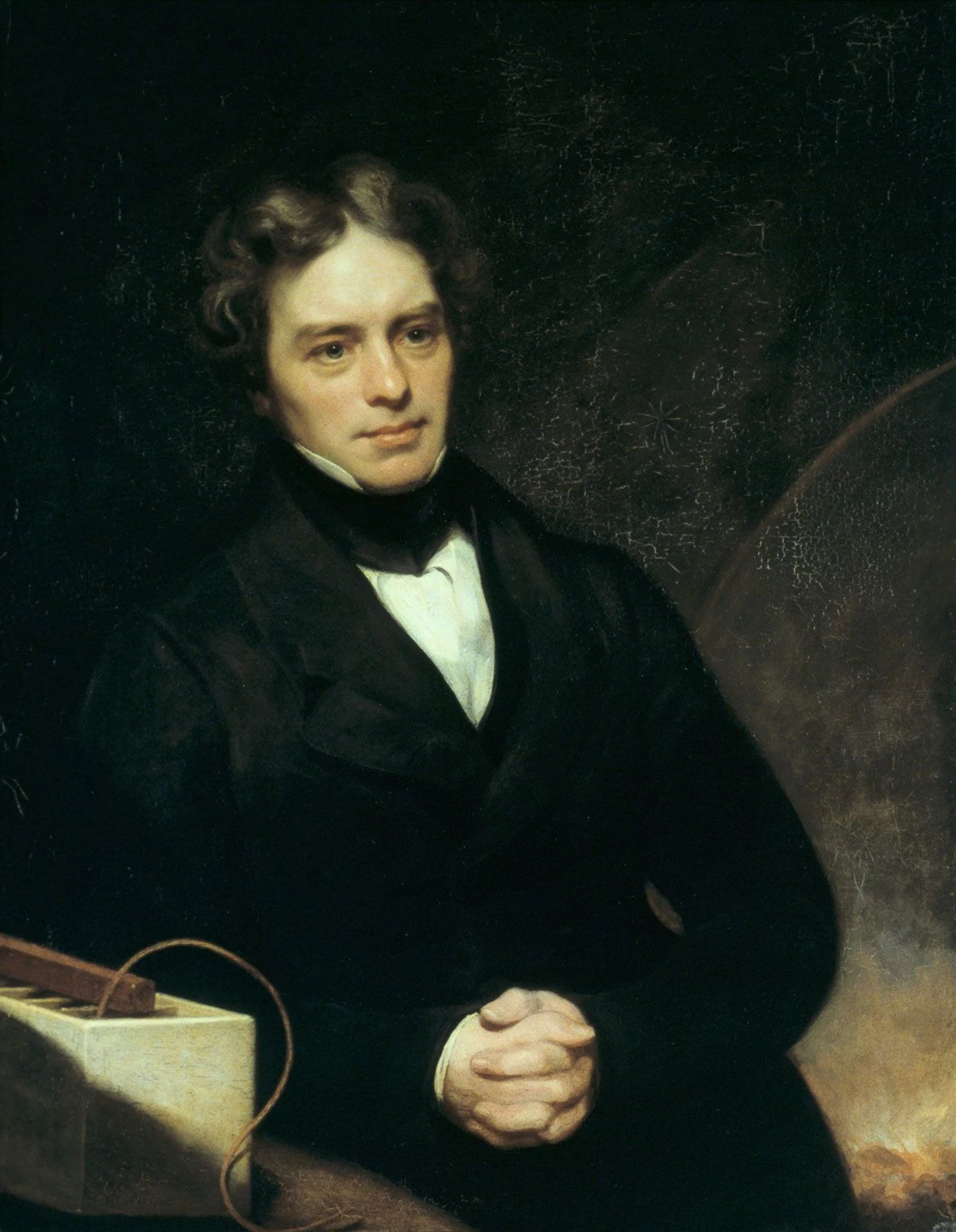
Michael Faraday began with little formal schooling and no obvious route into scientific life. A bookbinder’s apprentice, he read widely and taught himself to experiment. He went on to demonstrate how changing magnetic conditions could produce an electric current, establish important laws of electrolysis and help form the idea of the electromagnetic field. His discoveries did not build the power stations, motors or lighting systems of a later age. They supplied principles on which those technologies could be developed.
Faraday’s achievement extended beyond the laboratory. Based for most of his career at London’s Royal Institution, he became a celebrated lecturer and gave scientific advice on matters ranging from lighthouses to mine safety. His life connects experimental science with public education and practical service: a working Londoner whose research changed physics and whose explanations invited audiences beyond specialist circles to look closely at the natural world.
A bookbinder’s apprentice enters the laboratory
Faraday was born on 22 September 1791 at Newington Butts, then in Surrey and now part of south London. His family had limited means, and his schooling was basic. At 14, he began a seven-year apprenticeship with George Riebau, a bookbinder and bookseller in Blandford Street. The shop gave him access to books. He read widely, including scientific works, and developed habits of close attention that served him throughout his career. He also attended lectures and took part in discussions at the City Philosophical Society.
In 1812, at the end of his apprenticeship, Faraday attended lectures by the chemist Humphry Davy. He sent Davy a substantial set of notes from the talks. The following year, after an accident had affected Davy’s eyesight, Faraday was appointed Chemical Assistant at the Royal Institution on 1 March 1813. There he learned through laboratory work and travelled on the Continent with Davy. The Royal Institution became the setting for most of his scientific career, bringing research, lectures and public demonstration into close contact.
Faraday’s appointment did not make him a mathematician in the mould of later theoretical physicists. His distinctive strengths were experimental patience, visual thinking and an ability to notice connections between phenomena. He became Director of the Royal Institution’s Laboratory in 1825 and, in 1833, its first Fullerian Professor of Chemistry, a position held for life. His career shows how far disciplined experiment and self-education could take someone excluded from the conventional educational route into science.
His early career also included responsibilities beyond research. Faraday became Assistant Superintendent of the House of the Royal Institution in 1821, and his appointment as laboratory director followed four years later. The institution gave him a place to work, but also an audience: his experimental practice and his public teaching developed side by side. That combination helps explain why his influence was not confined to papers or apparatus. He made scientific reasoning visible to people who could watch an experiment and follow the question it raised.
Induction and the electrical age
In 1821 Faraday investigated electromagnetic rotation. One of his devices produced continuous circular motion through the interaction of an electric current and a magnetic force, an early demonstration of the principle behind an electric motor. Electricity could now be understood not only as something to observe but as a means of producing mechanical movement. The experiments helped establish a foundation for electromagnetic technology, although the devices and systems that made electricity commonplace belonged to later generations.
Faraday’s best-known breakthrough came in 1831. He wound two insulated coils around an iron ring and found that switching a current on or off in one coil induced a momentary current in the other. He also showed that moving a magnet through a loop of wire could produce a current, as could moving the loop past a stationary magnet. The crucial point was change: varying magnetic conditions could induce electrical effects.
The apparatus was modest; the principle was not. Faraday’s induction ring is often described as an early transformer, while electromagnetic induction underlies the operation of generators. The scale and engineering of modern power stations bear little resemblance to a laboratory experiment, but the central relationship Faraday demonstrated remains essential. His work helped make it possible to generate and transform electrical power. He did not construct the later networks, lamps or motors; engineers and others developed those technologies using principles he helped establish.
Faraday’s experiments also gave later scientists a way to think about forces acting through space. He proposed that electromagnetic effects were associated with lines of force extending around conductors and magnets, rather than being merely invisible pushes and pulls between objects. This field-based picture was not immediately accepted. James Clerk Maxwell later expressed the ideas mathematically, giving them a form Faraday’s own limited mathematical training had not allowed him to provide. The relationship between Faraday’s experimental insight and Maxwell’s mathematical treatment became central to modern accounts of electromagnetism.
Faraday’s work did not end with induction. In 1845 he discovered diamagnetism, the weak repulsion of some materials by a magnetic field, and showed that a magnetic field could rotate the plane of polarised light travelling through a material. This effect, now known as the Faraday effect, offered experimental evidence of a connection between light and magnetism. It strengthened his interest in lines of force and the unity of natural phenomena. The SI unit of capacitance, the farad, was later named in his honour.
A chemist as well as a physicist
Faraday’s reputation as a pioneer of electricity can overshadow the range of his chemistry. He investigated chlorine and other gases, and succeeded in liquefying chlorine. In 1825 he identified benzene, which he called bicarburet of hydrogen. His work on gases helped clarify their relation to liquids; his wider investigations included compounds of chlorine and carbon, alloys and glass made for optical purposes. He also studied the diffusion of gases and produced new kinds of glass whose behaviour in a magnetic field became important to his later optical experiments.
His laws of electrolysis brought precision to the study of chemical change caused by electricity. Faraday established that the amount of material changed at an electrode is related to the quantity of electric charge passing through an electrolyte, and that equivalent quantities of charge produce equivalent chemical effects across different substances. These relationships made electrochemistry measurable and comparable. They have practical relevance to processes such as electroplating and metal refining, as well as to the development of battery science.
Faraday also helped shape the vocabulary used to describe electrical chemistry. Terms including electrode, anode, cathode and ion became part of scientific language; William Whewell proposed much of this terminology, which Faraday helped popularise. In 1857 Faraday reported that the optical properties of gold colloids differed from those of bulk gold, an observation noted in the history of nanoscience. His work ranged across chemistry and physics, not as separate pursuits but as experimental questions about how matter and forces behave.
His investigations of electricity included the ice-pail experiment, which helped demonstrate that charge on a conductor resides on its exterior and that the interior is shielded from external electrical effects. In 1836, Faraday tested the principle with an electrified enclosure made from a wooden frame, paper and wire mesh, standing inside it while it was charged. The experiment demonstrated electrostatic shielding and contributed to understanding the principle behind what is now called a Faraday cage. It is more accurate to describe this as experimental work demonstrating shielding than to say simply that he invented every later form of the cage.
Making science visible and useful
At the Royal Institution, Faraday made public explanation part of his scientific life. He helped establish the Friday Evening Discourses, where new research was presented, and became a leading figure in the Institution’s Christmas Lectures for young people and the wider public. Between 1827 and 1860 he gave 19 series. His approach depended on demonstration as well as explanation: audiences could watch an experiment unfold and consider what it showed.
The Chemical History of a Candle is the best-known example of his gift for making complex ideas intelligible. Faraday used an ordinary flame to explore combustion, gases, heat and observation. His lectures asked audiences to follow evidence and think about what they had seen, treating public education as part of serious scientific work. He had first refined his lecturing through chemistry talks for the City Philosophical Society, and the Royal Institution’s lecture theatre remained a central part of his career.
Faraday’s public work also took him beyond lecture theatres. He advised the Admiralty from 1829 and served Trinity House, responsible for lighthouses and other maritime aids, from 1836 to 1865. His work addressed lighthouse efficiency, optical glass, lighting and the corrosion of ships. These questions mattered in a country whose safety and commerce depended on the sea. His practical engagements included work on the construction and operation of lighthouses and the preparation of optical glass. His workshop at Trinity Buoy Wharf was associated with experiments in electric lighting for lighthouses.
His advice was sought on other public matters, too. Faraday assisted with planning and judging exhibits for the Great Exhibition of 1851, advised the National Gallery on the care of its paintings and served on its site commission. He investigated industrial pollution at Swansea and air pollution at the Royal Mint. In 1855 he wrote to The Times about the foul condition of the River Thames. These were different problems, but each called for careful observation applied to public life.
After the Haswell Colliery explosion, which killed 95 miners, Faraday and the geologist Charles Lyell investigated the disaster. Their report, published in 1846, identified coal dust as a contributor to the explosion’s severity and demonstrated how ventilation could help prevent such events. The findings were an important step in understanding industrial explosions, although the risk was not acted on promptly. Faraday’s scientific work was not a simple division between pure research and practical service. He moved between them, bringing evidence to urgent problems beyond the laboratory.
Recognition, principle and later years
Faraday was elected a Fellow of the Royal Society in 1824. His distinctions included the Copley Medals in 1832 and 1838, the Royal Medals in 1835 and 1846, and the Rumford Medal in 1846. He also received the Bakerian Medal on several occasions and, in 1866, the Albert Medal. The honours recognised work across chemistry and physics, but his authority also rested on the clarity of his experimental method and his ability to explain it.
He twice declined the Presidency of the Royal Society. The supplied biographical account says he refused a knighthood on religious grounds; however, the available source material does not resolve the current article’s more cautious statement that there is no evidence one was formally offered. That distinction cannot be settled by the supplied evidence, so the claim is not presented here as established fact. Faraday received an honorary Doctor of Civil Law degree from the University of Oxford in 1832 and honours from scientific bodies abroad.
Faraday married Sarah Barnard in 1821; they had no children. He was a devout Christian and served his Sandemanian congregation as a deacon and elder. After a period of ill health, he retired in 1858 to a grace-and-favour house at Hampton Court. He died there on 25 August 1867, aged 75, and was buried in the dissenters’ section of Highgate Cemetery. He had declined burial in Westminster Abbey, where a memorial plaque was later placed near Isaac Newton’s tomb.
His name has remained visible in British public life. A statue stands at Savoy Place in London, and the Faraday Memorial is near his birthplace. His image appeared on the Bank of England’s £20 note from 1991 to 2001, and his work has been commemorated on Royal Mail stamps. Scientific organisations have named medals and prizes after him, while British institutions and places have adopted his name. These memorials do not substitute for his scientific work, but they show how broadly his reputation has been carried into public culture.
Why Michael Faraday deserves a place in British Legacy
Michael Faraday deserves a place in British Legacy because his work helped turn electricity from a subject of experiment into a source of practical possibility. His investigations of electromagnetic rotation pointed towards the motor; his experiments in 1831 established the principle of induction that underpins generators and transformers. He did not build the electrical infrastructure that later changed homes and industry, and the distinction matters. His contribution was to reveal relationships that engineers and inventors could develop into technologies. That connection between a carefully designed experiment and consequences beyond the laboratory is one of the clearest reasons his work remains significant.
His British legacy is also visible in the way he joined scientific research to public life. At the Royal Institution he gave lectures that invited young people and general audiences to observe, question and understand. In service to Trinity House and the Admiralty, he applied scientific judgement to lighthouses and maritime safety; with Charles Lyell, he brought forensic investigation to the Haswell Colliery disaster. His work on electrolysis strengthened a field with practical uses in industry, while his research in chemistry and optics shows a mind not confined to one celebrated discovery. Faraday’s life demonstrates how self-education, rigorous experiment and clear communication could serve both scientific knowledge and the public good. It is that combination—specific discoveries, useful advice and accessible teaching—that makes his story part of Britain’s scientific and civic inheritance.
Sources
Michael Faraday — Wikipedia, revision 1374547585
Adapted in part from Michael Faraday by Wikipedia contributors, under CC BY-SA 4.0. Text has been edited and combined with the existing article; this adapted text is shared under the same licence. Contributor history.