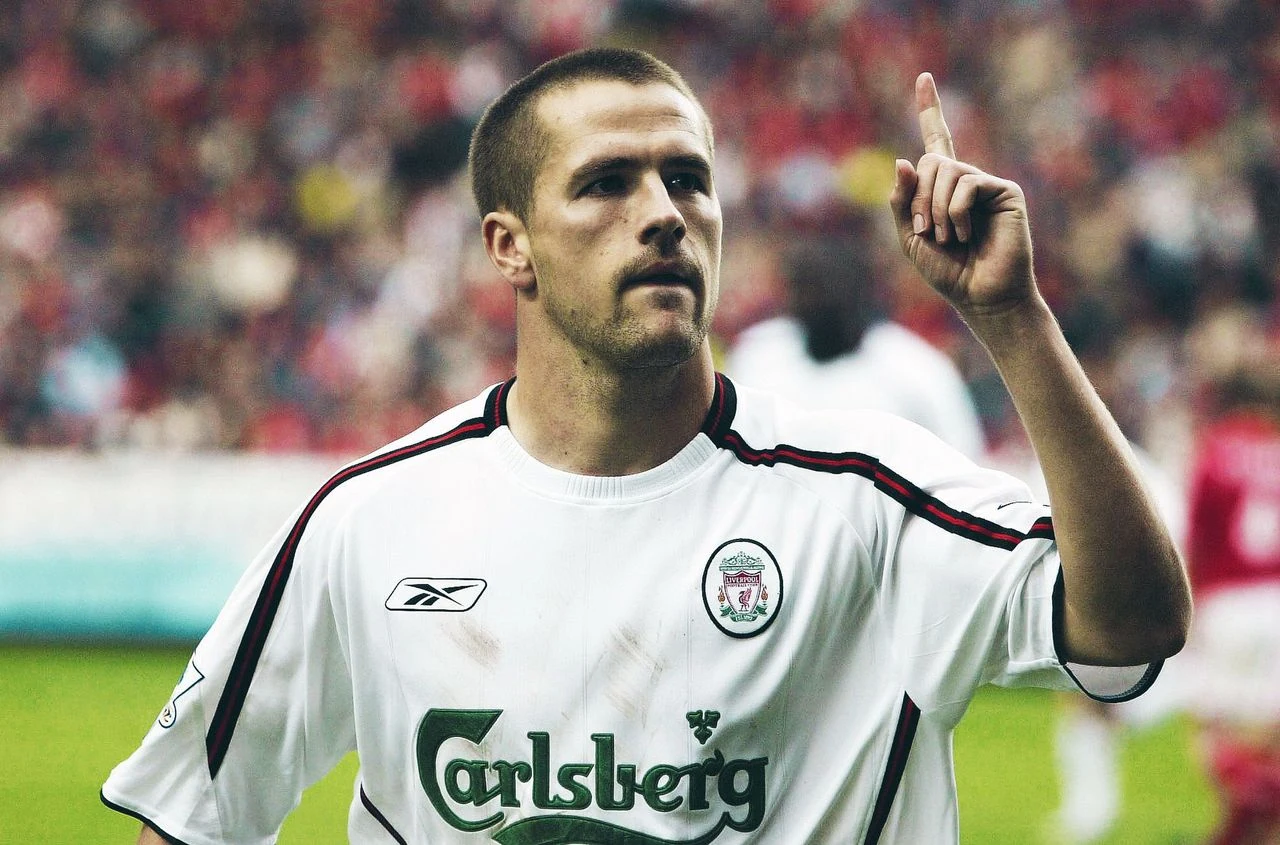
Michael Owen announced himself with a goal on his Liverpool debut at 17. Within a year, he had won the Premier League Golden Boot; by 2001, he had helped Liverpool to a cup treble and become the first English winner of the Ballon d’Or since Kevin Keegan. His career also carried a cost: recurring hamstring trouble and, later, a serious knee injury curtailed the speed that had made him such a threat. The rise, the goals and the interruptions belong together in the story of one of England’s most recognisable modern strikers.
From Chester to Anfield
Owen was born in Chester on 14 December 1979, the fourth child of Jeanette and Terry Owen, a former professional footballer. His father introduced him to the game when he was seven. Owen attended Rector Drew Primary School in Hawarden, Flintshire, and Hawarden High School, and played youth football for Mold Alexandra. He was already prolific: at ten, he scored 97 goals in a season for the Deeside Area Primary School team, beating Ian Rush’s record there.
Liverpool recruited him into their youth set-up in 1991. He attended the FA’s School of Excellence at Lilleshall and progressed quickly through England’s junior teams, scoring 28 goals in 20 games for the under-15 and under-16 sides. At 16, he became the leading figure in Liverpool’s 1995–96 FA Youth Cup campaign. He scored repeatedly against Manchester United and Crystal Palace, then returned from England under-16 duty to score in the final against West Ham United. Liverpool won the competition for the first time.
Owen signed a professional contract on his 17th birthday and made his senior debut on 6 May 1997, scoring against Wimbledon. The goal could not prevent Liverpool losing the match, but it marked the arrival of a teenager ready to compete for a first-team place. In 1997–98, he replaced the injured Robbie Fowler as Liverpool’s first-choice striker, scored 18 league goals and shared the Premier League Golden Boot. He was named PFA Young Player of the Year. He retained the Golden Boot the following season, again with 18 goals, but a hamstring injury brought his campaign to an early end.
Goals, trophies and a Ballon d’Or
Injuries repeatedly interrupted Owen’s seasons. He returned after almost five months out in 1999–2000, and further hamstring problems restricted his appearances. Yet his finishing continued to distinguish him. He became Liverpool’s leading scorer in every season from 1997 until he left the club, and remained a central part of the side even as it went through changes under Gérard Houllier.
The high point came in 2000–01. Liverpool won the League Cup, FA Cup and UEFA Cup, ending a six-year wait for a trophy. In the FA Cup final against Arsenal, Owen scored twice late in the match to turn a 1–0 deficit into a 2–1 win. His performances earned him the Ballon d’Or, making him the first English winner since Kevin Keegan in 1979. He also helped Liverpool win the Charity Shield and UEFA Super Cup in 2001; the club collected five trophies in that calendar year.
Owen’s Liverpool record was 158 goals in 297 appearances in all competitions, including 118 goals in 216 Premier League appearances. The frequently quoted league figures are not his complete club totals: cup and European matches added substantially to both. He scored his 100th goal for Liverpool in December 2001 and reached 100 Premier League goals in April 2003. Liverpool won the League Cup again in 2002–03, but missed out on qualification for the Champions League. After the 2003–04 season, Owen chose not to renew his contract.
Real Madrid and the return to England
Real Madrid signed Owen for £8 million in August 2004. He joined a team that included Zinedine Zidane, Ronaldo, Luís Figo and David Beckham, but was often used as a substitute. After a slow start, he scored in the Champions League and La Liga, including in a win over Barcelona. His league return was 13 goals in 36 appearances. Across all competitions, he scored 16 times in 45 games.
Owen returned to England with Newcastle United in 2005, joining for a reported club-record fee of £16.8 million. A broken foot and then a serious knee injury limited his early contribution. The knee injury came in England’s 2006 World Cup group match against Sweden: he tore his anterior cruciate ligament and missed nearly a year of regular football. His injury also prompted a dispute between Newcastle, the Football Association and FIFA about compensation for the costs and consequences of an injury sustained on international duty.
He returned to action in April 2007, later became Newcastle captain and was the club’s leading scorer in 2007–08. But injuries continued, and Newcastle were relegated in 2009. Owen moved to Manchester United as a free agent. His first season there included a stoppage-time winner against Manchester City and a hat-trick against Wolfsburg in the Champions League. He also scored in the 2010 League Cup final, but a hamstring injury ruled him out for the rest of that season. In 2010–11, he made enough league appearances to qualify for a Premier League winners’ medal as United took the title, although he was an unused substitute when it was secured.
After three seasons at Manchester United, Owen joined Stoke City in 2012. His only goal for Stoke came against Swansea City in January 2013, making him the seventh player to reach 150 Premier League goals. He announced in March that he would retire at the end of the season. His last appearance came against Southampton on 19 May 2013, when he received a standing ovation from both sets of supporters.
England’s youngest scorer and a defining goal
Owen made his England debut in February 1998, aged 18 years and 59 days, becoming the youngest player to represent the senior side in the twentieth century. He scored his first international goal in a friendly against Morocco and was selected for the World Cup in France. He became England’s youngest player at a World Cup when he came on as a substitute against Tunisia.
Against Romania, he scored as a substitute, becoming England’s youngest World Cup goalscorer at 18 years and 190 days. His impact earned him a place in the starting side against Colombia and then Argentina. In the second-round match against Argentina, Owen was fouled for the penalty that Alan Shearer converted. He then put England ahead with a solo goal, accelerating past Roberto Ayala and José Chamot before finishing past Carlos Roa. England drew 2–2 and went out on penalties; Owen scored his penalty. Later that year, the public voted him BBC Sports Personality of the Year.
Owen went on to score in four major tournaments for England: the 1998, 2002 and 2006 World Cups, and Euro 2000 and Euro 2004. He scored against Denmark and Brazil at the 2002 World Cup and against Portugal at Euro 2004. His international career ended with 89 appearances and 40 goals. He scored his last England goals in 2007, including twice against Russia at Wembley. A torn knee ligament at the 2006 World Cup kept him out until 2007 and, by his own later account, contributed to the pattern of injuries that followed.
After playing
Since retiring, Owen has worked as a football pundit and commentator. His public life has also included a sustained interest in horse racing: he bred Brown Panther, which won at Royal Ascot in 2011 and the Dubai Gold Cup in 2015, and later took part in an amateur race at Ascot. These pursuits followed a playing career in which his work was not confined to one club or one stage of the game.
Owen’s career can be read through the contrast between early acceleration and later interruption. As a teenager, he turned goals into first-team opportunities and major tournament selection; in his prime, he added trophies and a major individual award. Recurrent hamstring injuries and the 2006 knee injury reduced his availability and affected the pace central to his play. Across Liverpool, Real Madrid, Newcastle, Manchester United and Stoke, he scored 163 league goals in 362 appearances. For England, he added 40 goals in 89 appearances.
Why Michael Owen deserves a place in British Legacy
Owen’s place in British football rests on achievements that can be described precisely. He became Liverpool’s youngest goalscorer when he scored on his senior debut, won the Premier League Golden Boot in consecutive seasons and scored twice in the 2001 FA Cup final. That same season, he helped Liverpool win the League Cup, FA Cup and UEFA Cup and received the Ballon d’Or. He was the first English winner of that award since 1979. For England, his goal against Argentina at the 1998 World Cup became the defining image of his early international career; his final record of 40 goals in 89 appearances gives the moment a wider context.
His story also gives British Legacy a way to remember the less simple parts of sporting success. Owen’s early scoring brought expectation and acclaim, but recurring hamstring problems and a major knee injury altered the course of his career. He still scored for several major clubs, won a Premier League title with Manchester United and reached the 150-goal mark in the Premier League. The career therefore offers more than a sequence of honours: it shows how exceptional early ability can meet physical limits, and how achievement can continue across different teams and roles. Owen’s record connects Liverpool’s cup-winning side, England’s tournament history and the modern Premier League, giving his legacy a specific place in British football rather than relying on general claims about national character.
Sources
Michael Owen — revision 1379333657 · Michael Owen
Adapted in part from Michael Owen by Wikipedia contributors, under CC BY-SA 4.0. Text has been edited and combined with the existing article; this adapted text is shared under the same licence. Contributor history.