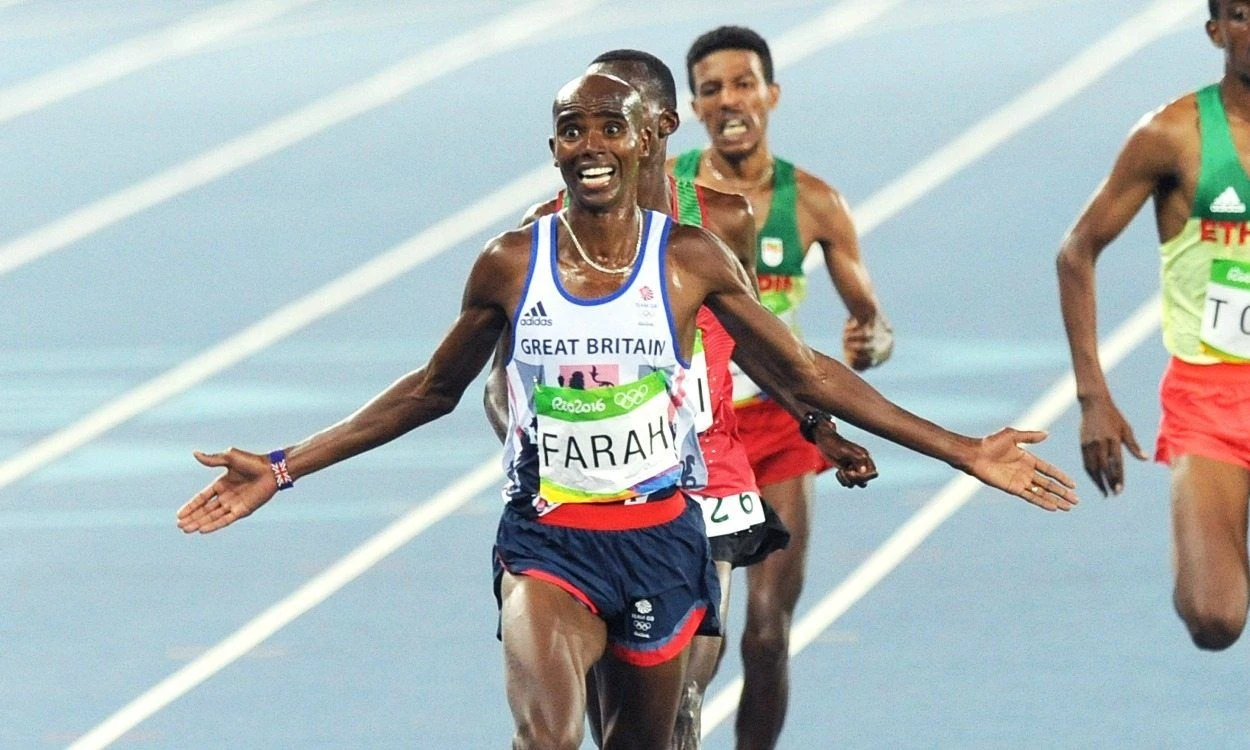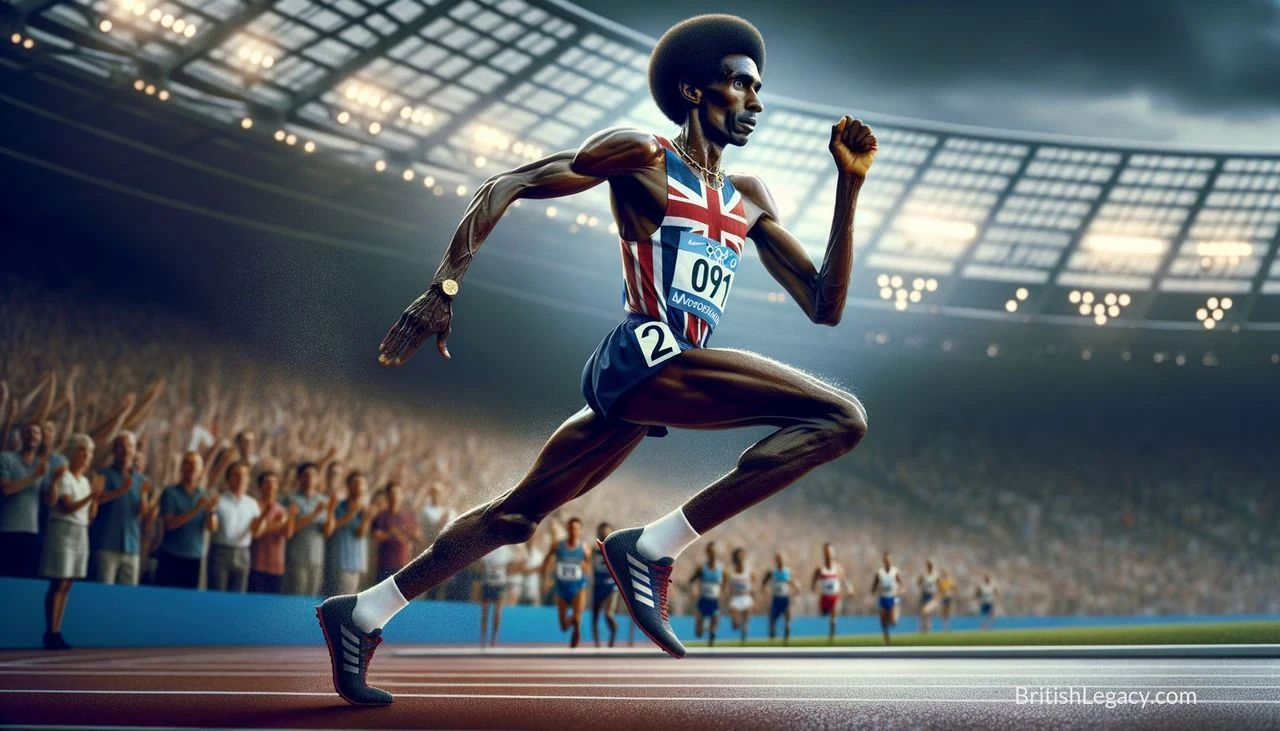
At the London 2012 Olympics, Mo Farah won the 10,000 metres and the 5,000 metres, turning home-ground triumph into the start of a remarkable run of championship success. He repeated the double at Rio in 2016. Across four Olympic gold medals and six World Championship titles, he became the most successful British track athlete in Olympic history and one of the leading distance runners of his generation.
A childhood kept out of public view
Farah was born Hussein Abdi Kahin on 23 March 1983 in Gabiley, in what was then the Somali Democratic Republic. His father died when he was young, and he was separated from his mother. At the age of nine, he was brought to London from Djibouti by a woman he had never met and made to use the name Mohamed Farah, belonging to another child. He was forced to work as a domestic servant and was initially prevented from attending school.
Farah’s circumstances became public in 2022, when he described his childhood in the BBC documentary The Real Mo Farah. At Feltham Community College, physical education teacher Alan Watkinson recognised his running ability. Farah later told his teacher what was happening; social services arranged for him to live with another family, and Watkinson helped him apply for British citizenship. Farah became a British citizen in July 2000.
His early promise soon showed in competition. He joined Hounslow Athletics Club and represented the borough at the 1994 London Youth Games. In 1997, he won the first of five English schools cross-country titles. His first major international title came in 2001, when he won the 5,000 metres at the European Junior Championships. That year he began training at St Mary’s University in Twickenham, where he lived and developed as an athlete.
From European titles to the Olympic double
Farah’s progress through the 2000s brought British records and growing experience in international competition. He won the European indoor 3,000 metres title in 2009, then claimed gold in both the 5,000 and 10,000 metres at the 2010 European Championships in Barcelona. In 2011, he made his breakthrough at the World Championships in Daegu: silver in the 10,000 metres and gold in the 5,000 metres. It was the first time a British man had won a World Championships medal in either event.
At London 2012, Farah won the 10,000 metres in 27 minutes 30.42 seconds and the 5,000 metres in 13 minutes 41.66 seconds. He became the first Briton to win Olympic gold in the 10,000 metres. Two years after Daegu, he also became the first British athlete to win two individual gold medals at a World Championships, taking both track titles in Moscow in 2013.
Farah defended his European double in Zürich in 2014 and his world double in Beijing in 2015. At Rio 2016, he retained both Olympic titles, becoming only the second athlete, after Finland’s Lasse Virén, to win the 5,000 and 10,000 metres at successive Games. In the 10,000 metres, Farah fell after being clipped, got back up and went on to win. His last World Championships appearance on the track came in London in 2017: he took gold in the 10,000 metres and silver in the 5,000.
A champion built for the finish
Farah could race over distances from 1,500 metres to the marathon, but the 5,000 and 10,000 metres became his signature events. His racing often depended on patience: staying with the leading group before using a fast final lap to separate himself from rivals. That combination of tactical control and finishing speed shaped a decade of success at major championships.
He also set records beyond the events that made him famous. In 2013, he ran 1,500 metres in 3 minutes 28.81 seconds, setting a British and European record at the time. In 2020, he covered 21,330 metres in an hour in Brussels, setting a world record. In the same year he won the Chicago Marathon in a European-record time of 2 hours 5 minutes 11 seconds, having moved towards road racing after his final track season.
Farah returned to the track in an attempt to qualify for the Tokyo Olympics, but an ankle injury affected his preparation and he did not meet the qualifying standard. He finished his competitive career after the Great North Run in September 2023. The change from track champion to marathon runner broadened his range, but the lasting public image remained the distance racer who could judge a race and produce a decisive sprint.
Honours, public life and the Mobot
Farah’s achievements brought national recognition as well as medals. He was appointed Commander of the Order of the British Empire in 2013 for services to athletics and knighted in the 2017 New Year Honours. In 2017, he also won BBC Sports Personality of the Year. Among his European achievements were five individual European Athletics Championship titles, including the two doubles in 2010 and 2014.
His distinctive victory gesture, the “Mobot”, began as a playful idea on the television programme A League of Their Own in 2012. Presenter Clare Balding suggested the arms-raised “M”; host James Corden supplied the name. The pose became closely associated with Farah and was later used to raise funds for his foundation. His charitable work included launching the Mo Farah Foundation after a visit to Somalia in 2011. In 2012, he won £250,000 for the foundation on the television programme The Cube.
Farah’s memoir, Twin Ambitions: My Autobiography, appeared in 2013. His later account of trafficking and domestic servitude added a difficult truth to the story of the athlete once publicly presented as having simply moved to Britain as a child. The account also brought into focus the role of a teacher who recognised his talent and helped him reach safety and citizenship.
Why Mo Farah deserves a place in British Legacy
Mo Farah belongs in British Legacy for a sporting record that is both exceptional and precisely defined. He won four Olympic gold medals, taking the 5,000 and 10,000 metres at London 2012 and Rio 2016, and collected six World Championship golds. His championship doubles at the Olympics and at the 2013 and 2015 World Championships established a rare standard of consistency. He was the first British athlete to win two individual gold medals at a World Championships and became the most successful British track athlete in Olympic history. Those results gave British athletics champions on home soil and on the world stage, while his European titles and records show the breadth of his career beyond the Olympics.
His legacy also has a human dimension that should be told without turning hardship into a sporting fable. Farah’s public account of being trafficked to Britain as a child, forced into domestic work and kept from school revealed the circumstances behind a life that had long been described differently. His teacher’s intervention helped him access protection, education and a route to citizenship; Farah’s later success cannot erase what happened, but it makes the consequences of that support visible. His foundation work and use of the Mobot to raise funds extended his public role beyond competition. Together, these achievements give his place in British history substance: sporting excellence, a lasting connection to British athletics, and a personal story that changed how the public understood the champion.
Sources
Mo Farah — Wikipedia revision 1376830983
Adapted in part from Mo Farah by Wikipedia contributors, under CC BY-SA 4.0. Text has been edited and combined with the existing article; this adapted text is shared under the same licence. Contributor history.