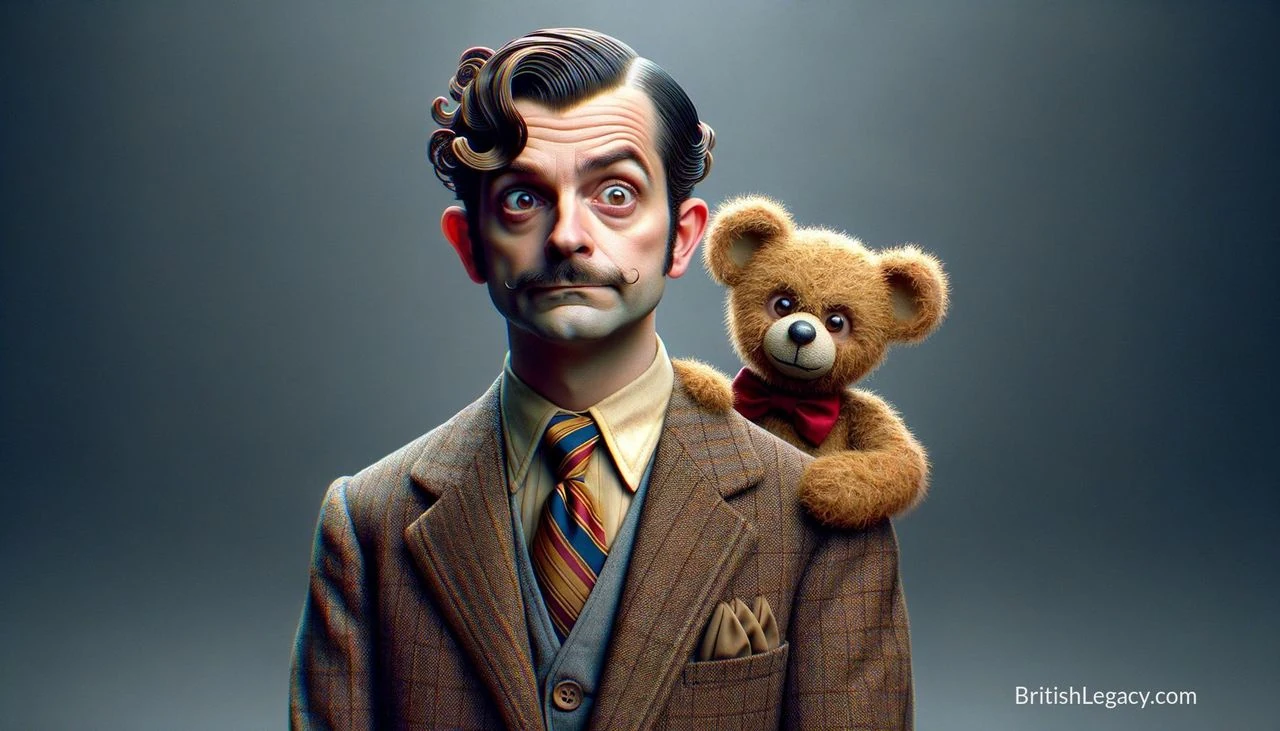
Mr Bean turns ordinary tasks into elaborate problems. A visit to the swimming pool, a television that needs adjusting or a simple meal can become a sequence of improvised schemes, mishaps and collateral damage. Rowan Atkinson’s almost wordless performance gives those schemes their shape: a twitch of the face, a pause or a painstakingly serious bit of business can carry the joke. Created with Richard Curtis, the character became the centre of a British television comedy whose visual approach travelled widely without needing much translation.
A character takes shape
Atkinson developed Mr Bean while studying for a master’s degree in electrical engineering at The Queen’s College, Oxford. A version of the character appeared in a sketch at the Edinburgh Fringe in the early 1980s, before an appearance at the Just for Laughs festival in Montreal in 1987 gave the physical comedy an international test. Atkinson chose to perform on the French-speaking bill despite having no French dialogue in the act. The experiment put the character’s gestures, rather than words, at the centre of the performance.
The character’s name was not settled until after the first episode had been made; other vegetable-inspired possibilities included Mr Cauliflower. Atkinson and Curtis shaped Bean as “a child in a grown man’s body”, drawing on traditions of physical comedy. Atkinson cited Jacques Tati and Peter Sellers among his influences, alongside performers from early silent films. The result was not quite silent: Bean occasionally mumbles a few words. But his thoughts and intentions are mainly carried by expression and action.
The sitcom began on ITV on 1 January 1990. Its fourteen episodes were co-written by Atkinson, Curtis and Robin Driscoll, with Ben Elton contributing to the pilot. John Howard Davies, John Birkin and Paul Weiland directed episodes. The television run ended in 1995; a fourteenth instalment, “Hair by Mr Bean of London”, was released on VHS in 1995 and did not reach television until 2006. A separate clip-show special followed in 1996.
Small tasks, extravagant solutions
Bean’s comic world is recognisable but never quite ordinary. He lives alone in a flat in Highbury and is rarely seen without his tweed jacket and skinny red tie. His name and occupation are not explained in the series. Rather than give him a detailed backstory, the programme makes his approach to everyday life the subject: he takes on simple tasks with elaborate contraptions and an often startling disregard for the people around him.
Recurring props help turn that behaviour into visual storytelling. Teddy, his battered brown teddy bear, is treated as a confidant, companion and sometimes a practical tool. Bean’s car is a green Mini with a black bonnet, best known in the original series by the registration SLW 287R. He secures it with a bolt and padlock, and at times removes its steering wheel as an additional precaution. Its long-running rivalry with a light-blue Reliant three-wheeler gives the series another recurring gag: Bean’s Mini repeatedly leaves the Reliant overturned or displaced, often while Bean seems oblivious to the consequences.
Matilda Ziegler plays Bean’s girlfriend, Irma Gobb, who appears in three episodes. Their relationship supplies a different kind of awkwardness. Bean treats Irma more as a companion than a romantic partner; when she expects a proposal at Christmas and he fails to offer one, she leaves him. The programme’s supporting characters generally serve as foils for his self-absorption, while the teddy bear and vehicles let the comedy unfold even when Bean has little to say.
From ITV to a worldwide audience
The series attracted large audiences in Britain. “The Trouble with Mr Bean” was watched by 18.74 million viewers, and the first episode won the Golden Rose and two other prizes at the 1991 Rose d’Or festival in Montreux. “The Curse of Mr Bean” received BAFTA nominations, including for best light entertainment programme and best comedy; Atkinson was nominated for best light entertainment performance in 1991, 1992 and 1994.
Its international reach followed from a design choice rather than a heavily explained premise. With little intelligible dialogue, episodes could be shown to viewers with limited or no English. The series has been sold in 245 territories. Its humour still depends on timing and context, but its central situations—trying to get dressed, use a television or complete an everyday errand—need little verbal explanation.
Bean’s life beyond the original sitcom has included two theatrical films, a television animation and appearances in sketches and at major events. The 1997 film Bean sends him to Los Angeles in connection with the transfer of Whistler’s Mother to an art gallery. In 2007, Mr Bean’s Holiday follows an eventful journey through France. A television animated series began in 2002, with Atkinson reprising the role and helping shape the character’s animated actions. Further animated episodes followed from 2015.
Atkinson returned to the character for a performance during the 2012 London Olympic Games opening ceremony. In a comic interlude within the London Symphony Orchestra’s performance of “Chariots of Fire”, the bored musician played one repeated synthesiser note, drifted into a dream of racing on a beach and woke to find the orchestra had moved on. Director Danny Boyle later said the character in the performance was not, strictly speaking, Mr Bean, although the ceremony’s public presentation identified him that way. The ambiguity is a reminder that the character has become larger than the boundaries of the original series.
The craft behind the silence
Sound is part of the programme’s comic identity, even when speech is scarce. Composer Howard Goodall wrote the choral theme heard from the second episode, performed in different episodes by the choirs of Southwark Cathedral and Christ Church Cathedral, Oxford. Its Latin opening, “Ecce homo qui est faba” (“Behold the man who is a bean”), gives the title sequence a mock-solemn grandeur. The first episode instead used an instrumental piece by Goodall. That contrast captures the show’s method: a carefully arranged musical or visual cue can heighten an absurdly small event without explaining the joke.
The wider Mr Bean franchise has included books, commercials, Comic Relief appearances and music videos. These extensions have given the character new settings, but the central device remains consistent: a man approaches familiar situations on his own terms and makes them harder for everyone nearby. In the original sitcom, the economy of the performance leaves room for viewers to follow each small adjustment and anticipate what might go wrong next.
Why Mr Bean deserves a place in British Legacy
Mr Bean deserves a place in British Legacy because the series turned a distinctively physical style of British television comedy into an exportable form without flattening it into a simple formula. Atkinson and Curtis built the character around familiar routines and practical frustrations, then let gesture, timing and visual invention do most of the work. That approach helped the programme reach viewers beyond the English-speaking audience and supported its continuing life in films, animation and live appearances. Its international success is grounded in a specific craft: comedy that can be understood from what a performer does, not only from what he says.
The programme’s influence is also visible in the strength of its recurring comic world. Teddy, the Mini and the Reliant are more than decorations; each becomes a means of telling jokes through behaviour and repetition. The series won major recognition, drew a substantial British audience and gave television viewers a character who could turn a minor inconvenience into a tightly staged disaster. Its later forms have introduced Bean to new audiences while retaining that central method. Remembering the series is therefore not just a matter of celebrating a familiar character. It recognises how British writers, performers, directors and musicians made precision, physical performance and visual storytelling the basis of a comedy that crossed language barriers.
Sources
Mr. Bean — Wikipedia revision 1379775959 · Mr. Bean — Wikipedia
Adapted in part from Mr. Bean by Wikipedia contributors, under CC BY-SA 4.0. Text has been edited and combined with the existing article; this adapted text is shared under the same licence. Contributor history.