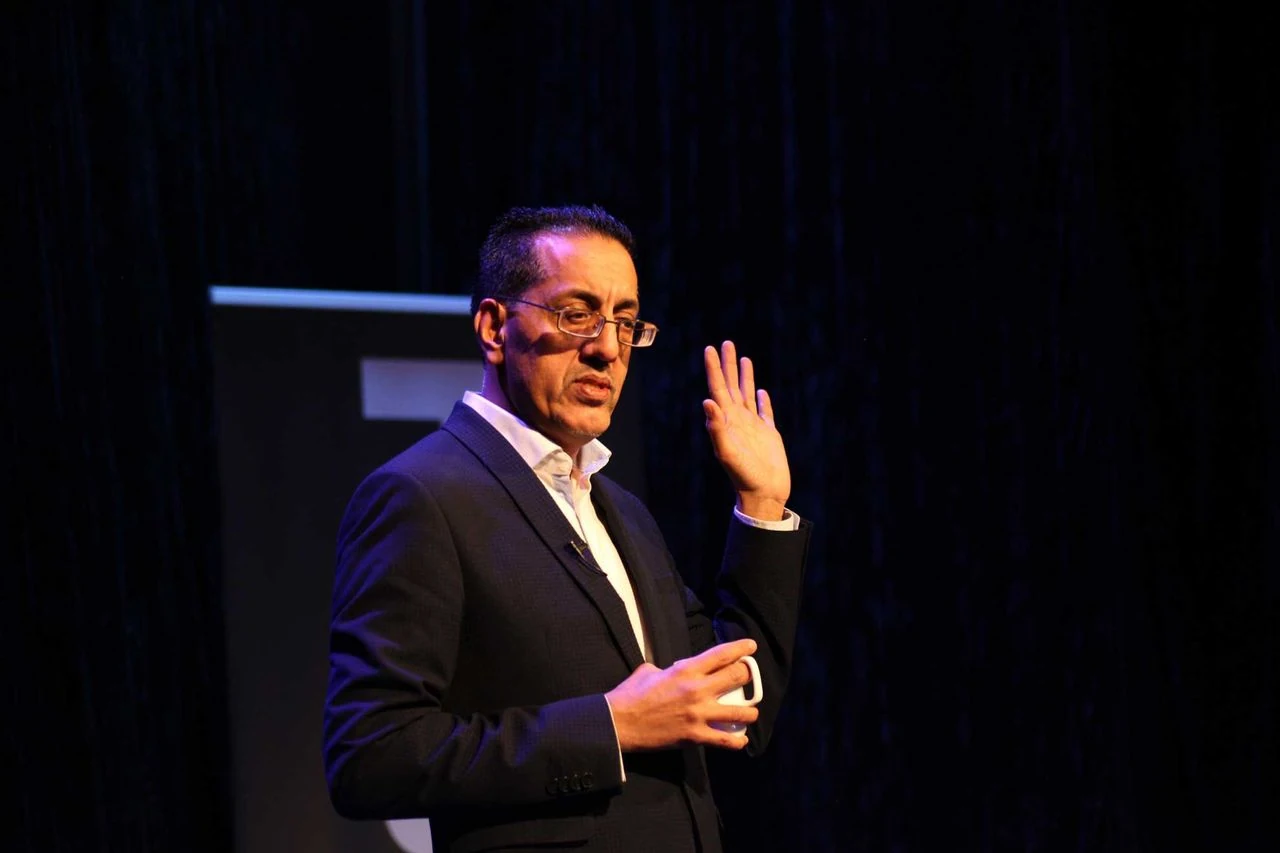
When Nazir Afzal became Chief Crown Prosecutor for North West England in 2011, one of his first decisions was to reopen the Rochdale child sexual exploitation case after an earlier decision not to prosecute. The prosecutions that followed brought the abuse of girls into national focus and exposed how assumptions about victims could obstruct justice. Afzal’s career was not the work of one case or one office: it combined prosecution, institutional reform and public argument about whom the law protects, and whether public bodies are prepared to listen.
Small Heath and the path into law
Afzal was born in Birmingham on 1 October 1962. His parents had emigrated from Pakistan, and he grew up with six siblings in a two-up two-down house in Small Heath. He has described being bullied and racially abused as a child. A racially motivated attack when he was 13 helped shape his view of racism and justice: he later recalled his father telling him that the police were not interested in him. His parents’ ability to speak English also meant they could help neighbours who struggled to make themselves heard. That experience of acting as an intermediary would become a useful way to understand his later public role.
Afzal studied law at the University of Birmingham and then attended the College of Law in Guildford, where he developed an interest in criminal law. He worked as a solicitor in Birmingham from 1988, moving to London in 1991 to join the Crown Prosecution Service (CPS) as a Crown Prosecutor. His route into public service was therefore through legal practice and the daily decisions of prosecution, rather than an inherited position in public life.
In 2001 he became the youngest person and the first Muslim to be appointed Assistant Chief Crown Prosecutor. His early career included cases that were far removed from the later public attention surrounding Rochdale. One prosecution that reached national news involved two supermarket employees who had sex on a crowded train and smoked in a no-smoking carriage. He also prosecuted serial killer Colin Ireland. These cases show the range of work that can fall to a prosecutor, from offences that attract attention for their oddity to grave violence.
Responsibility across the North West
Afzal became Chief Crown Prosecutor for North West England in 2011, with responsibility for Greater Manchester, Cumbria and Lancashire. The post involved more than prominent trials: the region handled over 100,000 prosecutions a year, and the role included managing a large workforce of lawyers and paralegals. Decisions about individual cases sat within the wider responsibilities of consistency, staffing and public confidence.
Afzal argued that prosecutors should engage with the public and explain their decisions. That stance made him a visible figure in a profession that often enters public conversation only when a decision is disputed. His approach was to treat prosecution not as a remote technical service but as part of the state’s responsibility to the people it serves. Public explanation could not undo an error, but it could make decisions and their consequences more open to scrutiny.
The North West role placed him amid a series of serious cases. His team dealt with the swift prosecution of people involved in the 2011 summer looting. In 2012, Afzal successfully prosecuted Dale Cregan, who was convicted of four murders, including those of two police officers, and three attempted murders. The case resulted in a whole-life order. Such work formed part of the ordinary weight of the office, even as the Rochdale case came to define much of Afzal’s public profile.
Rochdale and the duty to hear victims
In the Rochdale case, Afzal overturned an earlier CPS decision not to prosecute. The girls had been treated as unreliable or complicit, rather than recognised as children being sexually exploited by adults. Reopening the case redirected attention towards the accused and the evidence of coercion. The resulting convictions mattered, but the wider lesson concerned what can go wrong before a case reaches court: a system can fail victims through its assumptions as well as through the actions of offenders.
Afzal argued that fear of appearing racist may have contributed to justice being stalled. He also stressed that abuse was not confined to one ethnicity or faith. His position resisted two kinds of evasion: avoiding difficult questions for fear of causing offence, and using the abuse of children to advance racial hostility. The distinction mattered. Naming failures in institutional judgement need not turn victims into instruments of prejudice, and refusing that prejudice need not require silence about failures.
Afzal’s decision came amid wider development in the CPS’s approach to violence against women and girls. Reports from 2007–08 and 2012–13 describe work including specialist prosecutor training, research into forced marriage and so-called honour-based crime, improved case flagging and updated guidance. The later report also records a greater emphasis on assessing the credibility of allegations and suspects, rather than placing the victim under the same burden of suspicion. These were institutional changes, not the achievement of one prosecutor alone. Afzal became one of the public figures associated with the pressure to make them meaningful in practice.
Making hidden abuse visible
Rochdale was part of a longer focus on violence against women and girls, child sexual abuse, forced marriage and so-called honour-based abuse. In 2004, after women approached him with accounts of forced marriage and honour crimes, Afzal organised a conference and established a national database to record potential cases. He later led CPS work on honour-based violence. The killing of Samaira Nazir in 2005 led to the prosecution of her relatives; Afzal described the beliefs behind the murder as tragic and outdated.
This work involved more than bringing cases to court. Institutions need the right language and records to recognise patterns, as well as staff prepared to act on them. The CPS reports document training, research and guidance intended to improve that capacity. Afzal also spoke publicly about patriarchal control and violence within families, treating them as matters of justice rather than customs beyond scrutiny. His public identity as a practising Muslim and the son of immigrants informed that argument, but did not soften its demand for accountability.
He argued that the beliefs associated with so-called family honour were not limited to older generations, and that education to challenge controlling attitudes needed to begin early. In 2019, he mediated a dispute over LGBT-inclusive education at Parkfield Community School in Birmingham. He argued that removing inclusion did children no service and that schools should be places where pupils can learn what they might not learn elsewhere. The episode extended his public work into questions of education, equality and safeguarding, beyond prosecution itself.
In 2018, the Welsh Government appointed Afzal and Yasmin Khan as advisers on violence against women, gender-based violence, domestic abuse and sexual violence. Their work concerned the implementation of Welsh policy and law and improvements to services. Their terms were extended to July 2022 so they could complete work delayed by the pandemic and contribute to the next phase of government priorities. The appointment carried the concerns he had addressed in prosecution into a different national setting, where advice and service planning were central.
From prosecution to civic service
Afzal left the CPS in 2015. In 2016 he became chief executive of the Association of Police and Crime Commissioners, leaving the post in 2017 after the Manchester Arena bombing so that he could speak freely about the attack. He also joined the Independent Press Standards Organisation’s Complaints Committee in 2017. In 2018 he became chair of the Corporation Board at Hopwood Hall College in Rochdale. These roles broadened his work from prosecution into policing, press standards and education.
In 2022 Afzal became Chancellor of the University of Manchester, succeeding Lemn Sissay. The university describes the chancellor as a public representative of the institution, including at degree congregations. Afzal has spoken of wanting the university to be open to Greater Manchester and of acting as a conduit for students’ concerns and ambitions. The role gives an institutional setting to a recurring theme in his career: public organisations should be understandable and accessible to the people they serve.
His connection to Manchester also has a professional dimension. He has described himself as born in Birmingham, nurtured professionally in London and made in Manchester. That is more than a convenient summary of three places: Birmingham was his home and the site of his legal education; London was where he joined the CPS; and Manchester became the base for the regional prosecution role that brought him national prominence. He is also Chair of The Lowry in Salford. The university records that his tenure as the first independent chair of the Catholic Church’s safeguarding agency ended in 2024, after more than three years.
Afzal’s public commentary has continued beyond formal appointments. He has criticised cuts to the CPS and Ministry of Justice, arguing that reduced resources weaken the ability to prosecute serious offences, including rape. His memoir, The Prosecutor, published in 2020, brought his experience and arguments to a wider readership. In both public speaking and writing, he has discussed the difficulty of persuading institutions to believe victims and the need to address violence across communities rather than treat it as the property of one group.
Recognition and public memory
Afzal was appointed an Officer of the Order of the British Empire in the 2005 New Year Honours for services to criminal justice. The University of Birmingham awarded him an honorary Doctor of Laws in 2014; the University of Manchester and the University of Leicester also awarded him honorary law degrees. These honours recognise different parts of a career that has joined legal work to safeguarding, education and public service.
His work has also entered popular culture. The BBC drama Three Girls, about the Rochdale scandal, was broadcast in 2017, with actor Ace Bhatti playing Afzal; Afzal served as a consultant on the series. The drama offered a fictionalised route into a case that had already exposed serious failures in the treatment of exploited girls. His contribution to it reflected a continuing effort to make the circumstances and institutional consequences of abuse intelligible beyond the courtroom.
Why Nazir Afzal deserves a place in British Legacy
Nazir Afzal deserves a place in British Legacy because his work helped expose how a justice system can compound harm when it treats vulnerable victims as the problem. His decision to reopen the Rochdale case contributed to prosecutions that brought the exploitation of girls into national view. More broadly, his work and public advocacy helped press institutions to examine how they assessed victims, recorded abuse and responded to violence against women and girls. This was not a solitary reform, and it should not be presented as one. The CPS reports show that training, research and revised guidance were part of the same changing landscape. Afzal’s place in that history rests on making the consequences of institutional hesitation difficult to ignore.
His British connection is grounded in a life of public service within British institutions and across British cities: born in Birmingham to parents who had emigrated from Pakistan, educated there, professionally formed in London and later a prominent civic figure in Manchester. He moved from prosecution into work with policing, press standards, education, safeguarding and the Welsh Government. Across those settings, he has argued for institutions that listen, explain themselves and protect people who may otherwise struggle to be heard. That work offers a specific legacy: not a claim that one person solved entrenched problems, but an example of how legal judgement, public explanation and sustained attention can help change what institutions recognise and how they respond.
Sources
Adapted in part from Nazir Afzal by Wikipedia contributors, under CC BY-SA 4.0. Text has been edited and combined with the existing article; this adapted text is shared under the same licence. Contributor history.