Nico Rosberg reached the summit of Formula One in 2016, beating Mercedes team-mate Lewis Hamilton to the drivers’ championship by five points. Five days later, he announced his retirement. It was an abrupt ending to a career of 206 starts, 23 wins and 57 podiums, but not an impulsive one: Rosberg had already decided that the title would be his final season. His story is also connected to Britain through the teams and circuits that shaped his career, and through his later work as a Formula One analyst for UK broadcaster Sky Sports.
From karting to the top of the junior ranks
Rosberg was born in Wiesbaden, West Germany, on 27 June 1985. His father, Keke Rosberg, won the 1982 Formula One world championship; his mother, Gesine, was German. Nico grew up between Monaco and Ibiza and held both Finnish and German citizenship. He began competitive karting at six, winning French regional and national titles before progressing to international competition. Although he initially raced on a Finnish licence, he switched to a German one after his first season in the Formula 3 Euro Series, believing it would make major sponsorship easier to secure.
His progress through the junior categories was swift. In 2002, driving for VIVA Racing, he won the Formula BMW ADAC championship with nine victories from 20 races. The following year he moved to the Formula 3 Euro Series, finishing eighth; in 2004, he placed fourth. Rosberg passed an interview for a place at Imperial College London to study aeronautical engineering, but chose to commit to racing instead. In 2005, he won the inaugural GP2 Series championship with ART Grand Prix, establishing himself as a leading candidate for a Formula One seat.
Learning the sport at Williams
Rosberg made his Formula One debut with Williams in 2006. He scored points in his first race, the Bahrain Grand Prix, and set the fastest lap, but the season brought retirements and an unreliable car. He finished 17th in the championship. His results improved over the following years: he was ninth in 2007, then scored his first podium with third place in Australia in 2008. That year he also finished second at the inaugural Singapore Grand Prix. Williams’s car was not consistently competitive, but Rosberg ended his final season with the team in 2009 seventh in the standings.
For 2010, he joined Mercedes, which had entered Formula One after acquiring Brawn GP. His first team-mate there was Michael Schumacher. Rosberg finished seventh in the championship in both 2010 and 2011, then took his first pole position and first Grand Prix victory in China in 2012. In 2013, Lewis Hamilton joined Mercedes. The two had known one another through karting, but as team-mates their competition became increasingly consequential.
Mercedes’s base in Brackley, Northamptonshire, gives Rosberg’s career a direct British connection: he worked with a team headquartered in England throughout the most successful period of his racing life. He also won the British Grand Prix in 2013. The same season, he won in Monaco, becoming the first son of a world champion to win that race.
Rivalry, setbacks and a title decided in Abu Dhabi
Rosberg and Hamilton became the principal contenders for the championship as Mercedes grew stronger. In 2014, Rosberg won five races and took the title fight to the final round in Abu Dhabi. Hamilton won the race, while an energy-recovery failure left Rosberg without points; Rosberg finished second in the championship, 67 points behind his team-mate. He was runner-up again in 2015, winning six races, including the final three of the season.
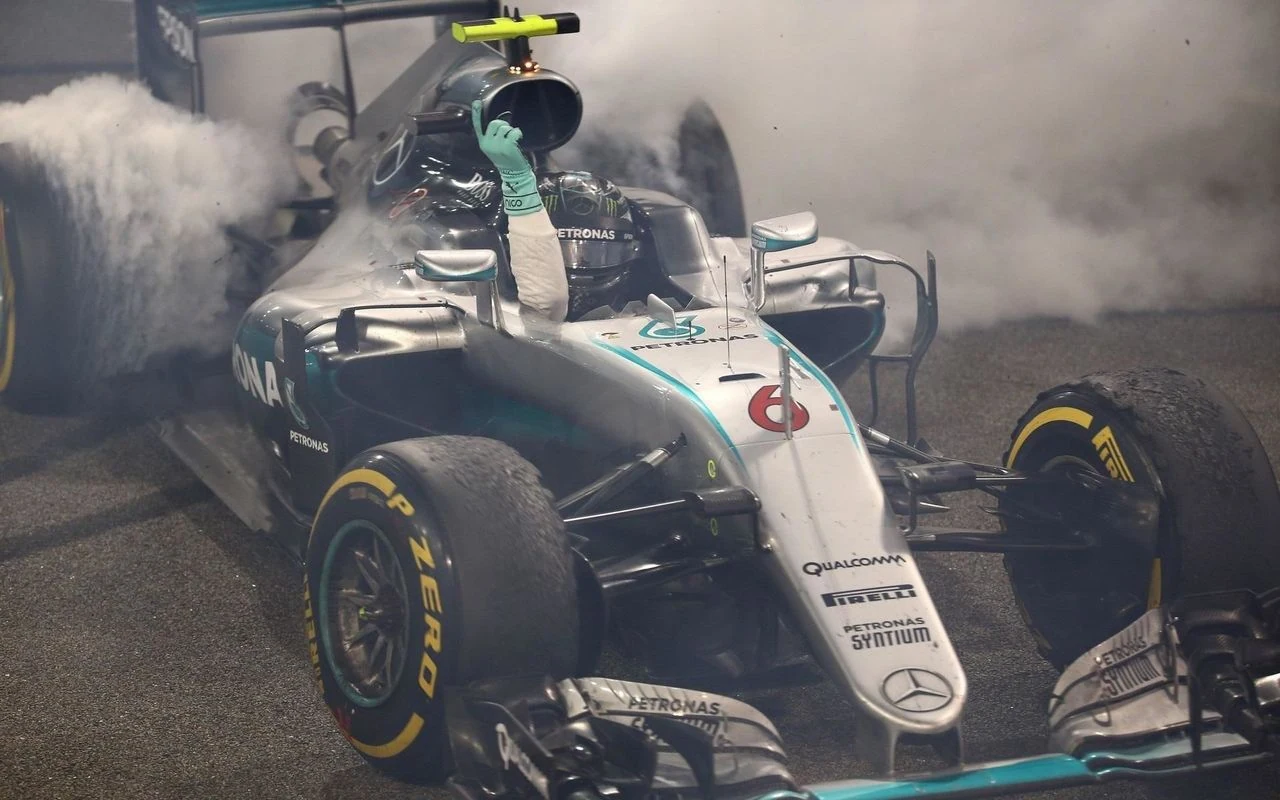
Rosberg’s 2016 campaign began with four consecutive victories. Hamilton recovered ground during the middle of the season, and the contest remained open until the finale in Abu Dhabi. Rosberg entered the race leading by 12 points and needed to finish no lower than third to secure the title, even if Hamilton won. He finished second, holding off pressure as Hamilton slowed the pace in an attempt to bring the chasing cars into contention. Rosberg won the championship by five points.
The result made Nico and Keke the second father-and-son pair to win the Formula One drivers’ title, after Graham and Damon Hill. Across his Formula One career, Rosberg made 206 starts, recording 23 victories, 30 pole positions and 57 podium finishes. Those totals were built across very different phases: early development at Williams, years of steady progress at Mercedes, and finally a title-winning season in which he beat a team-mate who had already won the championship twice.
Retirement, broadcasting and new ventures
Rosberg had considered retirement before the 2016 season ended. He announced his decision at the FIA prize-giving ceremony in Vienna, five days after winning the championship. He said he had reached the pinnacle of his career, did not want his driving skills to decline, and wanted more time with his young family. His departure brought his competitive career to a close while he was still the reigning champion.
After retiring, Rosberg moved into broadcasting, business and driver development. Since 2018, he has analysed selected Formula One races for Sky Sports F1 in the United Kingdom, as well as broadcasters in Germany and Italy. He also joined the management of driver Robert Kubica and, with karting mentor Dino Chiesa, helped establish the Rosberg Young Drivers Academy in 2018.
Environmental technology became another focus. Rosberg invested in electric mobility and, in 2019, co-founded the GreenTech Festival in Berlin to present sustainable technologies. In 2020, he established Rosberg X Racing to compete in Extreme E, an electric off-road racing series. The team won the inaugural constructors’ championship in 2021, with Johan Kristoffersson and Molly Taylor taking the drivers’ title. It won the team championship again in 2023. Rosberg also launched Rosberg Philanthropies in 2022, with a focus on environmental protection and supporting children.
Why Nico Rosberg deserves a place in British Legacy
Rosberg’s place in a British sporting story rests on specific professional links, not on a claim that he was British: he competed under the German flag, had German and Finnish citizenship, and was born in West Germany. His career nevertheless ran through Williams and Mercedes, and its defining years were spent with Mercedes’s Formula One operation in Brackley, Northamptonshire. He won the British Grand Prix in 2013, then became a regular analyst for Sky Sports F1, bringing his experience of the championship to a UK audience. Together, those connections make his story relevant to the people and institutions of British motor racing without obscuring his own nationality.
His championship also offers a substantial sporting record to remember. Rosberg rose through karting, Formula BMW, Formula 3 and GP2 before establishing himself in Formula One; after years of improvement and two championship runner-up finishes, he beat Hamilton in a close title contest. His decision to retire at the peak of his career made that achievement a complete, sharply defined chapter rather than the beginning of another campaign. In later years, his work in British broadcasting kept him connected to the sport, while his investments and racing projects extended his attention to electric mobility and sustainable technology. His legacy for British Legacy is therefore both competitive and continuing: a world champion formed in international racing, whose career and post-racing work have had clear, evidenced links to Britain.
Sources
Nico Rosberg — revision 1379853195
Adapted in part from Nico Rosberg by Wikipedia contributors, under CC BY-SA 4.0. Text has been edited and combined with the existing article; this adapted text is shared under the same licence. Contributor history.